
Vandaag of morgen in huis

Kwaliteit gegarandeerd

Welkomstaanbiedingen ontgrendelen: GRATIS bezorging | Tot 80% korting | Gratis 30 dagen JoyPlus-proefperiode
Download de app
A portable hand fan may seem simple: charge it, switch it on and feel the cool air. However, models vary considerably in airflow, battery life, noise levels and ease of use. A small fan that is comfortable to use at your desk may not move enough air at a festival. A model with a large battery, meanwhile, may be heavier than expected.
So don’t focus solely on terms such as “turbo”, “long battery life” or “quiet”. Look at verifiable specifications and consider where you will actually use the fan: on the train, while cycling, at a concert, in the office or when travelling.
Manufacturers usually state battery life based on the lowest speed setting. For example, a USB-rechargeable fan may run for up to 30 or 40 hours, but considerably less at a higher setting. Check whether the product information lists multiple values, such as a range of 3 to 30 hours or 3 to 40 hours.
For everyday commuting, a smaller battery may sometimes be enough. For camping, long train journeys or a festival without access to a power socket, a model with 4250 mAh or 5000 mAh is more practical. Also take charging time into account.
A powerful hand fan with a turbine or blower design can produce a concentrated airflow. That is useful outdoors, but may feel too strong or be noticeably loud indoors. A traditional compact fan with several blades often distributes the air more gently.
As well as rotational speed, check the maximum wind speed, the number of settings and the noise level. A model with 100 adjustable levels offers finer control than a fan with three or five settings, but that does not automatically make it more suitable for every situation.
A pocket fan should fit in a bag or coat pocket, but the controls, handle and carrying options are also important. A fan weighing 180 grams may be comfortable to hold, while a heavier model may be less suitable for prolonged use.
Look out for features such as:
Capacity is measured in mAh. A higher figure indicates a larger battery capacity, but actual running time also depends on motor power and the selected setting. A 5000mAh battery may be suitable for long days, but it will often take longer to charge as well.
A USB-C connection is useful if you already use a phone charger, power bank or laptop. Check whether a cable is included and what charging input is required. Use a suitable USB power source and do not continue charging a damaged fan.
A wind speed measured in m/s provides a technical indication of the airflow. In practice, the distance from your face also affects how strong the cooling feels. For a quiet fan in an office, library or on a train, low settings and the stated noise level are important.
The specifications for some models may state, for example, 23 dB as the minimum value and 46 dB as the maximum value. Other models give a range of 55 to 76 dB at 30 centimetres. These measurements are not always directly comparable, as the measuring distance and conditions may differ.
A compact fan weighing around 130 to 180 grams is easy to carry. A model weighing approximately 280 to 300 grams, on the other hand, may have a larger battery, a metal housing or additional features. Choose according to how you intend to use it:

Why it suits this profile: An accessible pocket fan for short trips, commuting and use in the office. It combines a fan, torch and power bank in one compact housing.
The stated running time is 12 to 21 hours, depending on the mode. This makes it clear that the maximum figure does not apply to every setting.
2000mAh battery, USB-C, two fan speeds, torch and power bank function. The design is foldable and, according to the product information, weighs approximately 130 grams.
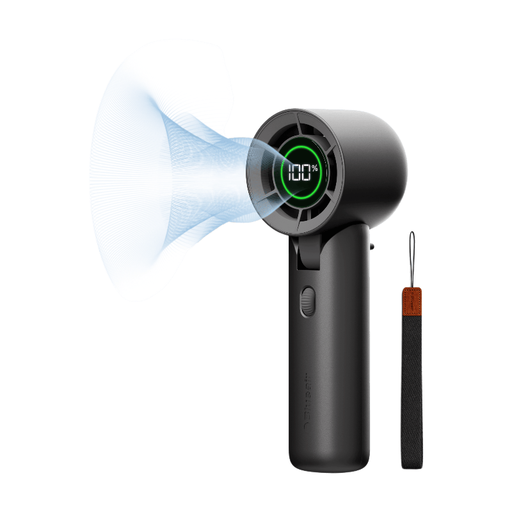
Why it suits this profile: Designed for anyone looking for a quiet, precisely adjustable personal fan for the train, office, bedroom or desk.
The product information states both a minimum value of 23 dB and a maximum value of 46 dB. It also links battery life to the low setting.
0–100 adjustable speeds, USB-C charging, a head that tilts up to 75 degrees and a stated battery life of up to 32 hours on the low setting.

Why it suits this profile: A good choice for concerts, outdoor activities and travel, where strong airflow, quick controls and high battery capacity are important.
The product specifications state a running time of 3 to 40 hours, depending on the wind speed. The maximum figure should therefore be understood as setting-dependent.
5000mAh battery, stated wind speed of up to 9 m/s, 100 speed levels, LED display and a stated charging time of approximately 1.5 to 2 hours with a suitable input.
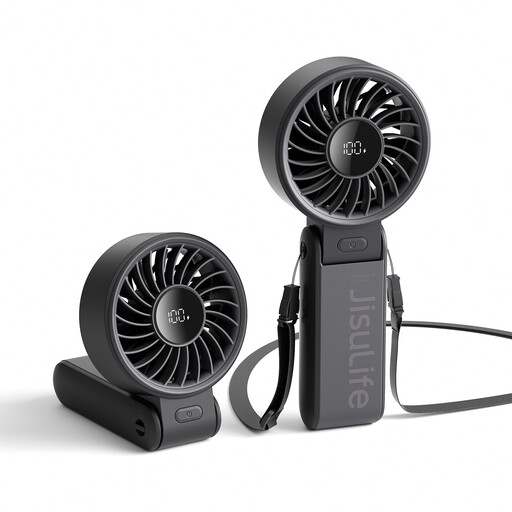
Why it suits this profile: Ideal if you are looking for a fan for use on the go that can also be used on a desk or around your neck.
The product information states a running time of 3.5 to 19 hours, depending on the setting. The LED display shows the speed and remaining battery.
5000mAh battery, five speed settings, folding design, LED display and three ways to use it: handheld, on a table and with the carry cord.
A hand fan contains a lithium-ion battery and moving parts. Keep fingers, hair, loose clothing and jewellery away from the grille. Do not expose the device to rain or prolonged dampness. If the battery swells, or you notice smoke, an unusual smell or excessive heat, stop using the fan immediately.
Clean the housing with a soft, slightly damp cloth. Do not immerse the fan in water and do not attempt to replace a built-in battery yourself. At the end of its life, dispose of the device in accordance with local regulations for electronic waste.
We have put together a complete, up-to-date list of products that fully meet these strict selection criteria and the applicable European safety regulations.
It depends on the battery capacity, motor and speed. The product information may state a range from a few hours to several dozen hours. Treat the maximum battery life primarily as an indication for the lowest setting. At higher wind speeds, actual running time will be shorter.
Yes, provided the event allows it. Choose a compact model with a safety lock, carry cord and sufficient battery capacity. A high setting may produce more noise, so check the stated noise level and consider using a quieter low setting.
Power consumption is generally low, but the cost depends on the wattage, charging frequency and your electricity tariff. A fan using a few watts consumes little energy when charged occasionally. Fully charging the battery will usually cost less than running a larger fan or air conditioner for a prolonged period.
