
Vandaag of morgen in huis

Kwaliteit gegarandeerd

Welkomstaanbiedingen ontgrendelen: GRATIS bezorging | Tot 80% korting | Gratis 30 dagen JoyPlus-proefperiode
Download de app
A portable hand fan is handy on the train, in the office, at a festival or on your way to a sporting event. However, models can vary considerably in airflow, noise, battery life and ease of use. A low price doesn’t always mean good practical value, while a long battery life is often only achievable on the lowest setting.
As a Joybuy Product Recommendation Officer, I sift through product specifications to find the most important information and give marketing claims no more weight than verifiable details. This helps you avoid buying a mini fan that runs out of power after a few hours, makes too much noise or proves awkward to use.
Manufacturers often quote a run time of, for example, 19.5, 22, 30 or 40 hours. This figure usually applies at a low fan speed. A rechargeable hand fan can run out of power much faster on its highest setting.
So look for a range, not just the highest figure. A model with 3–30 hours of use tells you more than simply “30-hour battery life”. Also check the capacity in mAh, the charging time and the type of connection.
A powerful hand fan isn’t automatically pleasant to use for long periods. A high motor speed can mean more noise, vibration and a strong airflow. That may be welcome at a concert or during an outdoor activity, but a quiet fan is often more practical in an office, on a train or in a meeting room.
So check:
A fan for taking out and about needs to be more than just small. A lanyard, wrist strap, storage pouch, folding head or neck attachment can make all the difference. If you’re choosing a fan for concerts, check its weight too. A model weighing around 180 grams feels different from one weighing around 280 to 300 grams when you’re holding it for a long time.
A neck fan keeps your hands free, but distributes the weight around your neck. That’s handy when walking or travelling, but not everyone finds this style comfortable. Choose the carrying style that suits your activity.
A capacity of 4,250 to 5,000 mAh is available in several models in this range. Actual run time depends on the setting you choose. Also check whether the fan charges via USB-C or another USB connection. USB-C is handy if you already use a compatible cable for your phone, power bank or laptop.
A short charging time is particularly useful for commuting and travelling. Some models quote a charging time of around 1.5 to 2 hours, while the product description for one neck fan says it takes around 3 to 4 hours.
For everyday carry, size and weight matter more than a long list of extra features. A hand fan weighing around 180 grams is easier to fit into a small bag or coat pocket. A heavier model, on the other hand, may have a larger battery or a more powerful motor.
Also look for:
A model with 5 settings is easy to use. An adjustment range of 0–100 gives you more control, but only if the controls remain clear and straightforward. The product description for the BLUEAIR AlwaysCool Portable Handheld Fan F7 gives a noise level of 23 to 46 dB. Treat this as a manufacturer’s specification; actual noise can vary depending on the setting and surroundings.
With powerful turbo models, consider the difference between airflow and noise comfort. The product description says the JISULIFE Pro1S reaches a motor speed of up to 9,700 rpm. This could be useful for intensive outdoor use, but a high speed isn’t automatically suitable for quiet spaces.
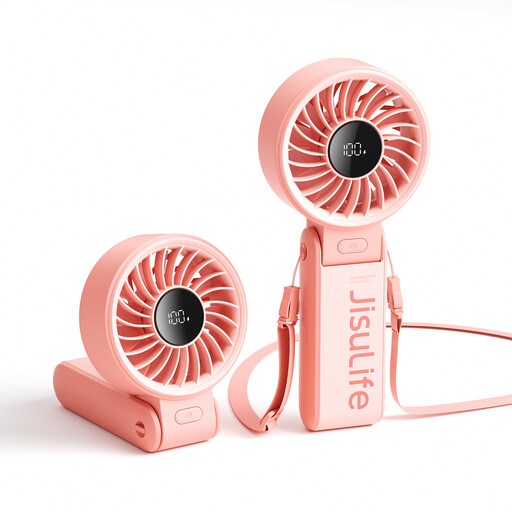
Why it suits this profile: This model can be used as a handheld, desk or neck fan. Its 5 speeds and foldable design are practical for everyday use, without having to go straight for a turbo fan.
The product specification gives a run time of 3.5–19 hours, depending on the setting. This makes battery life clearer than a single maximum claim.
5,000 mAh battery, LED display, lanyard and foldable 3-in-1 design.
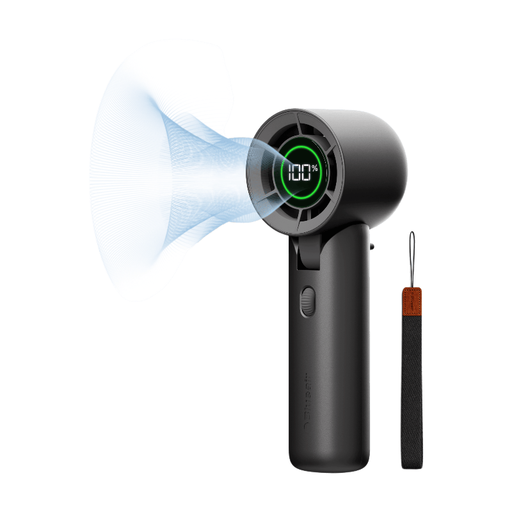
Why it suits this profile: A good choice for the office, train or desk when noise level, precise controls and directional airflow matter.
The product description lists 23–46 dB and 0–100 speed settings. This lets you fine-tune the airflow more precisely than a model with just three settings.
Up to 32 hours on a low setting according to the product specification, USB-C charging and a head that tilts up to 75 degrees.

Why it suits this profile: Designed for people who want powerful, instantly adjustable airflow at festivals, concerts, while travelling or during outdoor sports.
The quoted run time is 3–40 hours, depending on the speed. The LED display shows the speed and remaining battery, so you’re less likely to run out of power unexpectedly.
9,700 rpm according to the product description, 5,000 mAh, 100 speed settings and a quoted charging time of 1.5–2 hours.
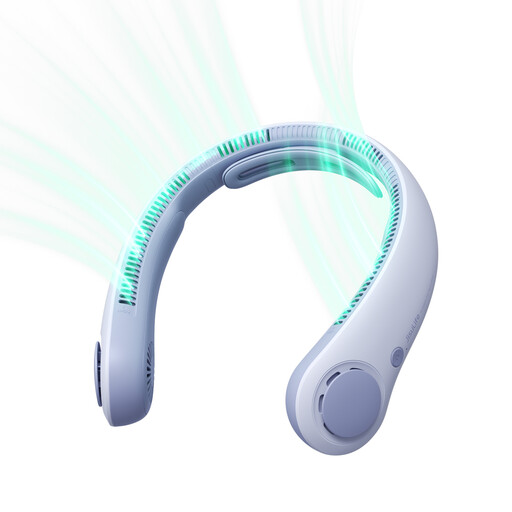
Why it suits this profile: This personal fan keeps your hands free while walking, travelling, working outdoors or attending a sporting event. Air flows from both sides towards your neck and face.
The product specification gives a run time of 2.5–16.5 hours and a charging time of 3–4 hours. It also states that the model isn’t waterproof, so avoid using it in the rain.
Bladeless design, 5 speeds, 5,000 mAh battery and a weight of around 282 grams.
We’ve put together a complete, up-to-date list of products that meet these strict selection criteria and the applicable European safety regulations.
A portable fan usually contains a lithium-ion battery. Use a suitable USB charger, keep the device dry and don’t charge it if the casing or battery is damaged. Stop using it if you notice unusual heat, smoke, leakage or an odd smell.
Clean the casing with a soft, slightly damp cloth, and never immerse a USB fan in water. Keep hair, loose clothing and fingers away from moving parts. If you have a neck fan, it’s a good idea to follow the instructions and not wear the device while sleeping.
It depends on the speed, battery capacity and motor. The models above quote run times of around 2.5 to 40 hours, but the maximum figure usually applies at a low setting. A display showing the remaining battery is useful for intensive use.
Yes, a compact model with a lanyard or wrist strap is handy as a fan for concerts. Check the venue’s rules on electronics and batteries beforehand. A turbo model can move more air, while a quieter model may be more comfortable in a busy setting.
The electricity cost per charge is usually low, as the battery is relatively small. The overall cost of use depends mainly on the battery’s lifespan, how often you charge it and whether you need to replace the device. Use the fan on a suitable setting and avoid charging it unattended for long periods.
