
Vandaag of morgen in huis

Kwaliteit gegarandeerd

Welkomstaanbiedingen ontgrendelen: GRATIS bezorging | Tot 80% korting | Gratis 30 dagen JoyPlus-proefperiode
Download de app
A portable hand fan seems simple: charge it, switch it on and enjoy some relief from the heat. But models can vary considerably in battery life, noise level, airflow and ease of use. A cheap mini fan, for example, may move very little air, while a turbo hand fan on its highest setting could be too loud for the office or train.
So don’t just look for words like “powerful” or “long-lasting”. Check the technical specifications and think about where you’ll actually use the fan: on your commute, at the office, at a concert, on a camping trip or while travelling by plane.
Manufacturers usually quote battery life for the lowest fan setting. On a higher setting, the run time often drops significantly. A rechargeable hand fan with a 5.000mAh battery, for example, might be rated to run for up to 18 or 22 hours, but that doesn’t mean it will run at top speed for that long.
Look out for the following information:
A turbo hand fan is useful outdoors, but a strong airflow isn’t comfortable in every situation. At the office, in a quiet carriage or while applying make-up, a low setting with precise adjustment may be more useful.
Check whether the model has multiple settings. Five settings offer basic control; models with a scale from 0 to 100 give you more control, but that alone tells you nothing about the actual noise level or airflow.
A pocket fan should be small enough to fit in a coat pocket or bag, but it should also feel comfortable to hold. Check whether it comes with a wrist strap, safety lock, stand or adjustable head. A fan without a stable way to position it is less convenient on a desk.
Comfort is especially important with a neck fan. Check its weight, the shape of the neck support and how the airflow is directed towards your face and neck.
For travel and long days outdoors, a 4.250 to 5.000mAh battery is a practical range among the models in this selection. A USB hand fan with USB-C is easy to charge using a compatible adapter, laptop or power bank. Always check the recommended charging voltage and use a certified charger.
Fast charging is especially useful if you only charge your fan just before setting off. Bear in mind that fast charging and maximum wind speed may not be available at the same time on every model.
Brand specifications sometimes list speeds such as 9.700, 27.000 or 40.000 rpm and wind speeds of up to 10 m/s. According to the product descriptions, these figures give an indication of motor and airflow performance. They don’t guarantee that you’ll feel cool in every setting.
For practical use:
For example, the BLUEAIR AlwaysCool F7 lists a noise level of 23 to 46 dB in its specifications. This makes it an interesting option if you’re looking for a quiet fan, although the noise you hear can vary depending on the setting and surroundings.
A fan with exposed blades needs extra care around fingers, hair and loose clothing. A bladeless model reduces the risk of direct contact with moving blades, but that doesn’t automatically make it suitable for use by young children without supervision.
Look out for:
Only wear a neck strap if it’s securely fastened. A portable fan isn’t waterproof unless this is clearly stated in the product specifications.
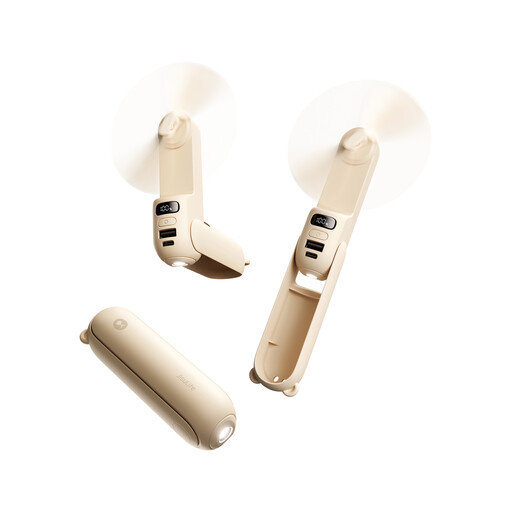
Why it suits this type of user: This compact model combines a mini fan with a power bank and torch. That makes it a practical choice for travel, camping and everyday use.
According to the product description, the LED indicator shows the fan setting and remaining battery. The stated run time of 15 to 24 hours varies depending on the setting.
2500mAh battery, foldable design, USB charging and a weight of around 130 grams.
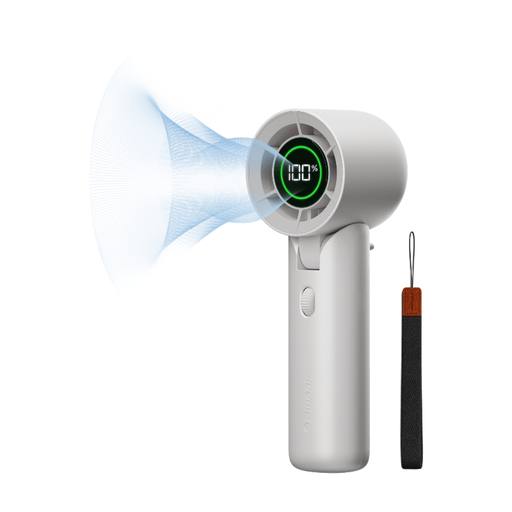
Why it suits this type of user: The adjustable head and fine control from 0 to 100 make it well suited to the office, train, desk or quiet personal use.
The product specifications state a noise range of 23 to 46 dB and battery life of up to 32 hours on the low setting. This makes the conditions behind the claim clearer.
USB-C charging, a head that tilts by 75 degrees, 0–100 adjustment and a compact size of 19 × 7 × 6,5 cm.

Why it suits this type of user: This model is designed for people who want plenty of adjustment options and strong airflow at concerts, sporting events or on hot outdoor journeys.
The rotary dial lets you adjust the 100 wind speed levels directly. The stated run time of 3 to 40 hours depends on the setting you choose.
5000mAh battery, LED display, USB-A-to-USB-C cable and, according to the product specifications, a charging time of 1,5 to 2 hours with a compatible fast-charging input.
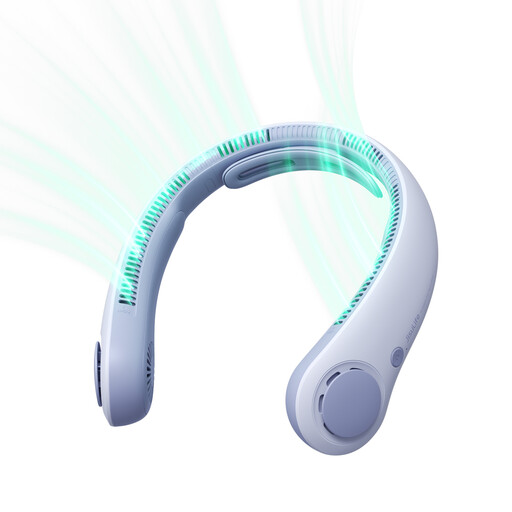
Why it suits this type of user: This neck fan keeps your hands free while you’re walking, working outdoors, travelling or attending a sporting event.
The bladeless design prevents direct contact with moving blades. According to the product specifications, run time ranges from 2,5 to 16,5 hours, depending on the setting.
5000mAh battery, five speeds, USB-C charging and a weight of around 282 grams.
We’ve put together a full, up-to-date list of products that meet these strict selection criteria and the applicable European safety regulations.
Run time depends on the battery capacity, fan setting and age of the battery. Many models are rated to run for a few hours on a high setting and for up to 18 to 40 hours on a low setting. A lithium-ion battery’s capacity decreases over time. Store the fan in a dry place and avoid leaving it exposed to heat for long periods.
Usually, yes, as long as the connector and recommended charging voltage are compatible. Check the instructions before using an adapter or power bank. Don’t use a damaged cable, and don’t leave a fan charging unattended for long periods.
That depends on the venue’s policy and the size of the device. A compact model with a safety lock, wrist strap and clear battery indicator is practical for travel and concerts. Check the organiser’s entry rules in advance, and be mindful of those around you and the noise level when using it.
