
Vandaag of morgen in huis

Kwaliteit gegarandeerd

Welkomstaanbiedingen ontgrendelen: GRATIS bezorging | Tot 80% korting | Gratis 30 dagen JoyPlus-proefperiode
Download de app
A portable hand fan is useful on a hot train journey, at the office, at a concert or while out walking. However, mini fans vary considerably in airflow, battery life and ease of use. A low weight, for example, says little about performance, while a long operating time often only applies to the lowest setting.
This practical buying guide helps you compare a rechargeable hand fan, pocket fan or personal fan based on the features that really matter in the UK.
A stated operating time of 20 or 30 hours usually applies to the lowest speed. At a higher setting, the operating time is shorter. So look for a range, such as 3 to 22 hours or 3 to 19 hours, rather than focusing only on the highest figure.
Also check the capacity in mAh, charging time and type of connection. A power bank, laptop or USB charger is practical when you are out and about, but only if the fan works with your cable and charging source.
A powerful turbo fan with a high rotational speed specification can move a lot of air, but that does not automatically make it pleasant to use in a quiet space. For an office, library or train, the noise level and lowest setting are more important than maximum power.
Check whether the brand states the noise level at a specific measuring distance. A decibel figure is only useful when the measuring conditions are clear. According to the product specifications, for example, the BLUEAIR AlwaysCool F7 has a noise range of 23 to 46 dB. For other models, the level is not stated or is described as higher at maximum speed.
A pocket fan should fit in a coat pocket or bag, but buttons that are too small, an unclear display or an awkward grip can make it frustrating to use. Therefore, check:
Airflow may be indicated in product information by m/s, rotational speed or the number of speed settings. These values cannot always be compared directly between brands. A fan with five settings does, however, offer a clear choice between a gentle breeze and a targeted airflow.
A model with 100 speed levels gives you finer control, but is not automatically more convenient. For everyday use, five well-chosen settings are often enough. A dial or straightforward controls may be more practical when you are out and about than navigating a display menu.
A battery of 4,250 or 5,000 mAh will generally offer more reserve than a compact model with 2,500 mAh, but energy consumption varies depending on the motor and speed. So look at the stated operating time for different settings.
A USB fan with a USB-C connection is well suited to modern chargers, laptops and power banks. Check whether only a cable is included or whether an adapter is supplied too. Use a suitable charger with lithium-ion batteries, avoid water and do not use a damaged or swollen battery.
For commuting, camping or exercise, a carrying strap, folding function or neck-mounted design can be useful. A fan for concerts should also be compact and easy to operate. Always check the venue’s rules in advance: some events restrict the permitted dimensions or types of device.
A fan is not a toy. Keep fingers, hair and loose clothing away from the air intake and grille. A neck fan should not be used during activities where it could restrict your vision or freedom of movement, such as cycling in busy traffic. Always follow the manufacturer’s safety instructions.
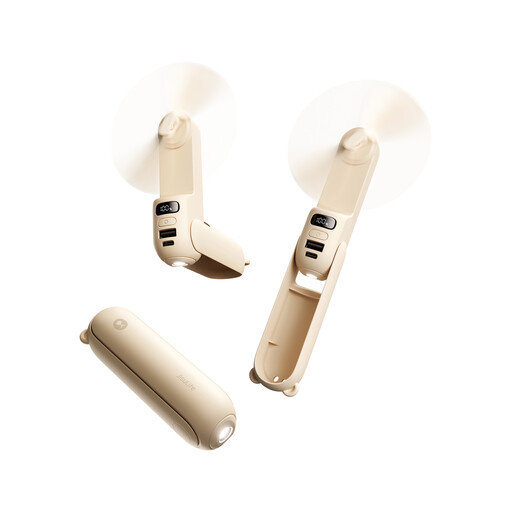
Why it suits this profile: This foldable model combines a mini fan with a power bank and torch. Weighing around 130 grams, it is suitable for everyday carrying and short trips.
The product specifications list three settings, a display showing speed and battery level, and an operating time of 15 to 24 hours, depending on the setting.
2500mAh battery, foldable design and three functions in one device.
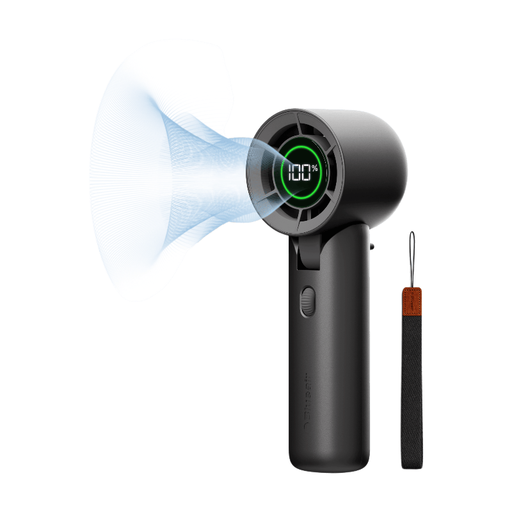
Why it suits this profile: The combination of an adjustable head, USB-C charging, 0–100 speed levels and a stated noise level from 23 dB is well suited to use in the office, on the train and at home.
The manufacturer states a range of 23 to 46 dB and specifies that the operating time is up to 32 hours on the low setting. Expect a shorter operating time on higher settings.
75° adjustable fan head, USB-C and 0–100 control.
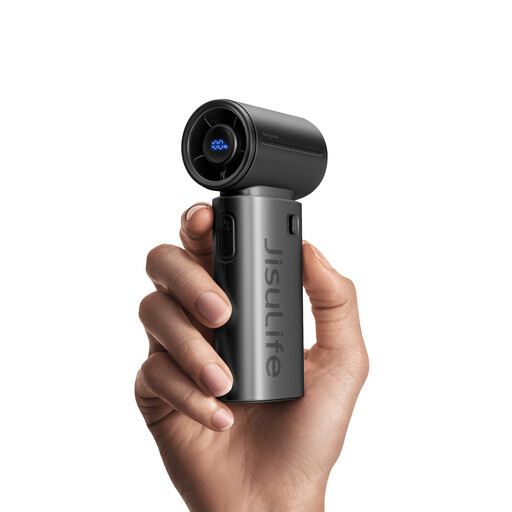
Why it suits this profile: If you want targeted airflow outdoors, while travelling or from a fan for concerts, this model offers five settings, a compact design and a carrying strap.
The product specifications state both a maximum wind speed of 10 m/s and a battery life of 3 to 22 hours, depending on the selected speed. This shows the difference between peak power and everyday use.
5000mAh battery, LED display, five settings and a weight of 180 grams.
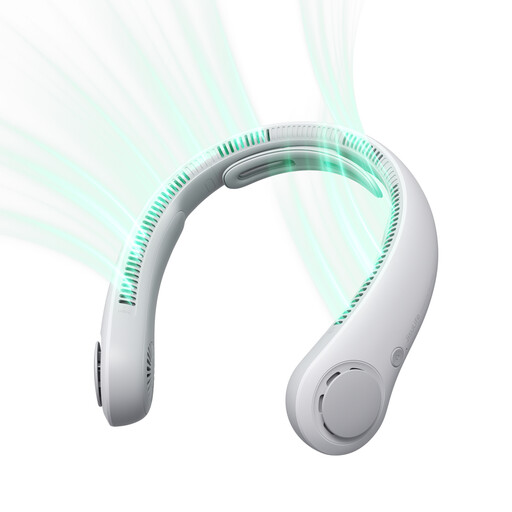
Why it suits this profile: This bladeless neck fan is designed to keep you cool, hands-free, while walking, working, travelling or taking part in light outdoor activities.
The bladeless design prevents contact with rotating blades. The stated operating time of 2.5 to 16.5 hours varies by setting; according to the specifications, charging via USB-C takes 3 to 4 hours.
5000mAh battery, five speeds and hands-free use with a weight of around 282 grams.
We have put together a complete, up-to-date list of products that fully meet these strict selection criteria and the applicable European safety regulations.
It depends on the battery capacity, motor speed and selected setting. The products in this selection offer operating times of approximately 2.5 to 32 hours. The highest setting uses more energy. If a battery becomes hot, swells or leaks, stop using it immediately.
A small model with a carrying strap and safety lock can be practical, but check the organiser’s entry policy in advance. Also consider the noise level and battery life at higher settings. A turbo model may provide more airflow, but it can also be noticeably louder.
A small USB fan uses relatively little electricity. The exact cost depends on the charging power, battery capacity and how often you recharge it. With daily use, the difference is generally limited; focus above all on safe charging options and a battery life that suits how you use it.
