What should you look for when buying?
FM radio
A good fit if: your preferred local station is available via FM where you plan to listen and you don’t need any stations that are only available on DAB+.
The trade-off: an FM radio can’t receive stations that broadcast exclusively via DAB+. Reception where you plan to listen is also a key factor.
FM and DAB+ radio
A good fit if: you want to search for stations on both radio bands or listen in different places.
The trade-off: a DAB+ tuner doesn’t guarantee that your local station is available where you plan to listen, so check in advance.
Local digital radio is linked to geographical areas, according to the Dutch Authority for Digital Infrastructure. Check your station’s current broadcasts and reception where you plan to listen.
| What to consider |
What should you check? |
Who is this most important for? |
| Listening quietly or privately |
Check whether the exact version has a headphone output. If possible, try the lowest usable speaker setting for yourself; the stated power output doesn’t tell you enough about this. |
If I’m listening in a shared space, I want to be able to turn the volume down low or use headphones. Around 36% of consumers prioritise listening quietly or privately. |
| Reception of your local station |
Check whether your station broadcasts via FM, DAB+ or both, and test reception where you plan to listen. |
If I mainly want to hear one local station, the chosen radio band needs to work there. Around 29% of consumers prioritise reception of that station. |
| Listening without a mains socket |
Check the type and number of batteries required, the power options and what’s included with the exact version. |
If I want to take the radio somewhere without a mains socket, I want to know in advance what power source I’ll need. Around 21% of consumers prioritise listening without a mains socket. |
| Easy tuning |
Decide whether you’d rather choose a frequency yourself or press a button to select a saved favourite station. |
If I often listen to the same station, I want to be able to find it easily. Around 14% of consumers prioritise easy station selection. |
Joybuy products
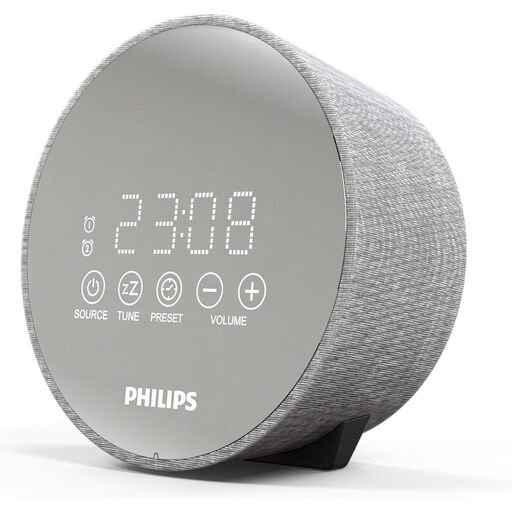
This Joybuy pick is an FM clock radio for listening to a local station that’s available via FM where you plan to listen.
 No image available
Philips TADR402/12 FM clock radio
An option for listening to a local station if it’s available via FM where you plan to listen. The sleep timer is also useful if you listen before going to bed.
FM tuner; dual alarm; USB charging port; night light; backup battery; sleep timer.
View at Joybuy
Frequently asked questions
Can I receive my local station on any DAB+ radio?
No. Having a DAB+ tuner alone doesn’t guarantee reception. Local digital broadcasts are linked to geographical areas, so check whether your station broadcasts on DAB+ and whether you can receive it where you plan to listen.
How do I set up the radio for reception and quiet listening?
First check whether your station is available via FM, DAB+ or both, then test reception where you plan to use the radio. For private listening, check whether the exact version has a headphone output. If using headphones, start at a low volume.
Do I need to buy batteries or an adapter separately?
It varies by model and version. Pure lists four AA batteries as a power option for the Elan One² and says they aren’t included. Denver lists an included adapter and four AA batteries, which aren’t included, for the DAB-42. Check the box contents before ordering.
What are my rights if a radio I buy online doesn’t work properly?
For online purchases from a business, you’re often entitled to a 14-day cooling-off period, according to the Dutch government. The Netherlands Authority for Consumers and Markets’ ConsuWijzer also explains the legal guarantee: if a product doesn’t do what you can reasonably expect under normal use, the seller must offer a solution. The applicable terms depend on the purchase and the problem.
Do I need a broadcasting licence to listen to a portable radio in the Netherlands?
The Dutch Authority for Digital Infrastructure’s information on local digital radio describes licences for broadcasters. It doesn’t make a separate, definitive statement about every type of radio reception by listeners.


