
Vandaag of morgen in huis

Kwaliteit gegarandeerd

Welkomstaanbiedingen ontgrendelen: GRATIS bezorging | Tot 80% korting | Gratis 30 dagen JoyPlus-proefperiode
Download de app
A portable EV charger Type 2 is handy when you don't have a fixed charging point at home, you go on holiday regularly, or you want to keep an extra charging solution in the boot. However, not every mobile car charger for an electric vehicle is automatically suitable for your situation. The charging power, the connection type and the safety features together determine whether you can use the charger safely and practically.
A product labelled as an 11 kW EV charger or even 22 kW sounds appealing, but your car also needs to be able to handle this power. In addition, your electrical installation must be suitable for single-phase or three-phase charging. With a standard household socket, the practical power output is usually lower.
So a higher figure on the product page does not automatically mean your car will charge faster. Check the specifications of your car's onboard charger and the available connection at home.
A USB charging cable, USB-C fast charging cable or car charger for your mobile phone will not work for charging an electric vehicle. An EV charger uses a Type 2 connector according to IEC 62196-2 and typically includes a control box, also known as an EVSE charger.
This control box manages the charging current and can display error messages or safety functions. A loose Type 2 charging cable without a suitable power supply is not the same as a complete portable charger.
A five-metre cable can be practical on a driveway, but it also takes up more space. Also check whether the charger has a Schuko plug, CEE plug or a fixed connection. A standard Schuko connection is not the same as a three-phase CEE connection.
Only use a household socket when the installation, plug and wiring are suitable for it. Avoid extension leads and loose adapters that are not designed for the required charging current.
An adjustable charging current is useful when you charge at different locations. Some portable models offer settings such as 8 A, 10 A, 13 A and 16 A. This allows you to adjust the power to the available connection.
As a rough guide:
The actual charging time also depends on the battery capacity, the car's onboard charger and the selected charging current.
Check whether your car has a Type 2 port. This is common on many European electric cars and plug-in hybrids, but the maximum charging capacity varies by model. A charging cable for a plug-in hybrid does not necessarily need to support the same power as a fully electric car.
Also pay attention to the plug on the socket side:
Look for features such as earth leakage detection, overcurrent protection, overheat protection and protection against overvoltage or undervoltage. An IP rating indicates how well the housing is protected against dust and water, but it does not mean every charger can be used in all weather conditions.
An OLED or LCD screen can display charging current, voltage, temperature and error messages. With a smart EV charger with app, you may be able to schedule charging sessions or monitor your consumption. Check whether the app requires a connection via Wi-Fi, Bluetooth or both.
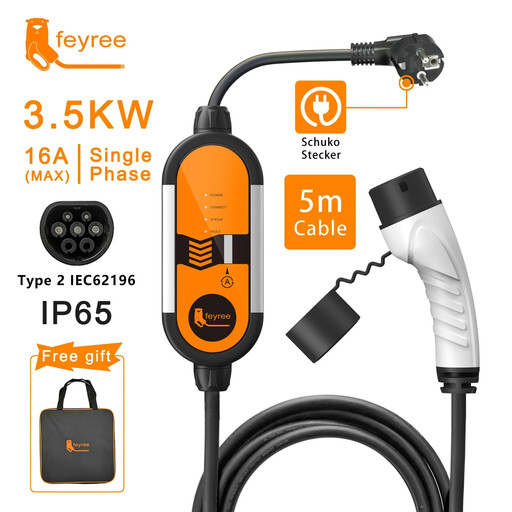
Why this fits the profile: This portable electric car charger is designed for charging via a suitable 230V connection. That makes it interesting for users who want to get started easily at home or on holiday without having a wallbox installed straight away.
The charging current is adjustable to 8 A, 10 A, 13 A or 16 A. The Schuko plug and maximum power of around 3.5 kW are clearly stated.
5-metre cable, OLED display and stated protection against leakage current, overheating and overcurrent.
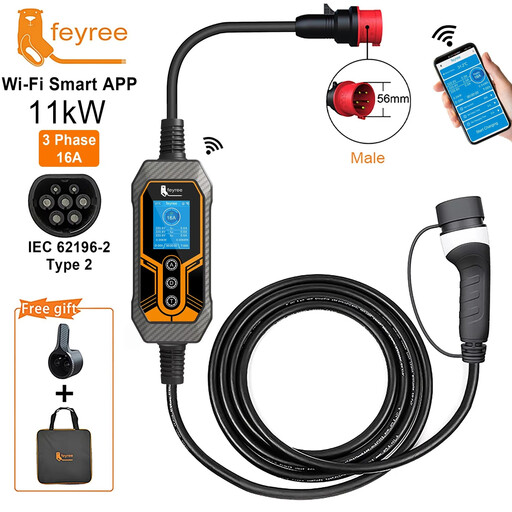
Why this fits the profile: Suitable for those who can charge three-phase and like to manage charging status, scheduling and current settings via an app.
The product states adjustable current from 8 A to 16 A, a 2.8-inch LCD screen and app control. Check beforehand whether your connection is three-phase.
Scheduling via app, LCD status display, 5-metre cable and multiple stated safety features.
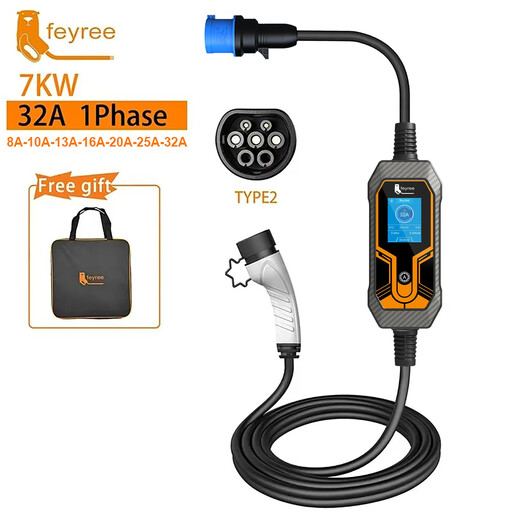
Why this fits the profile: A logical choice for those who have a suitable single-phase CEE connection and want to charge at a higher power more often, for example at home or at a fixed holiday location.
The specification mentions adjustable charging currents from 8 A to 32 A. This allows you to match the charging level to the installation, provided the connection supports it.
7 kW rating, 5-metre cable, LCD screen and a portable housing with stated IP65 protection.
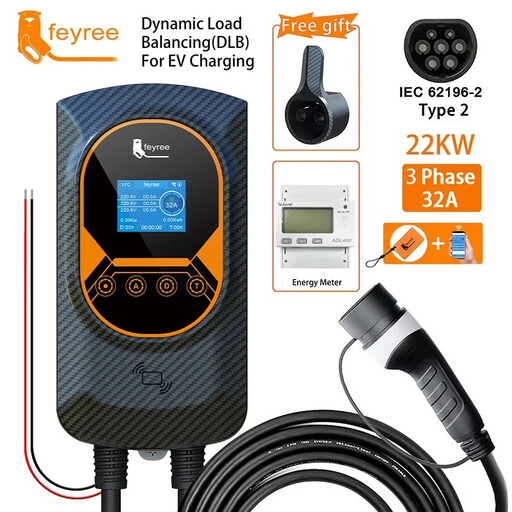
Why this fits the profile: Interesting for households considering a fixed charging solution with app control and dynamic load balancing. The installation must be supported by the available mains connection.
The product description mentions dynamic load balancing, adjustable current up to 32 A and control via an app. Check whether the function suits your fuse box and installation.
Rated up to 22 kW, 5-metre cable, Tuya app, LCD screen and stated IP66 protection.
We have compiled a full, up-to-date list of products that fully meet these strict selection criteria and comply with current European safety regulations.
A portable charger you can take with you and usually requires no fixed installation. That is practical for rented homes, travel and occasional charging. A wallbox stays in one place, but can offer a neater cable solution, higher charging capacity and features such as dynamic load balancing.
With an 11 kW or 22 kW solution, have it checked whether your fuse box, wiring and main fuse are suitable. A fast charger is of little use if the electrical installation cannot supply the current.
No. Check the circuit, wiring, plug and maximum charging current. Only use a Schuko charger on a suitable, well-maintained connection and follow the manufacturer's instructions.
That depends on the battery capacity and the charge level. A car with a 40 kWh battery theoretically needs just over eleven hours for a full charge, excluding charging losses. A plug-in hybrid usually has a smaller battery and therefore charges more quickly.
No. The car must support three-phase charging at a maximum of 32 A, and the electrical installation must also be suitable for it. If the car's onboard charger cannot handle it, the power is automatically limited or part of the capacity remains unused.
