
Vandaag of morgen in huis

Kwaliteit gegarandeerd

Welkomstaanbiedingen ontgrendelen: GRATIS bezorging | Tot 80% korting | Gratis 30 dagen JoyPlus-proefperiode
Download de app
A portable EV charger Type 2 is useful if you want to charge at home, at a family member’s house or while travelling without a fixed wallbox. However, many models look similar, even though their connections, charging power and safety features can vary considerably. Choosing the wrong one can result in a charging speed that is too low, an unsuitable socket or a cable that turns out to be too short in practice.
In this buying guide, you’ll discover what to look for in a portable EV charger 3.5 kW, a mobile charging cable for an electric car and more powerful charging solutions for intensive use.
A charger rated at 3.5 kW, 11 kW or 22 kW will not automatically deliver that power to every car. The actual charging speed depends on:
A 230V EV charger at 16 A theoretically delivers approximately 3.5 kW. An 11 kW charger, on the other hand, requires a suitable 400V three-phase connection and a car capable of three-phase charging.
The vehicle-side connection on European electric cars and plug-in hybrids is often Type 2 according to IEC 62196-2. However, the mains plug can vary. A Schuko EV charger uses a standard Type F socket, while a CEE model requires an industrial connection.
Therefore, always check:
An EV charger with Wi-Fi or Bluetooth may support scheduling and monitoring, but the app only works with a compatible network connection and software. Also check whether you can operate the charger without the app. A physical button, display or plug-and-charge function is practical when there is no signal or Wi-Fi available.
An adjustable charging current gives you greater flexibility. With an older socket or a circuit shared with other appliances, 8 A or 10 A may be wiser than switching straight to 16 A. Only use a setting that is suitable for the electrical installation.
A portable home charger for electric cars with 8A 10A 13A 16A settings is particularly suitable for drivers who charge in different locations. If you’re unsure about earthing, wiring or the load on the circuit, ask a qualified electrician to inspect the installation. Do not use unapproved adapters or extension leads.
A 5-metre cable will generally provide enough reach for a driveway or garage, but measure the distance between the socket and the charging port beforehand. Also consider:
An IP rating is not a licence to use the charger underwater. IP65 or IP66 provides information about protection against dust and water under certain conditions. Keep plug contacts clean and dry, and always follow the instructions.
Look for clear information about features such as overcurrent, overheating, earthing and residual-current protection. Some models specify Type A + DC 6 mA detection or Type B residual-current protection. Check that this matches the requirements of your electrical installation.
A manufacturer may list certifications or conformity information. According to the product description, TDC ENERGY states CE conformity for certain models; check the latest documentation, instructions and included information before using the charger. A safety feature does not prevent a damaged cable or unsuitable socket from creating a risk.
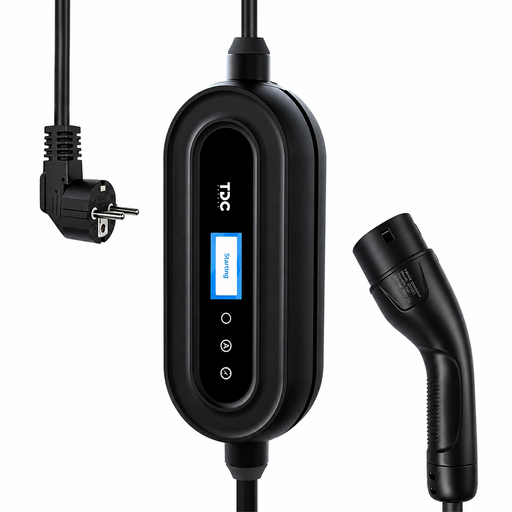
Why it suits this profile: This 230V EV charger uses a Type F plug and is suitable for drivers looking for a compact back-up charger for use at home or on the go.
The charging current can be set to 8, 10, 13 or 16 A. This allows you to match the setting to a suitable circuit instead of always using the highest setting.
3.5 kW maximum, 5 m cable, 1.9-inch LCD screen, Wi-Fi and Bluetooth, IP66 rating stated and suitable for portable or wall-mounted use.
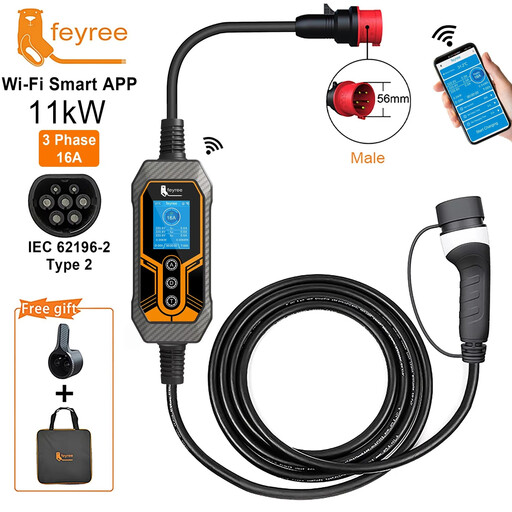
Why it suits this profile: This model is designed for those who want faster charging on the go or via a suitable CEE connection, and who value control through an app or button.
The product description lists 8A, 10A, 13A and 16A, so you’re not restricted to a single charging setting. However, 11 kW requires a suitable three-phase installation and vehicle.
5 m cable, LCD screen, Wi-Fi and Bluetooth function, scheduled start and Type 2 connector. The stated IP66 protection applies according to the product information; follow the instructions when using it outdoors.
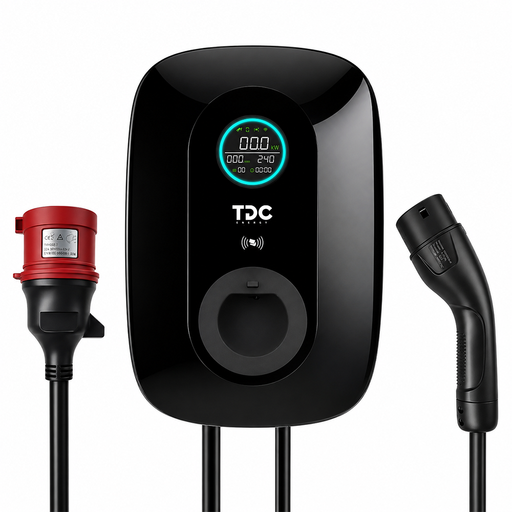
Why it suits this profile: This wall-mounted charger is suited to a permanent charging point and an electrical installation capable of supplying 400 V, three phases and 32 A.
The power is clearly linked to a 5-pin 32A CEE connection. This makes it clear in advance that this is not a standard Schuko EV charger.
22 kW maximum according to the product specifications, 5 m Type 2 cable, LCD screen, RFID cards and app control. Installation and inspection of the circuit should be carried out by a qualified electrician.
We’ve put together a complete, up-to-date list of products that fully meet these strict selection criteria and the applicable European safety regulations.
Before every charging session, check the mains plug, control box, cable and Type 2 connector. Stop immediately if you notice loose components, damage or unusual heat. Connect the charger directly to a correctly earthed socket and do not use an extension lead unless the manufacturer explicitly permits it.
Stop the charging session before disconnecting the plug. After use, allow a portable charger to cool for a few minutes before storing it. Store the cable in a dry place without sharp bends. Its service life depends on frequency of use, storage, mechanical stress and conditions; a stated IP rating does not indicate how many charging cycles a product will last.
Not without checking first. A Schuko model is designed for a suitable earthed Type F socket, but the circuit must be able to withstand prolonged loads. If you’re unsure, start with a lower charging current and seek advice from a qualified electrician.
This depends on your electricity tariff, charging losses, the selected charging current and how much energy the car needs. A simple calculation is: kilowatt-hours charged multiplied by your price per kilowatt-hour. Ultimately, the car determines how much energy is taken from the supply.
A PHEV with a Type 2 AC connection can generally use a Type 2 charging cable. Plug-in hybrids often have a lower maximum charging speed because of their internal charger. Always check the vehicle documentation and connector standard before ordering.
