
Vandaag of morgen in huis

Kwaliteit gegarandeerd

Welkomstaanbiedingen ontgrendelen: GRATIS bezorging | Tot 80% korting | Gratis 30 dagen JoyPlus-proefperiode
Download de app
A portable EV charger Type 2 7 kW can be handy when you want to charge at home, at a relative’s house, or at a temporary location without having a fixed charging point installed. However, not every mobile EV charger is suitable for every situation. A high power rating on the packaging, for example, does not automatically mean your car or electrical installation can actually use that power.
The main purchasing pitfalls usually come down to three points:
First, check whether your electric car or plug-in hybrid has a Type 2 connection according to IEC 62196-2. This connection is widely used in Europe, but compatibility does not mean every vehicle supports 7 kW AC charging.
Also pay attention to the difference between:
An adjustable charging current is practical when you are not always using the same connection. Some models offer settings of 8A, 10A, 13A, 16A, 20A, 25A and 32A. Only select a current within the capacity of the socket, the cable and the circuit. If you are unsure about the installation, a qualified electrician should assess the situation.
A portable charging point is more than just a Type 2 charging cable. The charging box contains electronics that manage the connection between the car and the power supply. Look for listed features such as:
Some feyree models list Type B residual current protection with AC 30 mA + DC 6 mA. The TDC ENERGY SNK03 mentions Type A + DC 6 mA residual current protection. Always check the product manual and the requirements of your electrical installation; a product listing does not replace installation advice.
A 5-metre cable often provides enough reach for a driveway or garage, but is more awkward to store than a shorter cable. Pay attention to the strain relief, flexibility at low temperatures and the included storage bag.
An IP65 or IP66 rating is useful for outdoor use, for example against splashing water or rain. Still, keep the mains plug and connection points clean and dry. A wall-mounting bracket can keep the charging box off the ground and prevent the cable from lying in an awkward place. Check that the fixing is suitable for your wall and mount it according to the instructions.
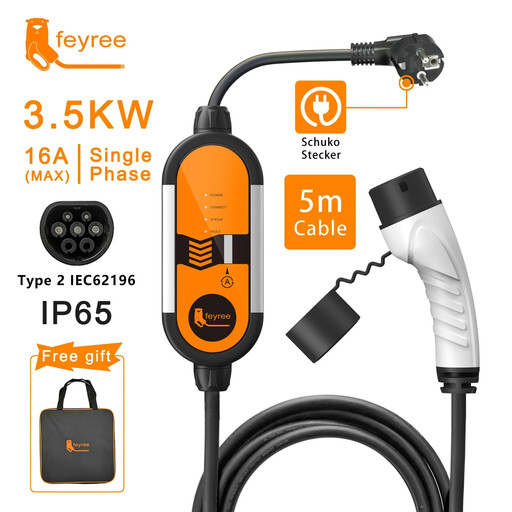
Why this fits the profile: This mobile EV charger is aimed at drivers who mainly charge at home or at a relative’s house via a suitable 230V socket and do not need a 32A connection.
The product clearly states a range of 8A to 16A and a maximum of 3.5 kW. This makes the difference between the nominal capacity and the practical connection clearer.
Type 2 connector, 5-metre cable, adjustable charging current, OLED status display and IP65 protection.
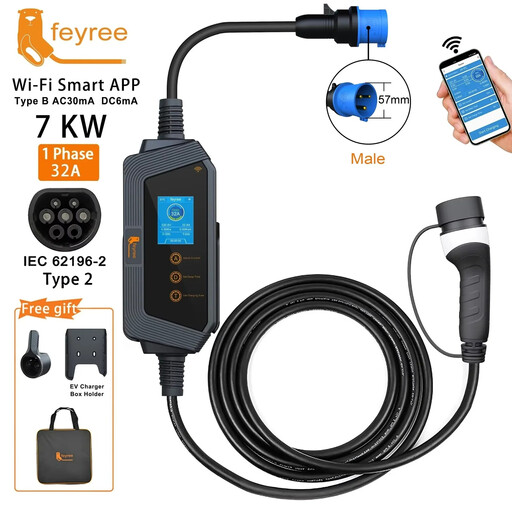
Why this fits the profile: Suitable for anyone looking for a portable 7 kW charger with app control, scheduling and the option of wall mounting.
The specifications mention 8A–32A adjustable, so you can adapt the charging current to the available installation. IP66 is listed, but the connection points still need to stay dry.
Maximum 7 kW and 32A, 5-metre cable, Type 2, Tuya app, LCD screen, timer function and bracket for portable or wall-mounted use.
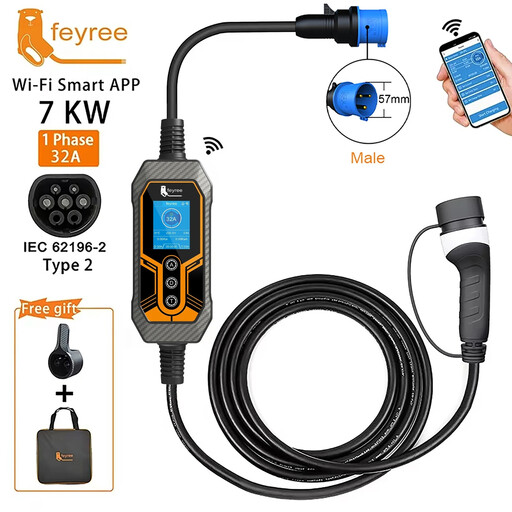
Why this fits the profile: For drivers who regularly switch between home charging, outdoor use and charging at different times.
The charging current can be adjusted via the app or buttons from 8A to 32A. This helps you avoid charging at the highest setting by default when the circuit is not designed for it.
7 kW maximum, 2.8-inch LCD screen, scheduling via Wi-Fi app, Type B residual current protection according to the product information and IP66 for the connector.
We have put together a full, up-to-date list of products that fully meet these strict selection criteria and comply with current European safety regulations.
Only use a 7 kW charging station on a connection that is suitable for it. A dedicated circuit and appropriate cabling may be necessary. Do not use an arbitrary extension cable or an unapproved adapter. Before each session, check the Type 2 charging cable, mains plug and housing for cracks, loose parts or unusual heat.
When charging at a lower current, a full session takes longer. The final charging time depends on the battery capacity, the car’s charging limit, the set current and the electrical installation. A timer or a smart EV charger with Wi-Fi can help you start charging at a desired time, but check whether the app requires a compatible 2.4GHz Wi-Fi connection.
Only vehicles with a suitable Type 2 AC connection can use this cable. The car must also support 7 kW AC charging to make full use of the maximum power. With a lower-rated onboard charger, the speed is automatically limited.
A 7 kW charger at 32A is generally not intended for a standard household socket. Choose a suitable electrical installation and, if in doubt, have the connection checked by a qualified electrician. For a normal 230V socket, a model with a lower adjustable current, such as 8A to 16A, is often more appropriate.
The cost depends on the energy consumption of the car and your electricity tariff. Multiply the number of kilowatt-hours charged by the price per kilowatt-hour. A timer may allow you to charge at a cheaper time, but the actual benefit depends on your energy contract.
