
Vandaag of morgen in huis

Kwaliteit gegarandeerd

Welkomstaanbiedingen ontgrendelen: GRATIS bezorging | Tot 80% korting | Gratis 30 dagen JoyPlus-proefperiode
Download de app
A portable EV charger Type 2 3.5 kW may seem straightforward at first: plug it into a socket, connect the Type 2 connector to your car and start charging. In practice, the wrong current setting, an unsuitable socket or a cable that’s too short can cause problems. Features such as Wi-Fi, Bluetooth and “fast charging” are also sometimes promoted without clearly explaining what they mean for charging at home in the Netherlands.
These points are worth considering before you buy a portable EV charger, a mobile charging cable for your electric car or a charging cable for a plug-in hybrid.
A 3.5 kW EV charger at 16 A uses a single-phase supply of around 230 V. You’ll only achieve that power if the socket, circuit and car’s onboard charger can all support it. So a vehicle with a lower AC charging capacity won’t automatically charge faster with a more powerful cable.
Don’t just look at “3.5 kW”. Also check:
Type 2, also known as IEC 62196-2, is the vehicle connector widely used in Europe. The mains plug at the other end is just as important. The TDC ENERGY SNK03, for example, has a Type F plug, designed for a suitable earthed 230V socket.
Don’t use an unapproved adapter or extension lead. If you’re unsure how much load the circuit can handle, ask a qualified electrician to check it. A portable charger is no substitute for a properly installed electrical system.
An EV charger with Wi-Fi and Bluetooth can be useful for scheduling and monitoring. The listed features of the TDC ENERGY SNK03 include charging via the app, a button and “plug & charge”. According to the product information, the app features require a compatible network connection.
However, smart controls don’t change the circuit’s maximum capacity. Think of Wi-Fi and Bluetooth as control features, not a way to charge faster or more safely.
An EV charger 16A can charge at up to 16 amps when connected to a suitable circuit. A lower setting is more practical for older installations, shared circuits or situations where you want to build up the load gradually.
The TDC ENERGY SNK03 offers four settings: 8A, 10A, 13A and 16A. This lets you match the charging current to the socket and circuit. Only choose a setting that’s within the capacity of your installation. If you’re unsure, 16 A isn’t automatically the right choice.
A 5-metre 230V charging cable usually gives you more flexibility between the socket and the charging port. Before buying, check where the socket is and which side of the car the Type 2 socket is on.
A longer cable isn’t always more convenient. It takes up more space and should be stored somewhere dry, without sharp bends, after use. If you mainly want to use the portable charger at home, also check whether it’s suitable for wall mounting.
The TDC ENERGY SNK03 product description lists IP66, overvoltage and undervoltage protection, overload protection, overtemperature protection, earth continuity monitoring and Type A plus DC 6 mA residual-current protection. IP66 refers to protection against dust and powerful water jets under the specified test conditions. It doesn’t mean the charger can be submerged.
A 1.9-inch LCD screen and a three-colour LED indicator show the charging status and relevant information. Check the plug, cable and Type 2 connector before each charging session. Stop immediately if you notice loose parts, damage or unusual heat.
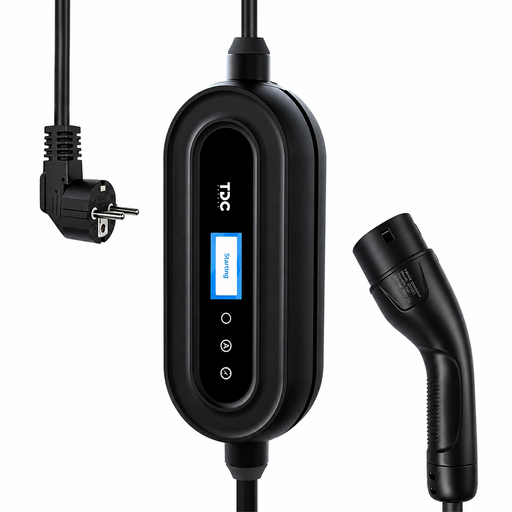
Why it suits this type of buyer: This portable car charger is designed for EV or plug-in hybrid owners who want to charge at home or on the go from a suitable Type F socket, without a fixed charging point.
The four charging settings, from 8A to 16A, mean you don’t have to charge at the highest current by default. The Type F plug and Type 2 connector are clearly specified.
Maximum power of 3.5 kW, 5 m cable, LCD screen, Wi-Fi and Bluetooth. The listed dimensions are 298 × 105.8 × 53 mm and the weight is approximately 2.1 kg.
Why it suits this type of buyer: If you want to schedule charging or monitor its status, you get app support as well as button controls, provided a compatible network connection is available.
The product information distinguishes between app controls, button controls and plug & charge. So you don’t have to rely entirely on Wi-Fi to start a charging session.
Adjustable charging current, 1.9-inch LCD screen, 5 m reach and listed IP66 protection. The manufacturer states a two-year warranty period.
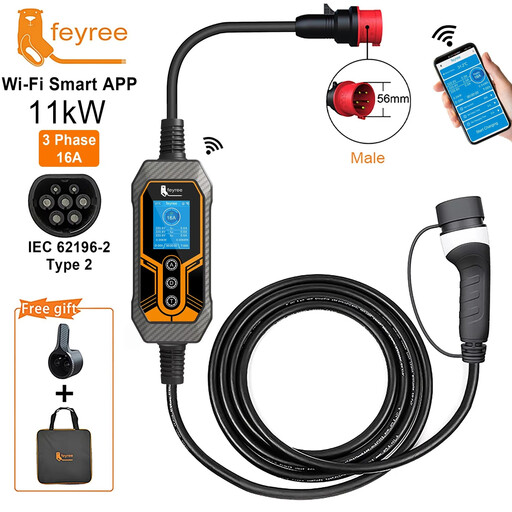
Why it suits this type of buyer: This model is intended for users with a suitable three-phase CEE connection and a car that supports higher AC charging capacity. It’s therefore not the obvious choice for a standard Type F socket.
The product information specifies a CEE plug and three-phase charging. Check the connection and your vehicle’s capacity beforehand rather than treating this model as a 230V charger.
Adjustable charging current from 8A to 16A, app and button controls, and a 5 m cable. The listed capacity reaches up to 11 kW with a suitable three-phase installation.
We’ve put together a complete, up-to-date list of products that meet these strict selection criteria and the applicable European safety regulations.
You can estimate charging costs with: charging power in kW × charging time in hours × your electricity tariff. Actual electricity use will be higher than the energy that ultimately reaches the battery, partly because of charging losses. Charging speed also depends on the car’s onboard charger, the battery’s state of charge and the electrical installation.
No. Only use a suitable, earthed 230V Type F socket and a circuit that can handle the selected charging current. Avoid adapters and extension leads that haven’t been approved for this purpose.
At 3.5 kW, an hour of charging theoretically delivers around 3.5 kWh. The actual amount depends on charging losses, the car, the battery and the available mains capacity. A plug-in hybrid may therefore charge relatively quickly, while a fully electric car will take longer.
According to the product classification, IP66 provides protection against dust and powerful water jets. The charger must not be submerged. Always follow the manual and keep plug connections clean and dry.
