
Vandaag of morgen in huis

Kwaliteit gegarandeerd

Welkomstaanbiedingen ontgrendelen: GRATIS bezorging | Tot 80% korting | Gratis 30 dagen JoyPlus-proefperiode
Download de app
A portable EV charger offers the freedom to charge your electric car wherever you want: on your driveway, at a campsite, or at a friend's house. It's a flexible alternative to a fixed wallbox. But the market is flooded with models that promise more than they can deliver. Before you make a choice, it's wise to be aware of a few common pitfalls that could cost you unnecessarily.
As a Joybuy Product Recommendation Officer, I'll help you see through the marketing jargon and focus on what truly matters.
smart charger with an app is only useful if the app is stable and offers features you'll actually use, like scheduling charging sessions during off-peak hours. A clunky app that constantly loses connection is just a source of frustration.To avoid a bad purchase, focus on the specifications that really matter. These are the three most important points to check before buying a portable EV charger.
The charging power determines how quickly your battery fills up. This depends on three factors: the charger, your home's grid connection, and your car's onboard charger.
home EV charger in many regions. An 11kW charger uses three-phase power and offers a good balance between charging speed and the load on your grid connection.22kW charger requires an upgraded grid connection (usually 3x32A or higher), which incurs additional costs. It only makes sense if both your car and your meter box support it.So, always check what type of connection you have at home and what your car's maximum AC charging power is first.
Safety is non-negotiable. A good portable EV charger must be equipped with the necessary protections to keep you, your car, and your home safe.
Look for the following specifications:
A smart charger with an app can help you reduce charging costs and give you insight into your consumption. Useful features include:
Most modern chargers in Europe use a type 2 charging cable, which is the standard for almost all electric cars.
Not every charger is suitable for every user. Below are a few popular choices, matched with different user profiles.
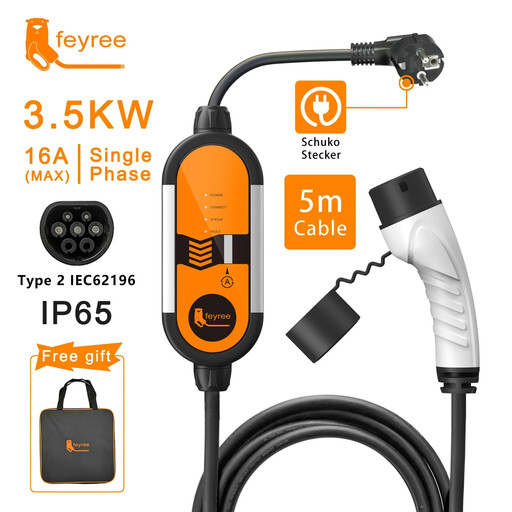
Why This Fits Their Persona: Ideal for plug-in hybrid owners or EV drivers who primarily charge overnight. This charger works with a standard Schuko socket, so you don't need any complex installation or modifications to your meter box.
This charger avoids the overcapacity trap. It delivers a realistic 3.5 kW of power that any standard socket can safely provide, without false promises of high speeds.
Simplicity and maximum portability. Adjustable current (8A-16A) and a clear OLED screen for status updates.
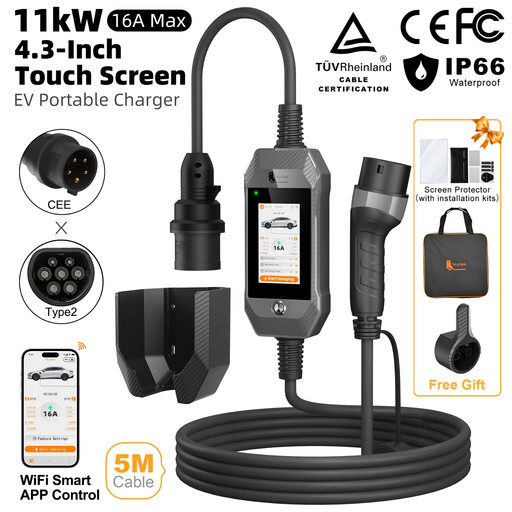
Why This Fits Their Persona: Perfect for the owner of a fully electric car with a 3-phase connection at home. This charger provides a solid 11 kW of charging power, significantly reducing charging time. The app control makes it easy to take advantage of off-peak rates.
This model sidesteps the trap of useless 'smart' features. The Tuya Smart App is a proven platform for scheduling charging sessions and monitoring consumption, which genuinely helps save money.
A combination of 11 kW charging speed, comprehensive safety features (incl. Type B), and a functional app with a touchscreen for full control.
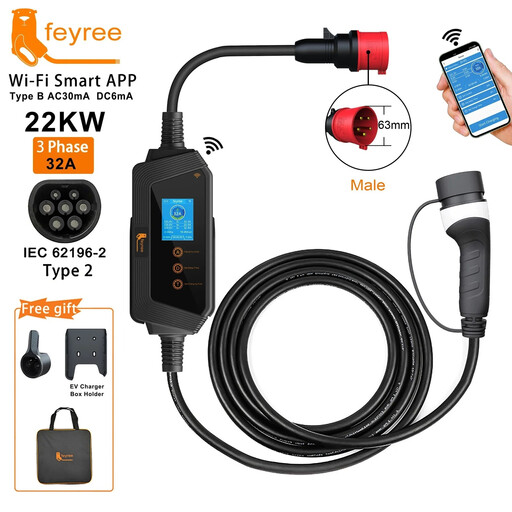
Why This Fits Their Persona: For the EV driver who wants it all. If your car supports 22 kW AC charging and you have (or are considering) an upgraded grid connection, this charger offers the highest possible charging speed in a portable format. Completely future-proof.
This is a deliberate choice for those who have the infrastructure. It prevents the disappointment of a slower charger when your car and home can handle more. The current is adjustable via the app, so it also works at lower power levels.
Maximum charging power of 22 kW for the fastest possible AC charging sessions. Includes all necessary safety features and smart app control.
We have compiled a complete, up-to-date list of products that fully meet these strict selection criteria and safety regulations.
No, it depends on the type of charger. Chargers up to 3.7 kW with a Schuko plug can be used in a standard household socket. For an 11kW charger or 22kW charger, you need a red 5-pin CEE three-phase power socket. For safety, do not use extension cords and ensure the socket is in good condition, as it will be under a heavy, sustained load.
In theory, a 22 kW charger can charge twice as fast as an 11 kW model. In practice, most homes have a standard 3x25A grid connection, which limits the power to 11 kW. To use 22 kW, you must have your connection upgraded by your grid operator, which involves significant additional costs. For most users, an 11 kW 3 phase car charger is the most cost-effective and fast solution.
The charging history in a smart charger with an app is an excellent tool for gaining insight into your energy consumption and charging costs. It helps you optimise your charging behaviour, for example, by charging more during off-peak rates. However, it's important to know that this is not a calibrated meter. The data is intended for personal insight and not for official settlement with an employer, for instance.
