
Vandaag of morgen in huis

Kwaliteit gegarandeerd

Welkomstaanbiedingen ontgrendelen: GRATIS bezorging | Tot 80% korting | Gratis 30 dagen JoyPlus-proefperiode
Download de app
An electric car offers freedom, but that freedom ends where charging begins. A fixed wallbox isn't an option for everyone, especially if you're renting or want to avoid installation costs. A portable EV charger seems like the perfect solution: flexible, no installation required, and you can take it anywhere.
However, the market is filled with models that overpromise and underdeliver. Before you invest, it's crucial to recognise the common pitfalls that can lead to unnecessary expenses.
Pitfall 1: Vague "Smart" Features. Many chargers are advertised as a charger with an app, but in practice, the app is often clunky, unstable, or offers little more than an on/off button. The true value of a smart charger lies in features that save you money, such as scheduling charging sessions during off-peak hours.
Pitfall 2: Inadequate Safety. A charger handles a large amount of current. Models without clear safety certifications (like CE) and essential protections (such as Type B leakage current protection) pose a risk to your car and your home.
Pitfall 3: Unrealistic Charging Speeds. A charger might advertise a high power output, but if your electrical panel or your car's onboard charger can't handle it, you're paying for speed you'll never achieve.
To avoid these traps, focus on the specifications that truly matter. These are the factors that determine whether a portable EV charger is right for your situation.
The charging power, expressed in kilowatts (kW), determines how quickly your car charges. This is directly linked to your home's electrical connection.
A good charger with an app gives you control over your charging costs. The following features are essential:
Virtually all modern electric cars in Europe use a Type 2 charging cable. Additionally, pay attention to the following safety features:
Based on these criteria, we have selected several popular choices that suit different user profiles.
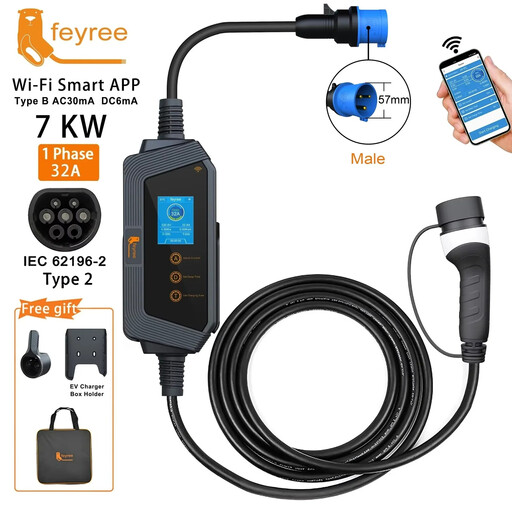
Why This Fits Their Persona: An excellent choice for those seeking a reliable and smart home charging solution without the expense of a 3-phase installation. Ideal for charging on a standard 1-phase connection, while the app control helps save money by charging during off-peak hours.
This charger delivers essential smart features (scheduling, amperage adjustment) via the Tuya app, without unnecessary gimmicks. The safety specifications, including Type B leakage protection and an IP66 rating, are clear and comprehensive.
Offers a high 1-phase charging power of up to 7kW and full app control. The included holder allows for both portable use and fixed wall mounting.
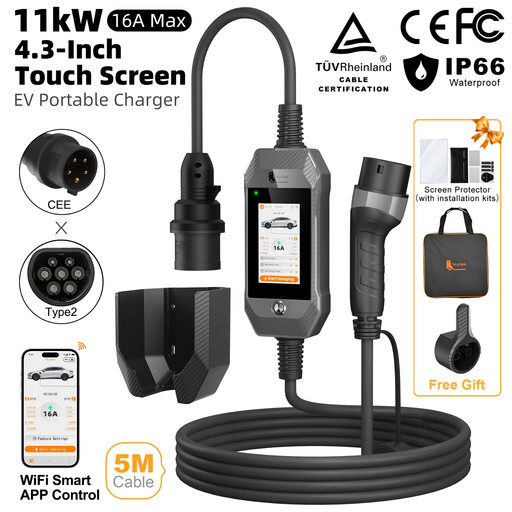
Why This Fits Their Persona: Perfect for those with a 3-phase connection who want to minimise charging time. The combination of a powerful 11kW charger, a clear touchscreen, and app control makes this a complete solution for both fast charging at home and flexible charging on the road.
This charger delivers on the promise of a "smart charger." The 4.3-inch touchscreen provides direct insight into all data, while the app offers extensive control over scheduling and consumption. The advertised 11kW is genuinely delivered on a suitable 3-phase connection.
Combines fast 3-phase charging with an intuitive interface (touchscreen and app). The dual temperature monitoring and OTA updates (firmware updates via the app) ensure long-term safety and functionality.
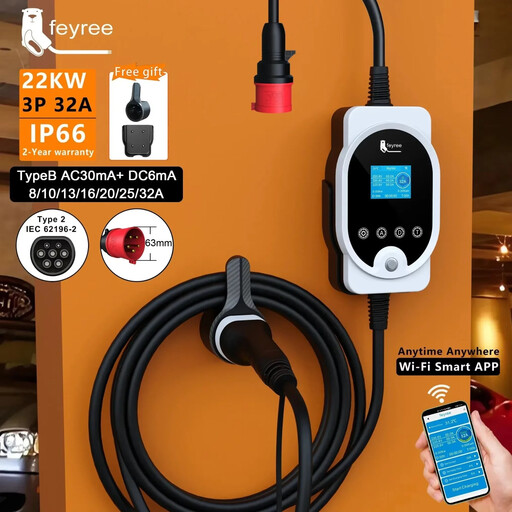
Why This Fits Their Persona: For the user who wants maximum charging power and to be prepared for the future. At 22kW, this is one of the most powerful portable chargers, ideal for EVs with large batteries and a 22kW onboard charger. Full control via the app makes it a powerful tool.
This charger is transparent about its requirements: 22kW is only achievable with a suitable 3-phase (32A) connection and a compatible car. The app offers precise, incremental amperage adjustment (from 8A to 32A), allowing you to fine-tune the speed to your exact situation.
Maximum charging power of 22kW for the fastest possible charging time. The charger supports both 1-phase and 3-phase charging and is equipped with Type B leakage current protection for optimal safety.
We have compiled a complete, up-to-date list of products that fully meet these strict selection criteria and safety regulations.
Yes, a portable EV charger is designed for use without complex installation. You plug it directly into a suitable socket. For models above 3.7kW, this is typically a red CEE industrial socket. If you don't have such a socket, an electrician will need to install one for you. The charger itself is plug-and-play.
A 1-phase charger (up to 7.4kW) uses a single power line and is suitable for most standard home connections. A 3-phase charger (from 11kW) uses three power lines and can charge significantly faster. However, this requires a 3-phase connection in your electrical panel and a car that supports 3-phase charging. Always check your car's specifications and your grid connection.
Yes, provided the charger has an adequate IP rating. Look for models with at least IP65. This means the housing and plug are protected against water jets. However, it is wise not to leave the control box (the unit on the cable) in a deep puddle and to ensure it is in a sheltered spot.
