
Vandaag of morgen in huis

Kwaliteit gegarandeerd

Welkomstaanbiedingen ontgrendelen: GRATIS bezorging | Tot 80% korting | Gratis 30 dagen JoyPlus-proefperiode
Download de app
As a Product Recommendation Officer at Joybuy, I see people struggle daily with the overwhelming number of choices for charging their electric car. A fixed wallbox isn't an option or a preference for everyone. A portable EV charger offers the flexibility you need. But the market is flooded with models that promise a lot but don't always deliver. Before you invest, it's crucial to know what to look for.
Many drivers fall into a few common traps:
A good portable EV charger is more than just a cable; it's a tool that makes your charging process efficient, safe, and cost-effective.
To make the right choice, it's important to understand three technical aspects. This will help you distinguish marketing hype from actual performance.
The charging power determines how quickly your car charges. This is expressed in kilowatts (kW). A charging cable with adjustable power is crucial for flexibility.
A charger that allows you to manually adjust the power (or amperage) prevents you from overloading a circuit. This is useful on holiday or when you're unsure what the electrical installation can handle.
The plug determines where you can plug in the portable charger.
Some chargers come with adapters, allowing you to use both a Schuko and a CEE connection.
A smart charging cable with an app is worth the money if the app helps you save costs and offers convenience. Look for the following features:
A good app, like Tuya Smart, is often a sign of a mature product, as it is stable and supported by many devices.
Based on these criteria, we have selected a number of models that suit different user profiles.
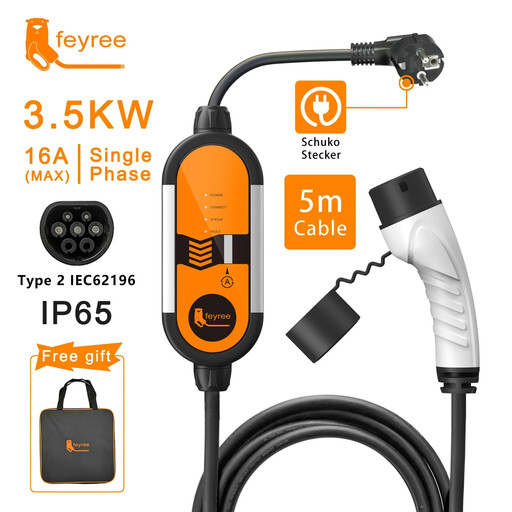
Why This Fits Their Persona: Ideal for those who primarily charge at home using a standard socket. Perfect for plug-in hybrids or when you're not in a hurry. The charger is compact and comes with a carrying case, making it easy to take with you.
This charger tackles the "one-size-fits-all" trap. You can manually set the current (8A/10A/13A/16A) on the control box, allowing you to use the charger safely on older or heavily loaded circuits.
The clear OLED screen displays the charging status, current, and any error messages. The charger remembers your last selected current for the next charging session.
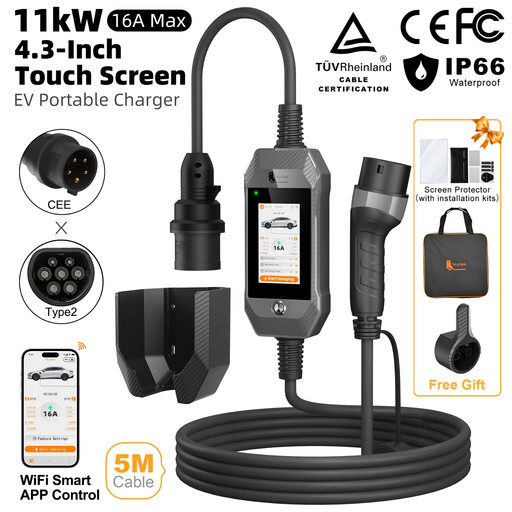
Why This Fits Their Persona: For the EV driver with a 3-phase connection who wants to charge their car quickly and make smart use of off-peak rates. The combination of 11 kW power and app control makes this a powerful and efficient home charger for the car.
This model bypasses the "pseudo-smart" trap. The integration with the Tuya Smart App is stable and offers features that genuinely save money, such as scheduling charging sessions. The app also provides insights into charging history and consumption.
The 4.3-inch touchscreen provides an instant overview and control. The charger features dual temperature monitoring (in the plug and the box) and Type B leakage current protection (AC 30mA + DC 6mA), ensuring a high level of safety.
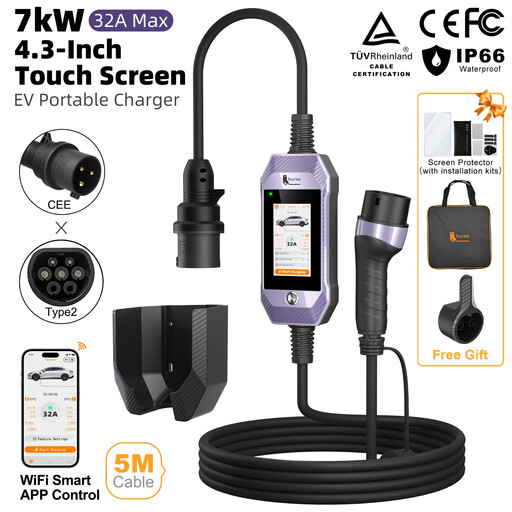
Why This Fits Their Persona: For the EV driver looking for a powerful yet versatile charger. The 7kW power (1-phase, 32A) is a great middle ground, faster than a standard socket but easier to connect than 11kW. The smart features and touchscreen make it an advanced travel companion.
This charger combines a high degree of control with safety. It avoids the trap of unsafe budget chargers by offering comprehensive, certified protections and dual temperature monitoring. The ability to adjust the current via the app or screen (8-32A) provides maximum flexibility.
The charger supports over-the-air (OTA) firmware updates, making it future-proof. The app provides detailed analysis of your charging history, complete with graphs, which helps you understand and optimise your charging patterns.
We have compiled a complete, up-to-date list of products that fully meet these strict selection criteria and safety regulations.
Yes, you can with a portable charger that has a Schuko plug. This is also known as 'Mode 2' charging. It's a relatively slow method, with a charging power of typically around 2.3 kW (10A). It's fine for topping up the battery overnight, especially for a plug-in hybrid. For a fully electric car, it can take 24 hours or more to go from empty to full. Always use a high-quality charger and a socket that is in good condition.
The charging time depends on three factors: your battery's capacity (in kWh), the portable charger's power output (in kW), and the maximum charging speed the car itself can handle. A simple calculation is: Battery Capacity (kWh) / Charging Power (kW) = Charging Time (hours). A car with a 60 kWh battery will theoretically charge in about 5.5 hours with an 11 kW charger (60/11). In practice, it takes a bit longer because the charging speed decreases as the battery gets fuller.
That depends on your usage. If you have a dynamic energy contract or use off-peak hours, an app that lets you schedule charging sessions is quickly worth the extra cost. The savings on your energy bill can be significant. The convenience of remotely monitoring the charging status and viewing your consumption is also considered a major advantage by many users. If you only use the charger occasionally as an emergency solution, a simpler model without an app may be sufficient.
