What should you look for when buying?
For waltz lessons, the keyboard construction and a suitable pedal are important points to compare. In a shared space, listening options and a practical setup matter too.
| What to consider |
What to look for |
Who it matters to |
| Touch response and pedal |
Compare the keyboard construction of the exact model and check which pedal is included and which functions it supports. |
I want to practise the melody and left-hand accompaniment with different touch responses, and learn to use the pedal too; around 33% of consumers put touch response and the pedal first. |
| Quiet practice |
Check the headphone socket and the room’s rules. Choose well-fitting headphones and listen at a moderate volume. |
If others use the room, I want to practise without turning on the speakers; around 27% of consumers prioritise quiet practice. |
| Moving and storage |
Measure the available space and route to storage, and compare the dimensions and weight of the instrument and chosen stand. |
I need to be able to move or store the instrument after use and want to know whether the whole setup will fit; around 20% of consumers put portability first. |
| Essential accessories |
Check what’s included in the exact bundle, particularly the required stand, seat, headphones and pedal. |
I want to know in advance which parts are included in my practice setup and what I’ll need to buy separately; around 20% of consumers put a complete setup first. |
Joybuy products for practising in the music room
The Joybuy options below are 61-key instruments for a compact practice setup. Check with your teacher that the range is suitable for your waltz lessons and lesson materials.
 No image available
MLS-931 digital piano, black, 61 keys
A portable option to consider if your teacher confirms that 61 keys are enough for your lessons.
The product name specifies a weighted keyboard and a headphone socket. Headphones won’t eliminate the noise of the keys being pressed.
Joybuy
 No image available
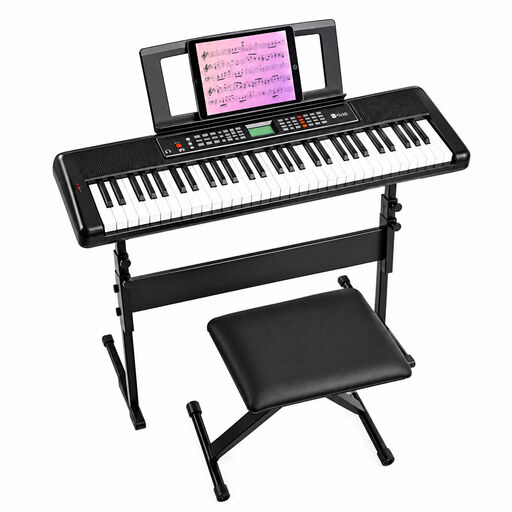
Digital keyboard piano set with stand and stool, 61 keys
This set could suit a compact practice space if your teacher confirms that the keyboard range is suitable for your lessons.
The product name lists a stand, stool and music rest. The product description mentions a headphone port and a three-level learning mode.
Joybuy
Frequently asked questions
Do I always need 88 keys to practise the waltz?
Not every waltz automatically requires the full range. If your lessons focus on piano technique and a full piano keyboard, an 88-key model gives you that option. If you’re considering an instrument with fewer keys, ask your teacher whether its range and keyboard are suitable for your lesson materials. For example, one Joybuy model listed as a digital piano has 61 keys.
How can I practise in a shared music room?
First, check the room’s rules and, if needed, use the headphone socket on a suitable model. VeiligheidNL recommends well-fitting headphones to keep out more background noise, so you don’t need to turn the volume up unnecessarily. Speakers may be needed when playing with others or getting feedback from a teacher.
What should I check when buying a portable piano?
Measure the space for the instrument and the complete playing setup, including the stand and room for the player. Yamaha lists the P-145 as 1.326 mm wide; this measurement doesn’t automatically include the space needed for the stand, player and accessories.
What if the piano I bought online doesn’t fit or breaks down prematurely?
According to ACM ConsuWijzer, online consumer purchases generally come with a statutory cooling-off period that ends 14 days after delivery, subject to applicable exceptions. Your statutory guarantee also depends on what you could reasonably expect from the product; if there’s a fault, the seller may need to offer an appropriate solution free of charge.
What should I check for electrical piano safety?
Check the seller’s product information and the markings on the specific model and power adapter. The Dutch government sets out safety requirements for electrical and electronic devices; the Government of the Netherlands states that electronic devices sold in the EU must carry a CE marking.


