
Vandaag of morgen in huis

Kwaliteit gegarandeerd

Welkomstaanbiedingen ontgrendelen: GRATIS bezorging | Tot 80% korting | Gratis 30 dagen JoyPlus-proefperiode
Download de app
A portable compressor fridge for your car is handy for long drives, camping, boating and working on the go. Unlike a standard cool box with ice packs, a compressor fridge can actively cool and freeze. However, not every model is suitable for every car, campervan or boat.
If you only consider capacity or a low price, you could run into practical problems. The fridge might not fit in your boot, its connection might not support 24V, or it could drain your battery faster than expected. Here are the main pitfalls and things to check.
A thermoelectric cool box typically cools to a few degrees below the ambient temperature. In hot weather, its contents may not stay as cool as you expect. A compressor fridge works differently: models in this category usually have an adjustable temperature range and, according to their product specifications, can also reach temperatures below zero.
So, check the stated temperature range. A model that can reach, for example, -18 °C to 15 °C can be used as both a fridge and a car freezer. A cool-and-warm box without a compressor is best suited to drinks, snacks and meals that don’t need to be frozen.
A 12V connection is standard in passenger cars. Lorries, some campervans and boats also use 24V. So check whether you need a 12V 24V car fridge. For use at a campsite or at home, a mains adapter is important. A model with a 220V and 12V cool box connection or 100-240V AC and 12/24V DC offers more flexibility.
Also check what’s actually included. Some compact cool boxes have an optional 220-240V adapter, while compressor models are more likely to include both cables.
A fridge can keep running when the engine is off. However, prolonged use without proper protection can put a strain on your vehicle’s battery. So, if possible, choose a portable fridge with battery protection and check whether it has several protection levels.
Low, medium and high settings give you more control. If your battery is older, or you’re using the fridge during a long stop, the higher protection setting is often the cautious choice. Cut-off thresholds vary by product, so always check the manual.
For one person on a day trip, 6 to 10 litres may be enough. For a couple or a weekend away, around 18 to 22 litres is more practical. Families, campervan owners and people travelling for several days may be better off looking at 35 to 50 litres.
Don’t just look at the capacity in litres. Also check:
A large campervan fridge isn’t automatically convenient if it’s difficult to move or blocks ventilation openings.
A compressor fridge is suitable if you want to chill and freeze food. Products with an adjustable range of, for example, -20 °C to 20 °C offer more options than a basic electric camping cool box.
A Peltier or semiconductor cooler can chill and warm, but usually doesn’t have a freezing function. Its stated cooling performance also depends on the ambient temperature. That may be enough for drinks on the back seat; for meat, frozen food or long-term storage, a compressor model makes more sense.
Check the stated power, ECO and MAX modes, and noise level. MAX is designed to cool things down faster; ECO can then help limit power consumption. Actual consumption depends on the ambient temperature, the temperature setting, ventilation and how often you open the lid.
Place the box on a stable surface and leave space around the ventilation openings. Some manufacturers recommend at least 10 centimetres. If the box has been tilted during transport, leave it upright before first use, following the instructions. This helps prevent problems caused by compressor oil shifting.
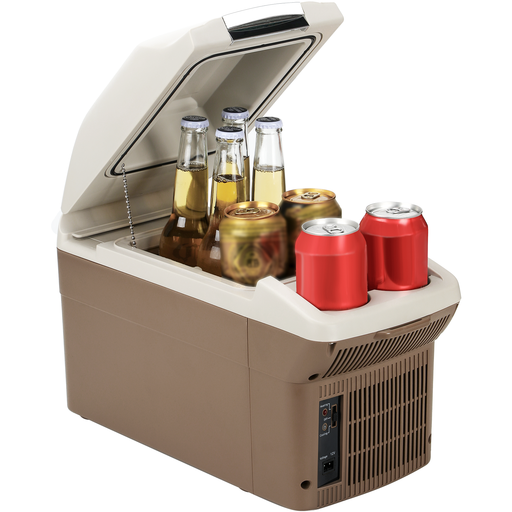
Why it suits this profile: Its compact capacity is ideal for drinks, fruit, sandwiches and snacks on your commute, day trips and short camping breaks.
The product specifications state that it uses 12V DC and can be used with an optional 220-240V adapter. Check that the adapter is included or available before planning to use the box at home or on a campsite.
Cooling and warming functions, around 40 dB according to the product specifications, two cup holders and a shoulder strap.

Why it suits this profile: Its 40-litre capacity, two zones and app control make it a good fit for longer campervan trips, family holidays and stays at a fixed campsite pitch.
The product specifications list 12/24V DC, 100-240V AC and three battery protection levels. Be sure to measure the available space first; this isn’t a small seat-side cooler.
Adjustable temperature range from -20 °C to 20 °C, ECO and MAX modes, LCD controls and a stated noise level below 42 dB.

Why it suits this profile: Its capacity is designed for families, lorry drivers, boat owners and anyone travelling for several days without access to a regular fridge.
The product specifications list 12/24V DC, 100-240V AC, ECO mode and three battery protection levels. Leave enough ventilation space around the compressor.
42-litre capacity, compressor cooling with a stated range of -18 °C to 15 °C, and suitable for use in a campervan, lorry, boat or at home.
We’ve put together a complete, up-to-date list of products that meet these strict selection criteria and the applicable European safety requirements.
Only if this is explicitly stated in the product specifications. Many models for cars, lorries, campervans and boats support 12V/24V DC. Don’t connect a 24V model to an unknown power source without checking, and use the cables supplied.
That depends on the battery’s capacity, the ambient temperature, the temperature setting, insulation and average power consumption. Battery protection switches the appliance off if the voltage gets too low, but it’s no substitute for a good battery or a separate power station. If you’re staying overnight without the engine running, a second battery or portable power supply is often more practical.
According to their product specifications, compressor camping fridges can often cool to much lower temperatures and sometimes freeze food. A thermoelectric electric cool box is usually lighter and simpler, but typically cools in relation to the ambient temperature. Choose according to how you’ll use it: drinks for a drive need less cooling than frozen food on a multi-day campervan trip.
