
Vandaag of morgen in huis

Kwaliteit gegarandeerd

Welkomstaanbiedingen ontgrendelen: GRATIS bezorging | Tot 80% korting | Gratis 30 dagen JoyPlus-proefperiode
Download de app
A portable compressor fridge for the car is ideal for road trips, camping, boating and long lorry drives. It keeps drinks, fresh produce and even frozen food cold without relying on ice.
That said, many models look similar. A low price can mean a small capacity, an unsuitable connection or poor protection for your vehicle’s battery. Below you’ll find what to check before you buy a 12V car fridge, a camper fridge or a compressor cool box for camping.
A thermoelectric cool box typically uses a fan and a heat sink. That type can be fine for keeping drinks cool on a short drive, but it usually can’t chill as effectively as a portable cool box with a compressor. The product details should clearly state which cooling system is used.
If you want to freeze items as well, look for an adjustable range below 0 °C. A model that only cools around ambient temperature isn’t a true car fridge freezer.
A 12V car fridge runs off a 12V socket, but that doesn’t mean every vehicle will run it for the same length of time. Check:
For a lorry fridge, 24V support is often relevant. In a car, only use the socket and fuse your vehicle is rated for.
A larger camping fridge gives you more storage, but also takes up more room and weighs more. Measure the available space in your car boot, motorhome, caravan or boat. Also check the lid can still open fully.
A capacity of 18 to 22 litres can be practical for one or two people. For a family or longer stays, 35 to 50 litres makes more sense. Larger models of 65 litres or more are better suited to a fixed camper or motorhome set-up.
A compressor fridge can often both chill and freeze according to its product specification. Models in this selection, for example, offer a range of about -18 °C to 15 °C or -20 °C to 20 °C. Do check whether the full range applies to a single compartment and whether there’s one or two zones.
A 12V 230V fridge is more versatile if you want to use it on the road and at a campsite, at home or in a garage. Check whether both the DC cable and the AC adapter are included.
A compressor needs space to dissipate heat. When positioning, keep at least the clearance specified in the manual; for the models mentioned that’s often about 10 cm around the ventilation openings. Don’t wedge the fridge between luggage and don’t cover the vents.
If you sleep in a motorhome or caravan, the stated noise level matters. Some models quote figures around 40 to 45 dB. That’s a product spec under certain conditions, not a guarantee the fridge will sound equally quiet in every situation.
A fridge with battery protection can cut power when the vehicle voltage drops. See whether you can choose low, medium and high protection. The highest setting leaves more margin for the starter battery, but may switch the fridge off sooner.
For extended use with the engine off, a separate leisure battery or power station is usually better than relying on the starter battery alone. Also make sure the 12V socket can supply enough current.
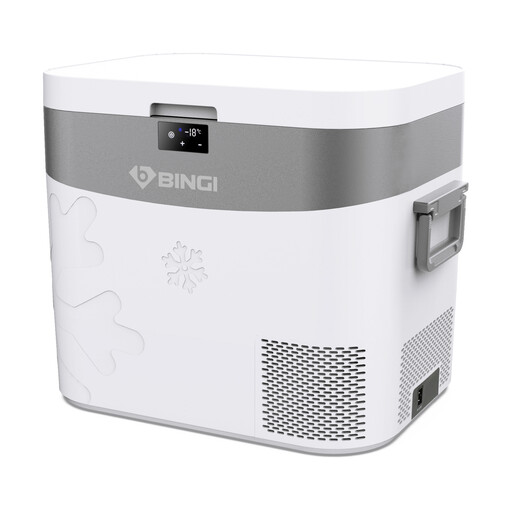
Why this fits the profile: The 22-litre capacity is ideal for short breaks, picnics and trips for two. The model supports 12V/24V DC and 100-240V AC.
The product description states a compressor, a range of -18 °C to 15 °C and built-in three-level protection.
Compact size, dual power inputs and adjustable cooling or freezing according to the product spec.
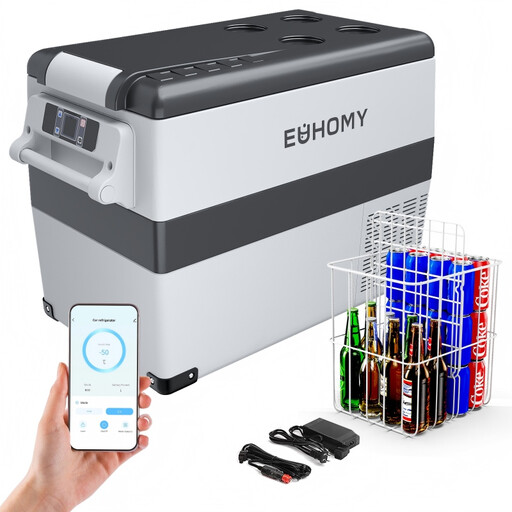
Why this fits the profile: The 40-litre capacity and separate storage sections suit families, motorhome owners and longer campsite stays.
The description lists 12/24V DC, 100-240V AC, ECO and MAX modes, and three levels of battery protection.
According to the product info: app control, LED lighting, a range of -20 °C to 20 °C and a stated noise level below 42 dB.
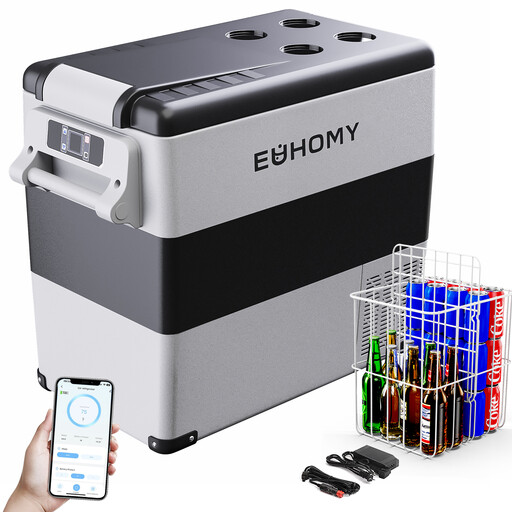
Why this fits the profile: This capacity targets users who carry lots of food, drink or fish in a motorhome, boat, lorry or on longer journeys.
The product description mentions two storage zones, 12/24V and AC adapters and adjustable low-voltage battery protection.
Two zones, app control, temperature setting from -20 °C to 20 °C and a stated average consumption of 45 W.
Place the fridge on a level surface during first use. If the unit was tilted during transport, leave it upright as the product instructions advise before switching on the compressor. That helps prevent issues caused by displaced compressor oil.
Also keep these points in mind:
A thermoelectric mini fridge of 4 to 9 litres can be enough for cans and lunch, but is usually not intended for freezer storage. For freezing and long-term cooling, a compressor cool box is the better fit.
We’ve put together a complete, up-to-date list of products that fully meet these strict selection criteria and the applicable European safety regulations.
Only if this is clearly stated in the product specifications. Models supporting both voltages are suitable for many cars, motorhomes, boats and lorries. Always check the included cable and the maximum load of your vehicle socket.
That depends on the wattage, the outside temperature, the set temperature and the battery capacity. A compressor also doesn’t run constantly at the same power. Use the built-in battery protection, but don’t see it as a replacement for a leisure battery or power station during prolonged use with the engine off.
Yes, if the model has the right connections and dimensions. A model with 12V/24V DC and 100-240V AC can be used on the road and on mains power. Before buying, check the ventilation clearance, the noise level, the weight and the available space in your camping, caravan or motorhome set-up.
