
Vandaag of morgen in huis

Kwaliteit gegarandeerd

Welkomstaanbiedingen ontgrendelen: GRATIS bezorging | Tot 80% korting | Gratis 30 dagen JoyPlus-proefperiode
Download de app
A portable compressor fridge for your car is handy for road trips, camping, campervan holidays or long-distance lorry driving. Unlike a standard cool box, a compressor fridge can often freeze food too. However, many models look similar, despite significant differences in their power supply, capacity and ease of use.
Here are some common pitfalls to watch out for:
A compressor car fridge uses an active cooling cycle, making it suitable for both cooling and freezing. Check the stated temperature range. Models on the market have specifications ranging from around -18 °C to 15 °C, and from -20 °C to 20 °C.
A portable fridge freezer is particularly useful for meat, fish, ice cream or frozen food. If you only need to keep drinks and lunch cool, a simpler electric cool box may be enough. Thermoelectric models such as the Cecotec and ICEROVER mini cool boxes are designed for compact transport and, according to their product descriptions, can also heat. They’re not the same as a compressor freezer.
Also check whether the temperature can be set digitally and whether the fridge has ECO and MAX modes. According to the product descriptions, MAX can cool the contents faster, while ECO is designed to maintain the set temperature using less power.
Don’t just look at the capacity in litres; check the shape of the interior too. A 22L cool box is relatively easy to fit in a car, while 40 to 50 litres gives you more room for supplies when travelling with several people. A larger model may be more practical for a campervan, boat or lorry, but measure the space available first.
A dual-zone design or removable divider lets you store different items separately. This can be useful for chilled and frozen food, but a dual-zone model often takes up more space.
For mobile use, 12V/24V DC connections are important. They let you use a 12V/24V cool box in many cars, campervans, lorries and boats. A model with a 100-240V AC or 230V connection can also be used at a campsite, at home or in a holiday home.
Check whether the right cables and adapters are included. Look for adjustable battery protection too, with settings such as low, medium and high. According to the product descriptions for various models, this feature switches the fridge off when the vehicle’s voltage gets too low. It can help reduce the risk of a flat battery, but it’s no substitute for a battery in good condition or a correctly fitted connection.
Place the fridge on a flat, stable surface and leave around 10 cm of clearance around the vents, unless the manual specifies otherwise. On a boat, take extra care with moisture and the electrical installation. Follow local installation regulations and use a residual current device where required.
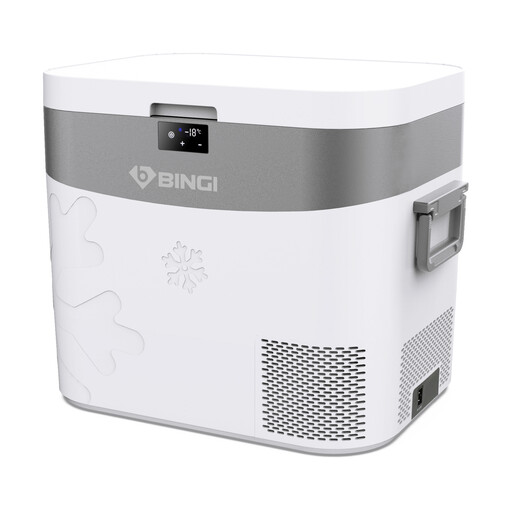
Why it suits this type of user: Its 22-litre capacity keeps the size manageable for a car, campervan or picnic. It supports 12V/24V DC and 100-240V AC, so you can also use it at a campsite or at home.
The product description specifies a compressor, an adjustable range of -18 °C to 15 °C and built-in battery protection with three levels.
22 litres, compressor cooling, 12V/24V DC, 100-240V AC, plus ECO and MAX modes according to the product information.
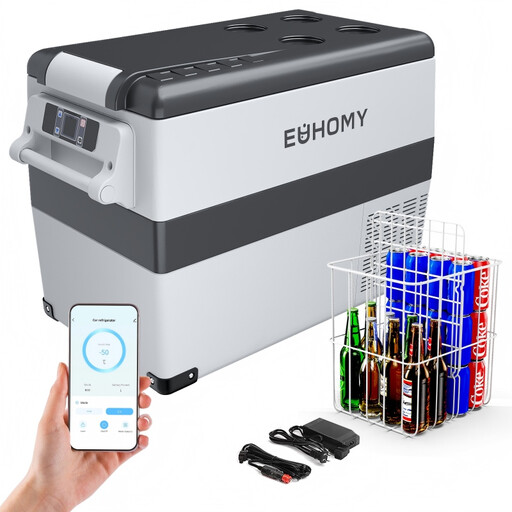
Why it suits this type of user: This model combines a 40-litre capacity with app control, an LCD panel, and both car and mains power. It’s a good fit for travellers who like to manage the temperature and power use in different ways.
The specifications list 12V/24V DC, 100-240V AC, three protection levels, and ECO and MAX modes. Before buying, check that the app works with your phone.
Temperature range of -20 °C to 20 °C according to the product description, app control and a stated noise level below 42 dB.
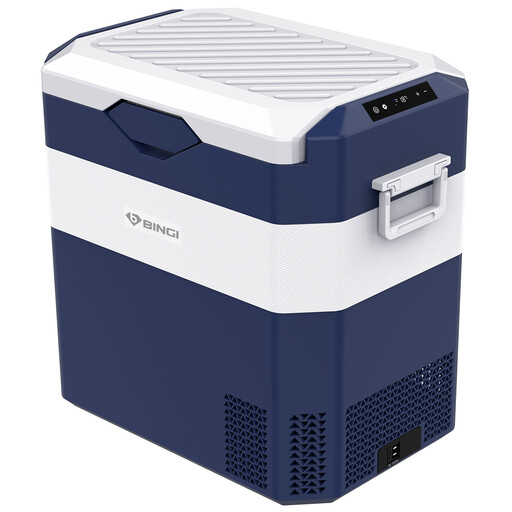
Why it suits this type of user: Its 42-litre capacity is aimed at families, longer campervan journeys and use on a boat or at a campsite. The 12V/24V and 100-240V connections offer flexibility away from the car.
The product information specifies a compressor, three protection levels and an ECO mode. This makes the relevant power features clear, rather than simply claiming that it cools.
42 litres, a range of -18 °C to 15 °C and, according to the product description, a noise level below 45 dB.
We’ve put together a complete, up-to-date list of products that meet these strict selection criteria and the applicable European safety regulations.
Yes, if the 12V socket remains active and the battery has enough capacity. Switch on the battery protection and check its setting. For extended use, a separate leisure battery or power station is often more practical than relying on the starter battery alone.
It depends on the model, ambient temperature, set temperature, insulation and mode selected. Some models state an average power consumption of around 45 W, but that doesn’t mean the compressor runs continuously at this level. So compare the stated consumption as well as the conditions in which you’ll use the fridge.
Its lifespan depends on ventilation, transport, moisture, cleaning and the quality of the power connection. Avoid leaving it tilted for long periods, keep the vents clear and store it somewhere dry. Before ordering, also check the warranty and contact details for the responsible seller or manufacturer.
