Vandaag of morgen in huis

Kwaliteit gegarandeerd

Welkomstaanbiedingen ontgrendelen: GRATIS bezorging | Tot 80% korting | Gratis 30 dagen JoyPlus-proefperiode
Download de app
A dead battery always strikes at the worst moment. Whether you're on the train, need to send an urgent email, or are navigating an unfamiliar city, you're stranded without power. A good portable charger is no longer a luxury—it's a necessity. However, the market is flooded with options, from compact power banks to high-performance car chargers.
This guide will help you make the right choice. We'll cover what to look for and highlight several popular options based on their specifications and real-world performance. This way, you can find the charging solution that fits your devices and lifestyle.
Before making a decision, it's helpful to consider three key factors. This ensures you choose a charger that truly meets your expectations.
Capacity, measured in milliampere-hours (mAh), determines how many times you can charge a device. For example, a 20,000mAh power bank can fully charge an average smartphone 4 to 5 times. For a day trip, 5,000 or 10,000 mAh is often sufficient.
Power output, measured in Watts (W), determines the charging speed. A higher wattage means faster charging. For modern devices like an iPhone and Samsung charger, a power output of 20W or more is recommended for fast charging. If you also want to charge your laptop, you'll need a laptop power bank with an output of at least 65W.
Check which ports the charger has. Most new devices use USB-C, making a USB-C charger a future-proof choice. Many chargers offer multiple ports (USB-C and USB-A) to charge several devices simultaneously.
Additionally, there are specific technologies like MagSafe. A MagSafe charger magnetically snaps onto recent iPhone models, offering a convenient, wireless charging experience.
Consider where you'll use the charger most often. For daily use in your bag, a compact, lightweight power bank is ideal. If you spend a lot of time on the road, a dedicated fast-charging car charger is a better investment. These models plug into your car's 12V socket and often provide very high power to charge multiple devices at once.
Below is a selection of portable chargers that stand out for their specifications and design.
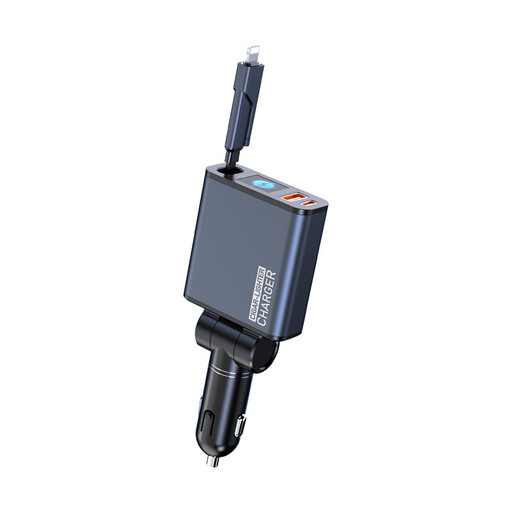
Why It Stands Out This car charger is designed for those who want maximum power and convenience in their vehicle. With a total output of 160W and three ports, it effortlessly charges a laptop, tablet, and phone simultaneously. The two 90 cm retractable cables keep your car neat and tidy.
Key Features
Who Is It For? Ideal for commuters, sales professionals, and families who spend a lot of time in the car. If you need to stay productive on the go and charge multiple devices at once, this is a highly practical solution.
View the ATSHARK K006S 160W Car Charger

Why It Stands Out This compact MagSafe charger from Anker is the definition of convenience. It magnetically snaps onto the back of your iPhone (12 series or newer) and starts charging instantly, no cables required. With 5,000 mAh, you have enough extra power to get through the day.
Key Features
Who Is It For? Perfect for iPhone users seeking a minimalist and convenient charging solution for daily use. Note: due to its size, it is not recommended for the iPhone 12/13 mini.
View the Anker 621 Magnetic Battery
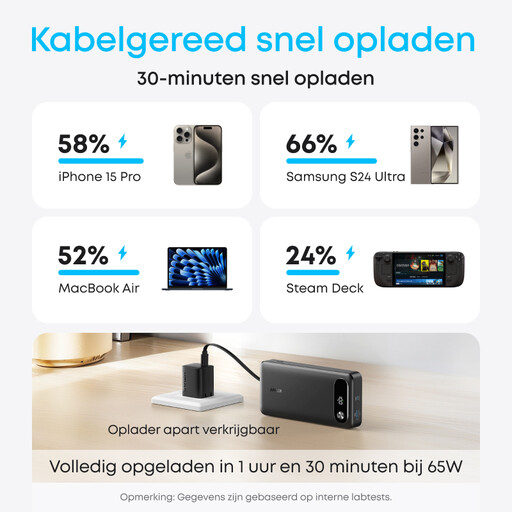
Why It Stands Out This 20,000mAh power bank combines high capacity with high power output and a built-in USB-C cable. With an 87W output, it's powerful enough to fast-charge a MacBook Pro, while the 20,000 mAh capacity ensures you have power for days. This is a true fast charger on the go.
Key Features
Who Is It For? The ideal travel companion for professionals, students, and anyone who relies on multiple devices, including a laptop. If you're looking for a reliable and powerful all-in-one solution, this is a strong contender.
View the Anker Power Bank (20K, 87W)
A good charger only performs at its best with the right cable. If you find you're missing a specific connection for your older devices or peripherals, like a printer or external hard drive, a USB-B cable might be the solution.
Browse our selection of cables here
1. How many times can a 20,000 mAh power bank charge my phone? This depends on your phone's battery capacity. An average smartphone has a 4,000-5,000 mAh battery. In practice, you can expect about 4 to 5 full charges, as some energy is always lost during the transfer process.
2. What is the difference between a regular charger and a fast charger? The difference lies in the power output (Wattage). A standard USB charger often delivers 5W to 12W. A fast charger provides a higher output, such as 20W or more, using protocols like Power Delivery (PD) or Quick Charge (QC). This allows a compatible device to be charged in a much shorter time, often up to 50% in 30 minutes.
3. Can I take a power bank on an airplane? Yes, power banks are allowed in your carry-on luggage, but not in your checked luggage. Most airlines have a limit of 100 Wh (watt-hours). A 20,000 mAh power bank (approximately 74 Wh) is well within this limit and is therefore not a problem. To be safe, always check the rules of your specific airline.