
Vandaag of morgen in huis

Kwaliteit gegarandeerd

Welkomstaanbiedingen ontgrendelen: GRATIS bezorging | Tot 80% korting | Gratis 30 dagen JoyPlus-proefperiode
Download de app
Do you drive a car you love, but whose dashboard takes you back to the early 2000s? You're not alone. Many reliable cars lack modern features like seamless navigation and music streaming. A full car stereo replacement is often expensive and complex. A portable CarPlay screen seems like the perfect solution, but the market is flooded with models that cause more frustration than convenience.
Before you invest in an infotainment upgrade, it's crucial to know the common pitfalls that can turn a handy gadget into a source of annoyance:
To avoid a bad purchase, focus on a few concrete specifications. These determine whether an external car screen is a valuable addition or a waste of money.
The core function is the connection to your smartphone. Look for a model that supports both wireless CarPlay and wireless Android Auto. This ensures maximum convenience without the hassle of cables. A crucial technical detail here is the Wi-Fi technology. A screen with dual-band Wi-Fi (2.4GHz/5GHz) offers a significantly more stable and faster connection than models with only a 2.4GHz band. This minimises the risk of stuttering and connection issues.
A larger screen isn't always better; it shouldn't obstruct your view of the road. A 10-inch car screen often provides a good balance between readability and a compact size. However, pay special attention to the resolution. A resolution of 1600 x 600 pixels or higher ensures a sharp and clear image, which is essential for reading maps. Also, check if the screen has adjustable brightness and a day/night mode to prevent glare in the dark.
The promise of a plug and play navigation system must be delivered. A good solution requires no technical knowledge. You attach the screen with a sturdy (adjustable) suction cup to your dashboard or windshield and connect the power cable to the cigarette lighter. Check if the device is suitable for both 12V and 24V systems. This makes the screen suitable not only for passenger cars but also for trucks and campers, demonstrating its versatility.
Based on the criteria above, we have selected a model that offers a solid balance between functionality, ease of use, and price.
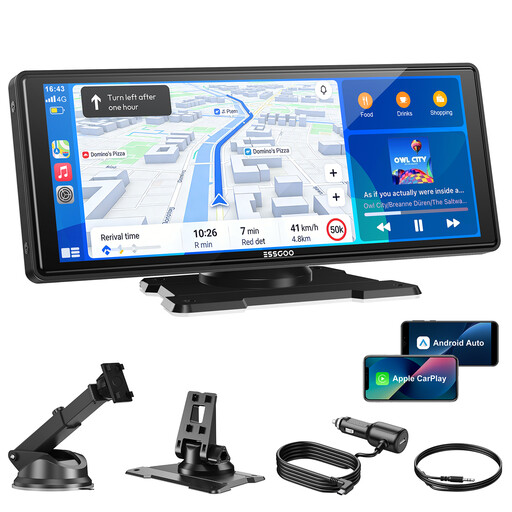
Why This Fits Their Persona: Ideal for drivers of older cars, lease drivers, or professionals (like truck drivers) seeking an affordable and non-permanent infotainment upgrade. It provides modern navigation, media, and hands-free calling without the high cost or complex installation of a new stereo.
This ESSGOO CarPlay display directly addresses the pitfalls with dual-band Wi-Fi for a stable wireless connection and a bright 10.26-inch HD screen (1600x600) that remains clearly readable. The mounting is designed for stability, and the power supply is compatible with 12V-24V.
Installation is completed in minutes. It offers four audio options (built-in speaker, Bluetooth, FM transmitter, AUX) for flexibility. Support for OTA (Over-The-Air) updates ensures the software stays current.
We have compiled a complete, real-time list of products that fully satisfy these strict selection criteria and UK safety regulations.
Essentially, yes. As long as your car has a standard 12V or 24V cigarette lighter socket for power, you can use a portable screen. Mounting is usually done with a suction cup on the dashboard or windshield, which is a universal solution that fits in almost any vehicle, from a small city car to a large truck.
Most portable screens offer multiple options to play audio through your car's sound system:
The lifespan depends on the build quality and software support. A well-built model can last for years. An important feature to look for is the availability of OTA (Over-The-Air) software updates. Manufacturers that regularly release updates to improve features and fix issues demonstrate long-term support for their product.
