
Vandaag of morgen in huis

Kwaliteit gegarandeerd

Welkomstaanbiedingen ontgrendelen: GRATIS bezorging | Tot 80% korting | Gratis 30 dagen JoyPlus-proefperiode
Download de app
A flat battery often strikes at the worst possible moment: in a car park, on the hard shoulder or just before setting off in your campervan. A portable car jump starter can be a practical way to get your car started. However, not every model is suitable for every car, petrol engine or diesel engine.
Look out for these three common pitfalls:
Read on to find out which specifications matter and which models suit different needs.
Most portable car jump starters are designed for 12V vehicles. Also check the maximum engine size supported for petrol and diesel engines. A diesel engine generally needs more starting current than a petrol engine of a similar size.
Don’t rely solely on a marketing claim such as 3000A or 8000A. Check:
A model listed in the specifications as suitable for engines up to 5 litres won’t necessarily be suitable for a large diesel engine. Match the battery booster to the vehicle you actually intend to use it with.
The jump leads need to be long enough to reach the battery terminals properly. Sturdy clamps with a reliable connection matter more than a big number on the packaging.
Useful safety features include:
Always use the supplied cables and follow the instructions. Connect the red clamp to the positive terminal and the black clamp to the negative terminal, unless the manufacturer specifies a different procedure. Keep each attempt to start the engine to just a few seconds. Wait before trying again.
A jump starter with a power bank can charge phones, tablets and other devices. A USB-C port is particularly useful if you already use USB-C chargers. Check the charging output: 15W, 65W and 100W are not the same.
A jump starter with a compressor combines a car jump starter with a tyre inflator. Check:
A high maximum pressure alone doesn’t guarantee a fast tyre inflator. For an ordinary car, a digital gauge, automatic shut-off and a suitable air hose are often more important than the highest PSI rating.
The recommendations below are based on the product specifications provided. Claims about starting power, charging time, operating temperature and safety features come from the product information supplied by the respective brands.

Why it suits this user: According to the product description, this 12V jump starter is designed for petrol engines up to 9 litres and diesel engines up to 7 litres. That makes it suitable for many cars, SUVs, campervans and boats.
The stated boost function is designed for batteries with very low voltage. Be sure to check engine compatibility first and charge the device according to the instructions.
3000A peak current, USB-C and USB outputs, an LED light and a stated storage life of 18 months.
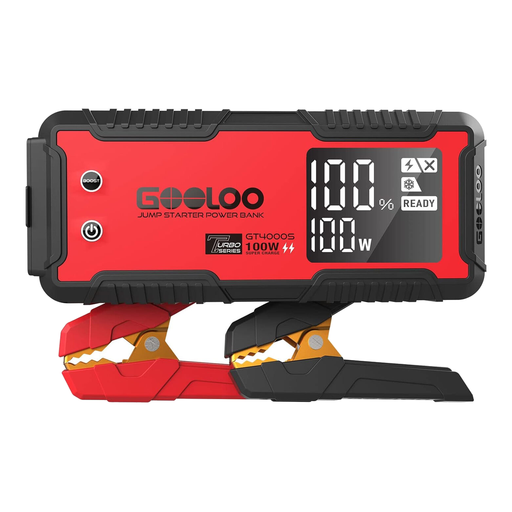
Why it suits this user: According to the product description, this model is aimed at larger vehicles, supporting petrol engines up to 12 litres and diesel engines up to 10 litres.
The specifications list ten safety technologies and an informative LED screen. This makes the connection status easier to see, but it’s still essential to connect the clamps correctly.
4000A peak current, 100W two-way charging, three USB ports and a 15V/10A socket for compatible accessories.
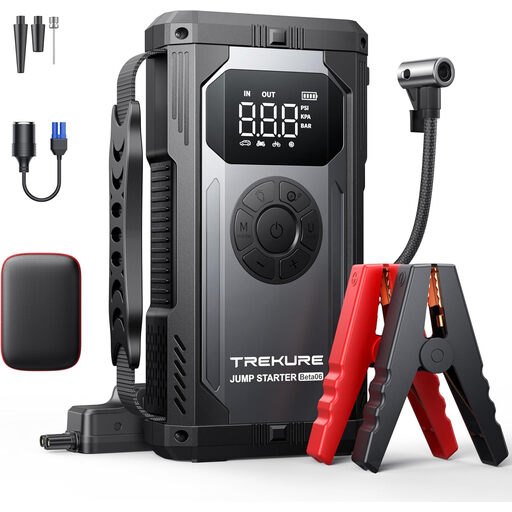
Why it suits this user: According to the product description, this model combines a car jump starter with a compressor rated at up to 150 PSI and a stated airflow of up to 35 litres per minute.
According to the product information, the digital gauge displays both the current and preset tyre pressure. Automatic shut-off helps prevent the pump from running for too long.
5500A peak current, a 23800mAh lithium-polymer battery, a 12V output, USB ports and three emergency light modes.
A portable battery charger or emergency car starter will only work reliably if its battery is sufficiently charged. Store the device in a dry place, away from prolonged exposure to heat. Before setting off, check:
Storage recommendations vary by model. According to the manufacturer, the GP3000 should be charged every 90 days, while other models state a longer standby time. Always follow the instructions for your specific lithium jump starter, and don’t use it if the battery is damaged, leaking or swollen.
We’ve put together a full, up-to-date list of products that meet these strict selection criteria and the applicable European safety regulations.
No. A 12V rating tells you the vehicle voltage, but not the maximum engine size or whether the jump starter is suitable for diesel engines. Always compare the product specifications with your car, campervan, boat or motorbike.
Its lifespan depends on how it’s charged, the temperature, storage conditions and how often it’s used. Charge the device according to the instructions, don’t leave it in extreme heat for long periods and check the charge level regularly.
It depends on how you’ll use it. If you only need to deal with a flat car battery, a compact model may be enough. If you also want to top up soft tyres, bicycle tyres or other inflatables, a built-in compressor with a digital pressure gauge and automatic shut-off could be useful.
