
Vandaag of morgen in huis

Kwaliteit gegarandeerd

Welkomstaanbiedingen ontgrendelen: GRATIS bezorging | Tot 80% korting | Gratis 30 dagen JoyPlus-proefperiode
Download de app
A flat car battery rarely happens at a convenient time. With a portable car jump starter, you may be able to get going again by yourself, without another car or immediate roadside assistance. However, many models seem more powerful and versatile than your vehicle actually needs.
The main pitfalls are a high amp rating without clear information about engine compatibility, a battery that loses charge in storage, and extra features you’re unlikely to use. Use the checks below to choose the right car battery booster, 12V jump starter or portable car battery charger.
A rating such as 3,000A, 4,000A or 7,000A sounds clear-cut, but the figure doesn’t tell you everything about compatibility. Always check:
A jump starter for small petrol engines isn’t automatically suitable for a large diesel engine. The stated starting capacity is a manufacturer’s product specification, not a guarantee that every battery or engine will start in all conditions.
A car power bank, LED light or compressor can be handy, but these features don’t replace suitable starting capacity. A model with a compressor is also heavier and uses more power when in use. So first decide whether you only need help starting your car, or whether you also want to inflate tyres and charge devices.
Lithium batteries gradually lose charge in storage. Product descriptions often recommend recharging the jump starter every few months. Store it somewhere dry, away from prolonged heat and preferably in the supplied case. An emergency car starter left unchecked in the boot for months may not have enough charge when you need it.
Choose a portable battery booster based on your vehicle, not just the price. A model with a lower stated engine capacity may be enough for a compact petrol car. For a van, campervan, SUV or diesel, extra headroom is useful.
Also check whether the product is suitable for:
Look for a smart cable set with protection against reverse polarity, short circuits, overheating and overloading. An indicator confirming a correct connection can help when attaching the clamps. However, you must still follow the instructions.
Generally, connect the red clamp to the positive terminal and the black clamp to the negative terminal or a suitable unpainted metal earth point, exactly as instructed in the manual. Don’t use a jump starter if the battery is visibly leaking, damaged or frozen.
A higher capacity can be useful if you also want to charge phones or other USB devices. Check the available ports, such as USB-A and USB-C, and whether a mains charger is included. Some models come with only a USB cable or a 12V car charger.
A jump starter with compressor should also have a clear pressure display, suitable nozzles and an automatic shut-off. Check the compressor’s maximum running time too, and allow the device to cool down between uses.

Why it suits this user: Weighing around 330g, this compact model is designed for drivers who want to keep a straightforward car jump starter in the glove compartment or boot. Its stated capacity is suitable for 12V petrol and diesel vehicles.
As well as a peak current of 1,200A, the product specifications list a starting current of 600A, an LCD display and a recommended charging time of around four hours.
12,800mAh according to the product information, USB output, LCD status display and three LED modes.
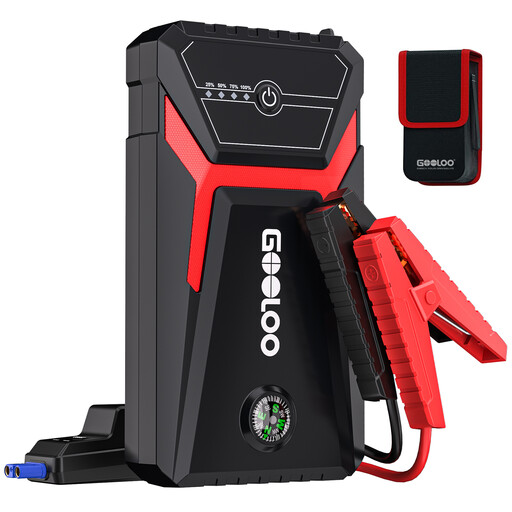
Why it suits this user: This model combines 12V jump-starting assistance with USB charging and, according to the product description, is designed for vehicles including cars, motorbikes, campervans and tractors.
Compatibility is clearly stated: up to 6.0 litres for petrol engines and 4.0 litres for diesel engines. The cable set lists ten safety features.
1,500A peak current, USB outputs, a 400-lumen light and a weight of around 0.878kg according to the product specifications.

Why it suits this user: A good fit if you want to check tyre pressure as well as have emergency starting assistance, for example on campervan trips, camping holidays or longer drives.
As well as a stated 4,500A, the product information lists an LCD screen, smart clamps and a compressor with automatic shut-off.
Up to 150 PSI, five inflation modes, four nozzles, a 500-lumen light and stated compatibility with engines up to 9.0 litres for petrol and 8.0 litres for diesel.
We’ve put together a complete, up-to-date list of products that meet these strict selection criteria and the applicable European safety regulations.
A jump starter is intended for emergencies. If your battery keeps going flat, have the battery, charging system and any current drain checked. A standard 12V battery charger may be more suitable for regular charging at home; compare the options on the category page.
Switch off the car, connect the red clamp to the positive terminal and the black clamp to the negative terminal or a suitable earth point. Wait for the smart cable to confirm the connection, then start the car as instructed in the manual. Don’t use the device if the battery is damaged, leaking or frozen.
How long it lasts depends on storage temperature, how often it’s charged and the number of starting attempts. Recharge the device after use and check it every few months. The lifespan of the internal lithium battery can vary by model and use.
That depends on the purchase price, how often you use it and your roadside assistance cover. A jump starter can be handy for drivers who travel often or visit remote places. However, it’s no substitute for assistance if you have a faulty alternator, damaged battery or another technical problem.
