
Vandaag of morgen in huis

Kwaliteit gegarandeerd

Welkomstaanbiedingen ontgrendelen: GRATIS bezorging | Tot 80% korting | Gratis 30 dagen JoyPlus-proefperiode
Download de app
A flat car battery always seems to happen at the worst time: on a cold morning, after a long day at work or on the way to the campsite. A portable car jump starter can get you going without relying on another car. But not every model is right for every engine or situation.
Watch out for these three common pitfalls:
Read on to find out which specifications to check and which type of car jump starter is right for you.
Most passenger cars use a 12V lead-acid battery. However, a 12V jump starter isn’t automatically suitable for every vehicle. Check the maximum engine size listed for petrol and diesel separately. Diesel engines generally need more starting power, especially in low temperatures.
Look for this information in the product description:
A jump starter for petrol and diesel may be suitable for several types of vehicle, but 24V systems found in some heavy lorries or buses are usually not supported. Always check your vehicle’s manual and specifications.
Manufacturers often quote a peak current, such as 1,200A, 2,000A or 4,000A. This is a technical figure for a short burst, not a guarantee that it will start every vehicle. Compare it with your engine size and battery type.
A powerful jump starter for an SUV, van or larger diesel engine will generally need a higher stated output than a model for a compact petrol car. For everyday use in a small car, a compact model rated at 800A to 1,500A may be enough, provided the product description confirms that it supports your vehicle.
Battery capacity also plays a part. A lithium jump starter with, for example, 10,000 or 20,000 mAh can also charge electronic devices, but its stated capacity doesn’t directly correspond to the starting energy available. Check both the capacity and the stated starting and peak current.
A good jump starter with jump leads should offer protection against:
Smart leads with an indicator light or display can help alert you to an incorrect connection. Also check that the clamps are sturdy, the leads are long enough and the casing is suitable for storage in a car.
Use a portable battery booster according to the instructions. In many cases, this means connecting the red clamp to the positive terminal and the black clamp to a suitable unpainted metal earth point, starting the engine briefly, then removing the clamps in the specified order. Don’t try to start the engine repeatedly without a pause, and don’t use a jump starter with a damaged or leaking battery.

Why it suits this type of buyer: This compact model is designed for drivers of cars, SUVs, motorbikes and boats who want a car battery jump starter to hand without taking up much boot space.
The product details list a peak current of 1,200A, a 12,800mAh lithium battery and support for 12V petrol and diesel vehicles separately. This makes it easier to compare the specifications with your vehicle.
Weighs 330 grams, LCD display, USB power bank function and three-mode LED light.
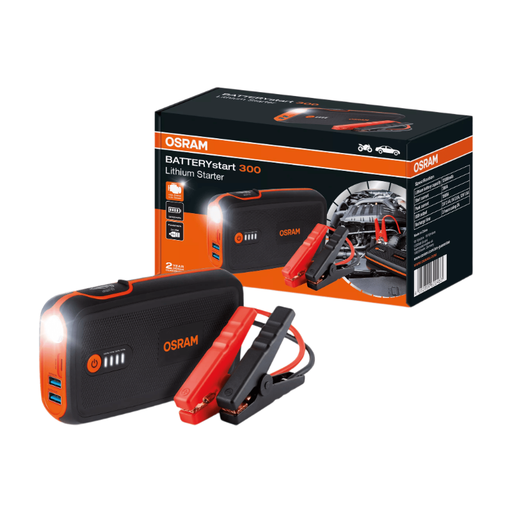
Why it suits this type of buyer: This model offers extra connection options for drivers who want to power a 12V cool box, tyre inflator or other accessory as well as jump-starting their car.
The product information lists a peak output of 2,000A, 12V operation and separate limits of 8L for petrol and 4L for diesel. Be sure to check these limits against your car’s engine.
12V output, two USB ports, LED light and a two-year manufacturer’s warranty, as stated on the product page.
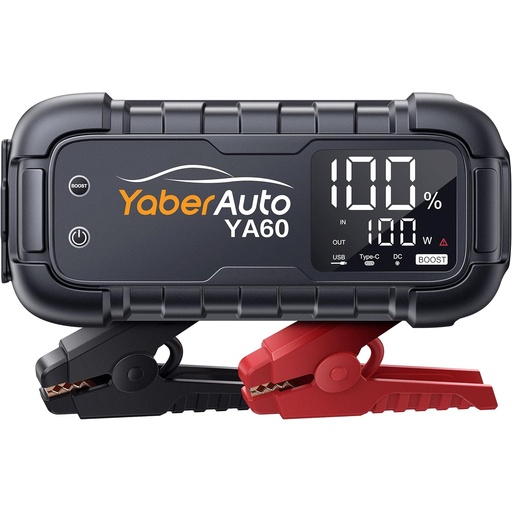
Why it suits this type of buyer: This model is aimed at drivers of larger vehicles, outdoor enthusiasts and anyone who wants to charge laptops, compressors or other devices too.
The product details specify 12V support, a peak current of 8,000A and limits of up to 12L for both petrol and diesel engines. With its higher capacity, it’s especially important to check the manual and compatibility before use.
65W USB-C charging, 150W DC output, 26,800mAh lithium polymer battery and a 600-lumen LED light, according to the product description.
We’ve put together a complete, up-to-date list of products that meet these strict selection criteria and the applicable European safety regulations.
A portable car jump starter only works if its internal battery has enough charge. Fully charge the device before using it for the first time, and check the charge level before setting off. It’s a good idea to recharge it after jump-starting a vehicle.
Store your car battery booster:
A lithium battery can lose capacity if stored for a long time. It’s more practical to check it regularly than to wait until you break down to test it.
No. The vehicle’s voltage must match, but engine size, fuel type and the condition of the battery matter too. A model for a compact petrol car isn’t automatically suitable for a heavy diesel or a 24V lorry.
Follow the manufacturer’s instructions. If you don’t use it often, it’s a good idea to check the charge level every few months. Recharge it after using it to jump-start a vehicle too.
Many models have USB ports and an LED light. Charging capacity varies by model. If you also want to use your jump starter with a phone, tablet or laptop, check the USB output, charging standard and any cables supplied.
