
Vandaag of morgen in huis

Kwaliteit gegarandeerd

Welkomstaanbiedingen ontgrendelen: GRATIS bezorging | Tot 80% korting | Gratis 30 dagen JoyPlus-proefperiode
Download de app
A flat car battery often strikes at the worst possible moment: on a cold morning, by the side of the motorway or at a campsite with no power socket. A portable car jump starter can be a practical alternative to jump leads. It uses its own lithium battery to temporarily start a vehicle with a 12V battery, without the need for a second car.
However, not every car battery booster is suitable for every vehicle. If you only look at a high amp rating or a large mAh figure, you could end up with a device that isn’t right for your engine, is too heavy to carry around every day or turns out to have insufficient charge after a few months.
A figure such as 2.000A or 4.000A catches the eye, but peak current is only one part of a jump starter’s performance. Also check:
A 12V jump starter for a small petrol engine has different requirements from a battery booster for a diesel van, motorhome or boat. 24V lorries and the high-voltage systems in electric cars are outside the scope of this product category.
A higher battery capacity can be useful for several starting attempts or charging phones. However, mAh alone doesn’t determine whether a device can start your car. The output current, cables, battery cells and electronics all play a part too.
So always compare capacity, peak current and compatible engine size together. A compact 12.800mAh model may be enough for a small car, while an SUV or diesel motorhome may need more headroom.
A good car jump starter should clearly indicate when the clamps are connected correctly. Look for features such as:
A lithium jump starter also needs to be checked regularly. Follow the manual for charging intervals; different products may recommend recharging after two to six months in storage, for example. Store the device somewhere dry, out of direct sunlight and not in an extremely hot car.
Start by checking your vehicle type and engine. Product information often gives separate limits, such as “up to 8,0 litres petrol” and “up to 6,0 litres diesel”. These are the brand’s stated compatibility figures, not a universal guarantee for every battery condition.
For motorbikes, quad bikes and smaller cars, a compact model is often easier to store. Vans, SUVs, motorhomes and boats usually need thicker cables, a higher stated starting current and enough physical space around the battery terminals.
Check whether the set comes with smart jump leads and whether the clamps are sturdy enough for the battery terminals. A display can show the remaining charge and warnings; a simple Ready indicator may be easier to read at a glance.
Always follow the manual. A typical sequence is:
A jump starter won’t fix a faulty battery. If your vehicle keeps needing a jump start, have the battery and charging system checked.
A jump starter with a power bank can charge a phone, GPS device or camera while you’re out and about. A USB-C port is handy for charging modern devices, while a 12V output may be suitable for certain tyre inflators or cool boxes. An LED light with an SOS or flashing mode can help if you break down in the dark, but it isn’t a substitute for a warning triangle or a safe place by the road.

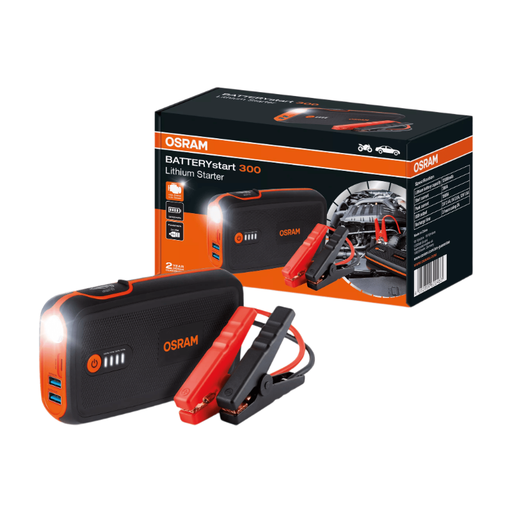
Why it suits this type of user: According to the product information, this model combines a compact design weighing around 330 grams with a 12.800mAh battery, an LCD display and a USB function. It’s a straightforward choice for drivers buying a portable jump starter for the first time.
The LCD display makes it easier to check the remaining charge. The stated 1.200A peak current and compatibility with 12V petrol and diesel vehicles are clearly listed.
Compact design, LCD display, 10W USB output and LED light with three modes.
Why it suits this type of user: According to the stated specifications, this model is designed for 12V vehicles with petrol engines up to 8 litres and diesel engines up to 4 litres. The 12V output is useful if you have additional accessories.
The stated compatibility makes it easy to check in advance whether your engine is within the product’s limits. Regular charging is still necessary, even with a stated capacity of 16.800mAh.
Two USB ports, 12V output, LED light and a stated peak output of 2.000A.
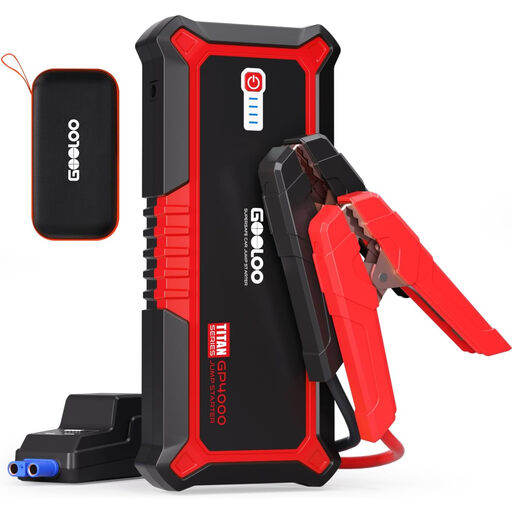
Why it suits this type of user: According to the product description, this car battery booster is designed for 12V vehicles, including motorhomes, pick-ups, tractors, vans and boats. It supports petrol and diesel engines up to 10 litres.
The BOOST function and the 10 stated safety features are designed for situations where a battery has very low voltage. Even so, check the manual and the condition of the battery before use.
Stated peak current of 4.000A, two USB outputs, USB-C and a built-in torch.
We’ve put together a full, up-to-date list of products that meet these strict selection criteria and the applicable European safety regulations.
No. Check the battery type, engine size and limits of the specific model. A product for 12V systems isn’t automatically suitable for 24V vehicles, high-voltage batteries or heavy diesel vehicles.
It depends on the model and how you use it. Many manufacturers recommend checking or charging a stored device every two to six months. Recharge it after using it to jump-start a vehicle, and store it according to the instructions.
A portable jump starter can serve as a jump lead alternative, as you don’t need a second car. However, it won’t fix a worn-out battery, faulty alternator or damaged wiring. If the problem keeps recurring, your vehicle will need attention.
