
Vandaag of morgen in huis

Kwaliteit gegarandeerd

Welkomstaanbiedingen ontgrendelen: GRATIS bezorging | Tot 80% korting | Gratis 30 dagen JoyPlus-proefperiode
Download de app
A flat 12V battery often strikes at the worst possible moment: on a cold morning, at the roadside, on a campsite or on a boat without shore power. A portable car jump starter can be a practical alternative to jump leads. You won’t need a second car, and many models also work as a power bank or torch.
However, a high amp rating doesn’t tell you everything. Some buyers focus only on the maximum peak current, overlook vehicle compatibility or leave the device in storage for months without charging it. Below, we cover the main pitfalls and what to check, followed by recommendations for different needs.
A rating such as 2,000 A, 4,000 A or 8,000 A sounds clear-cut, but manufacturers use different testing methods and conditions. The stated peak current is also not the same as a continuous starting current. So check the specified engine size for petrol and diesel too.
A 12V jump starter for a compact petrol car needs less capacity than a booster for a large diesel SUV, van or motorhome. Always check the product page and your vehicle handbook.
A car jump starter won’t necessarily work with every vehicle. Check:
Electric vehicles should not be started with an ordinary portable jump starter unless the vehicle and product instructions allow it. Always follow the vehicle handbook and product instructions.
A battery jump starter should come with clear connection instructions. Features such as reverse-polarity protection, short-circuit protection, overheat protection and spark-proof clamps can help if the clamps are connected incorrectly. However, they’re no substitute for careful use.
A lithium jump starter will slowly lose charge in storage. Check its charge level before you set off and recharge it periodically as instructed in the manual. Don’t leave it stored for long periods in direct sunlight, extreme heat or a damp boot.
Use the stated amperage as a point of comparison, but always consider it alongside the specified engine limit. For example, the GOOLOO GP2000 states that it supports engines up to 8.0 litres petrol and 6.0 litres diesel. According to the product information, the GOOLOO GT4000S supports engines up to 12.0 litres petrol and 10.0 litres diesel.
These figures are manufacturer claims. They don’t guarantee that every flat, damaged or frozen battery will start. If in doubt, follow your vehicle handbook and the product specifications.
A higher capacity in mAh can be useful if you also want to charge phones, tablets or a GPS device. However, the stated capacity doesn’t directly translate into a specific number of starts. Temperature, battery condition and engine size all play a part too.
Check the charging time and the cables supplied as well. Some models support USB-C fast charging. For example, the GT4000S states a charging capacity of up to 100 W and, according to the product information, comes with a 100W car charger. A simpler model with 18W QC3.0 is usually enough if you mainly want to charge a phone and the jump starter itself.
Sturdy clamps, a clear status indicator and a storage case make a car jump starter easier to use in an emergency. A display can show the remaining charge. An LED torch with SOS or flashing modes is useful if you break down in the dark, but check the brightness and available modes too.
If you’re looking for an alternative to jump leads, focus on cable quality, clear polarity warnings and instructions for low battery voltage. A boost button can help with batteries that fall below the normal detection threshold, but only use it if the manual says it’s safe to do so.
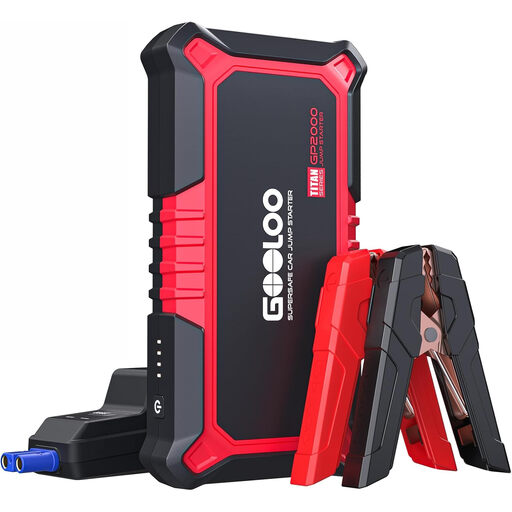
Why it suits this user: For drivers of a regular car, motorbike or mid-sized SUV, this model offers a straightforward combination of 2,000A peak current, USB outputs and a compact design.
The product information gives a clear limit of 8.0L petrol and 6.0L diesel. The smart cable also lists several safety features, including reverse-polarity and short-circuit protection.
According to the product details, the device weighs around 545 grams and has a 400-lumen torch with three modes.
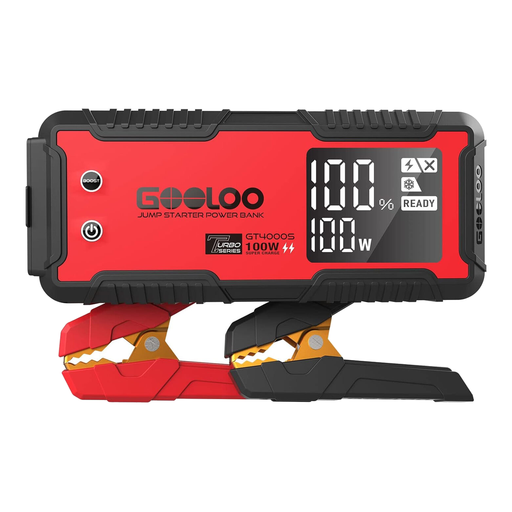
Why it suits this user: This model is designed for people with a large SUV, van, motorhome or boat, or several vehicles, who also value fast charging options.
The product page specifies engine limits of up to 12.0L petrol and 10.0L diesel, and mentions a display showing the device’s status.
According to the manufacturer, the model supports 100W two-way charging, three USB ports and a 15V/10A output for compatible devices.
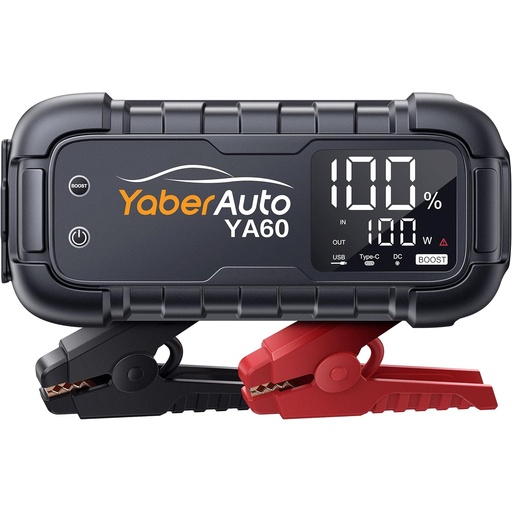
Why it suits this user: A good option for drivers of heavy vehicles, outdoor enthusiasts and anyone looking for a jump starter and power bank in one to charge several devices.
The product information states that it’s suitable for engines up to 12.0L diesel, and lists 10 safety features and a boost function for completely flat batteries. Always check these details against your own vehicle specifications.
According to the product page, the model offers 65W USB-C charging, a 150W DC output, 26,800mAh capacity and a 600-lumen torch.
We’ve put together a complete, up-to-date list of products that meet these strict selection criteria and comply with current European safety regulations.
Yes, provided the product information confirms that it supports your engine size and 12V system. Diesel cars often need more power to start than comparable petrol cars. So check the diesel rating carefully and connect the clamps according to the instructions.
Its lifespan depends on storage temperature, how often it’s charged and how it’s used. Fully charge the device before using it for the first time, then check its charge level every few months. Some manufacturers quote a longer standby period, but that doesn’t mean you can skip maintenance altogether.
A jump starter is a one-off purchase that you can also use as a power bank or torch. Jump leads are often cheaper, but you’ll need a second vehicle and someone willing to help. So compare more than just the purchase price: consider vehicle compatibility, charging options, warranty terms and maintenance too.
