
Vandaag of morgen in huis

Kwaliteit gegarandeerd

Welkomstaanbiedingen ontgrendelen: GRATIS bezorging | Tot 80% korting | Gratis 30 dagen JoyPlus-proefperiode
Download de app
A flat car battery usually happens at the worst possible time: on a cold morning, after a short journey or when the car has been sitting unused for a while. A portable car jump starter can get you back on the road without relying on another car or traditional jump leads.
However, not every car battery booster is suitable for every vehicle. Manufacturers often highlight high peak currents in product names, while the continuous starting current, engine size and safety features are less clearly stated. So before you buy, look out for the following pitfalls.
A peak current of, for example, 2000A or 8000A sounds impressive, but it does not tell you everything about real-world performance. Also check:
A powerful diesel jump starter may be unnecessarily large for a small petrol car. Conversely, a compact booster may not be powerful enough for a van, SUV or diesel engine.
Battery capacity is often shown in mAh, such as 10,000mAh or 26,800mAh. This mainly indicates how much energy is available for several starting attempts or charging devices. On its own, it does not determine whether a car can be started.
So look at the combination of capacity, peak current, starting current and vehicle compatibility. A car battery booster with a large power-bank function is useful for phones, but high capacity does not replace suitable, protected jump leads.
Incorrect connections can damage the booster or the vehicle. Check whether the portable jump starter lists protection against:
Always read the manual as well. Safety protection is no reason to connect the red and black clamps randomly. Also check that the battery is not leaking, bulging or visibly damaged. If it is, do not use a jump starter.
For an ordinary passenger car, the stated compatibility is particularly important. According to the product descriptions of some models, they support petrol engines up to 6.0 litres and diesel engines up to 3.0 or 4.0 litres. These are the manufacturer's product specifications and do not guarantee that every flat or faulty battery will start.
For a larger SUV, van or work vehicle, a model with a higher stated capacity and starting current may be more practical. Always check the car's handbook and the booster's specifications.
A power bank for your car is useful when you want to charge a smartphone, tablet or another USB device while on the road. Check the output, for example 5V/2A or 5V/3A. Laptops and devices with higher requirements need a USB-C or DC output.
Lithium batteries lose charge over time, even when the booster is not being used. Store the device somewhere dry and do not leave it in a very hot car for long periods. Check the charge level every few months and follow the manufacturer's maintenance instructions.
Heavy-duty clamps, insulated handles and sufficiently long cables make connecting the booster easier. A digital display can show the remaining charge or operating status. An LED emergency light with a constant light, SOS and flashing functions is useful if you break down in the dark, but it does not replace a warning triangle or a safe place at the roadside.
A built-in compressor can be useful for a low-pressure tyre. However, bear in mind the difference between temporarily inflating a tyre and repairing one: a jump starter with an air compressor will not fix a puncture.
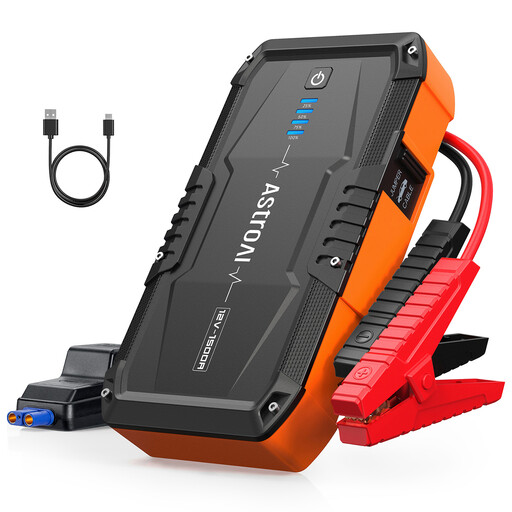
Why it suits this profile: This model combines a 1500A peak current with a compact design and features for everyday use. According to the product description, it is designed for 12V vehicles, petrol engines up to 6.0 litres and diesel engines up to 3.0 litres.
The product information lists several safety features, including protection against reverse polarity, short circuits, overcurrent and overcharging. Check the manual before use.
Compact design, three light modes and a USB power-bank function. The stated capacity is 37Wh.
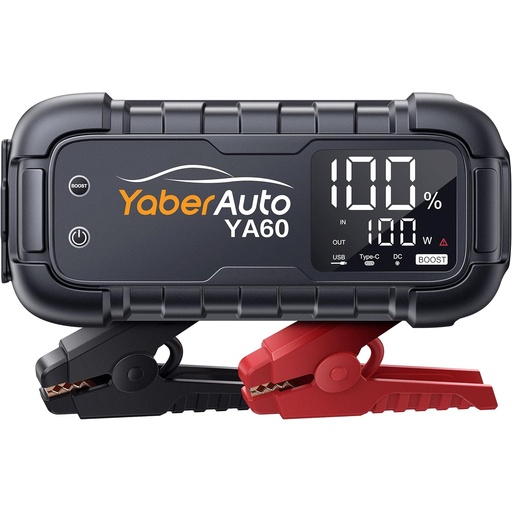
Why it suits this profile: The stated 26,800mAh lithium-polymer battery, USB-C 65W and 150W DC output are ideal for drivers who want to charge several devices on the road as well as start their vehicle.
The product description lists ten intelligent safety features and provides guidance on correct connections, short starting attempts and regular charging.
According to the product specifications, this model supports 12V petrol engines and diesel engines up to 12.0 litres. The LED light has three modes.
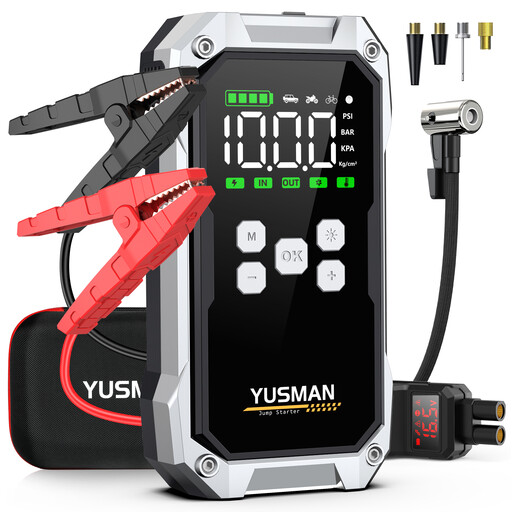
Why it suits this profile: This model is aimed at drivers of larger vehicles and users who want to carry a compressor for tyres, air beds or other inflatables.
The product information lists smart clamps with protection against short circuits, overheating, overload and reverse polarity. The booster must have more than 25% charge for a starting attempt.
According to the product description, this model offers a 5000A peak current, 21,800mAh capacity, an LED light and a compressor with a stated pressure of up to 150 PSI.
We've put together a complete, up-to-date list of products that fully meet these strict selection criteria and the applicable European safety regulations.
No. The result depends on the engine size, vehicle type, temperature, condition of the battery and the booster's specifications. A jump starter can support a flat battery, but it cannot repair a faulty battery or an electrical problem.
Service life varies depending on the battery type, use and storage. Charge the device according to the manual, store it somewhere dry and check the charge level regularly. Some product descriptions recommend recharging after several months in storage.
That depends on how you plan to use it. For long journeys, camping, caravans or working on location, a compressor can be useful. If you are simply looking for an emergency starter for a passenger car, a compact model with safe clamps, an LED emergency light and a USB output may be all you need.
