
Vandaag of morgen in huis

Kwaliteit gegarandeerd

Welkomstaanbiedingen ontgrendelen: GRATIS bezorging | Tot 80% korting | Gratis 30 dagen JoyPlus-proefperiode
Download de app
A portable car fridge is useful for long car journeys, camping holidays, working on site and travelling in a motorhome. However, these appliances vary considerably in cooling technology, capacity, power supply and ease of use. A compact mini fridge that works perfectly well for a few cans is not automatically suitable for frozen food or prolonged use in a motorhome.
The biggest purchasing mistakes usually stem from three misconceptions:
Below, we explain what to look out for and which models suit different situations.
A thermoelectric cooler uses an electric cooling element and fan. This type is generally compact and suitable for drinks, lunch and short journeys. However, the temperature depends on the surroundings. According to the product descriptions of various models, cooling performance can vary when the car or tent becomes very warm.
A compressor fridge works differently. According to its product description, the BINGI Portable Car Fridge Freezer 22L uses a compressor and has an adjustable range of -18 °C to 15 °C. This makes this type more suitable for prolonged cooling and freezing. Always check the stated temperature, capacity and ventilation space for each product.
If you mainly use the cool box for soft drinks and sandwiches, a thermoelectric mini fridge for car may be sufficient. For meat, frozen food or longer motorhome trips, a compressor fridge is the more obvious choice.
The capacity in litres does not tell you everything. An internal shelf, rounded corners and the shape of the cooling compartment all affect how much you can actually take with you.
As a practical guide:
Also check the external dimensions and placement. A model placed on the passenger seat must not obstruct visibility, controls or the seat belt. A portable camping fridge must also fit in the available storage space in your tent, caravan or motorhome.
You will usually connect a 12V cool box to the cigarette lighter or a 12V socket. Lorries and some motorhomes use 24V, so check whether this is explicitly supported.
For use at home, in the office or with a campsite hook-up, you need 100-240V AC or 220V. According to its product description, the BINGI fridge supports both 12V/24V DC and 100-240V AC. The ICEROVER PN-06 and PN-09 come with 12V power; according to the product information, a 220-240V adapter is optional. This difference can affect the total purchase price.
Also consider power consumption. Higher wattage can mean faster cooling, but it puts more strain on the battery. Some models have an ECO mode. According to its product description, the BINGI features three-stage battery protection that monitors the vehicle voltage. This is a function described by the manufacturer and is not a guarantee that every battery will remain sufficiently charged in all conditions.
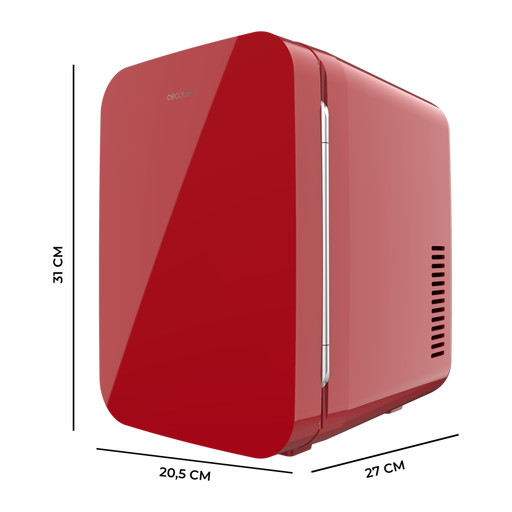
Why it suits this profile: The 6-litre capacity is easy to manage for everyday use in the car, at the office or on a short camping trip. The thermoelectric design is intended for drinks and small food items.
The specifications clearly state 6 litres, one shelf and no freezer compartment. You therefore avoid buying a larger fridge than you need and do not expect a freezer function that is not listed.
6-litre capacity, 12V connection, adjustable temperature control according to the product details and a compact design.

Why it suits this profile: The 22-litre capacity and stated range of -18 °C to 15 °C make it suitable for longer journeys, motorhome use, boat trips and carrying chilled or frozen products.
The product description mentions compressor cooling, 12V/24V DC and 100-240V AC. This makes the cooling technology and power options clearer than with a basic electric car cool box.
22-litre capacity, dual-power support, adjustable temperature range and an ECO and battery protection function described by the manufacturer.
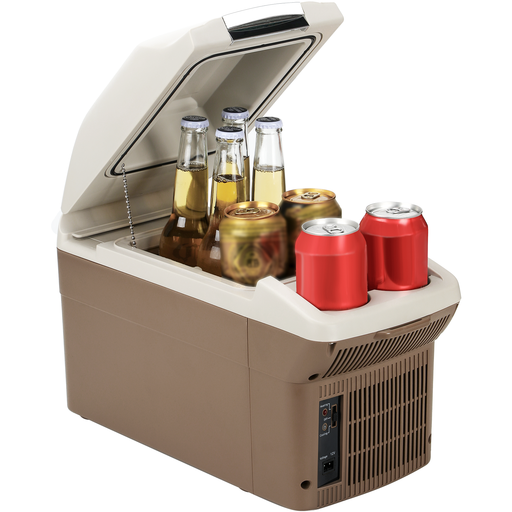
Why it suits this profile: This model is designed for car journeys, camping and travel where you want to cool drinks as well as keep meals warm temporarily.
The product information mentions cooling and heating functions, a shoulder strap and a 12V power supply. For use at home, check whether the optional 220-240V adapter is included.
9-litre capacity, two cup holders, shoulder strap and a stated noise level of approximately 40 dB according to the product description.
Place an electric car cool box on a flat, stable surface and keep the ventilation openings clear. According to the instructions for use, the BINGI model requires at least 10 cm of clearance around the ventilation openings. Do not place a cool box in direct water or rain, and check that the cables and plugs are suitable for the connection being used.
For a cool box with a heating function, bear in mind that keeping food warm is not the same as storing it safely for a prolonged period. Follow the product’s temperature and usage instructions, and do not leave perishable food in the cool box for longer than necessary.
We have put together a complete, up-to-date list of products that fully meet these strict selection criteria and the applicable European safety regulations.
That depends on the model. A 12V/220V mini fridge will usually list both connection options explicitly in its specifications. Some models include the 12V cable, while an AC adapter must be purchased separately. Check this before ordering.
The operating time depends on battery capacity, ambient temperature, cooling technology and power consumption. Do not leave a cool box running unattended for a prolonged period on a standard starter battery. A model with battery protection can reduce the risk of completely discharging the battery, but it is not a substitute for a separate leisure or camping battery.
Not always, but a compressor is the usual technology for an adjustable freezing range in portable models. Check the product details for the stated temperature range and see whether a freezer function is actually mentioned. A thermoelectric mini fridge is generally intended for cooling and sometimes keeping food warm, not for deep-freezing.
