
Vandaag of morgen in huis

Kwaliteit gegarandeerd

Welkomstaanbiedingen ontgrendelen: GRATIS bezorging | Tot 80% korting | Gratis 30 dagen JoyPlus-proefperiode
Download de app
A portable car fridge is useful for road trips, camping holidays, long drives and use in a campervan, boat or lorry. However, these appliances vary considerably. A compact electric cool box may be suitable for drinks, while a compressor cool box can also work as a car freezer.
Choosing the wrong one can lead to disappointment: not enough space, inadequate cooling in hot weather or a flat starter battery. Use the points below to compare models based on practical specifications rather than marketing claims.
A thermoelectric cool box usually lowers the temperature relative to the surrounding air. When it’s hot outside, the contents may not get as cold as you expect. A model listed as cooling to around 4 °C isn’t automatically suitable for freezing food.
If you want to store ice, meat or frozen food, choose a compressor cool box with an adjustable temperature range below 0 °C. Always check the stated temperature range and bear in mind that performance can depend on the ambient temperature, ventilation and how often you open the lid.
A 40-litre capacity sounds generous, but a dual-zone model may have internal dividers, baskets and technical components that take up space. So, as well as the capacity, check:
For a car or a short picnic, 6 to 10 litres may be enough. For a campervan, boat or longer trip, 18 to 40 litres may be more practical. Larger models of 65 litres or more are mainly worth considering if you have enough permanent storage space.
A 12V car fridge doesn’t work in the same way as an appliance for home use. Check whether the fridge runs on 12V DC only or also supports 24V DC. A 12V/24V fridge offers greater flexibility for lorries, campervans and boats. If you also want to use it at home or on a campsite with a mains connection, you’ll need AC support too.
A cool box with battery protection can cut off the power if the vehicle battery voltage gets too low. This reduces the risk of a flat battery, but doesn’t replace proper checks of the wiring, fuse and battery condition. Also check whether the protection can be set to low, medium or high.
A compressor works in a similar way to the cooling technology in a household fridge. According to the stated product specifications, some compressor models can both cool and freeze, for example from around -18 °C to 15 °C or from -20 °C to 20 °C. This makes them suitable as a portable fridge freezer, camping fridge or campervan fridge.
A thermoelectric electric cool box is usually lighter and simpler. According to the product information, ICEROVER models can both cool and keep food warm, but they aren’t designed to work as a full freezer. This makes them suitable for drinks, lunch, snacks and short journeys.
An AC/DC cool box can be connected to a 12V or 24V outlet, as well as to a mains socket using a supplied or optional adapter. Check carefully what’s included in the box. For some compact models, the 220–240V adapter is sold separately.
Actual energy consumption depends on the temperature setting, outside temperature, ventilation and how the compressor is used. ECO mode is designed to maintain the set temperature using less energy; MAX mode is designed for faster cooling. Product listings for some EUHOMY models state an average consumption of around 45 watts, but this isn’t a fixed figure for every situation.
A stated noise level of around 40 to 42 dB may be worth considering if the fridge will be next to your bed in a campervan. Place the appliance on a flat, stable surface and keep the ventilation openings clear. The product information for several models recommends leaving at least 10 cm of space around the vents.
After transport or prolonged tilting, it’s a good idea to leave a compressor fridge upright before switching it on. The exact waiting time varies by model; some product instructions recommend 6 to 12 hours. Also, don’t use a fridge for a boat or lorry without protection from rain or splashing water. Follow the manual and, on a boat, use a suitably protected electrical circuit.
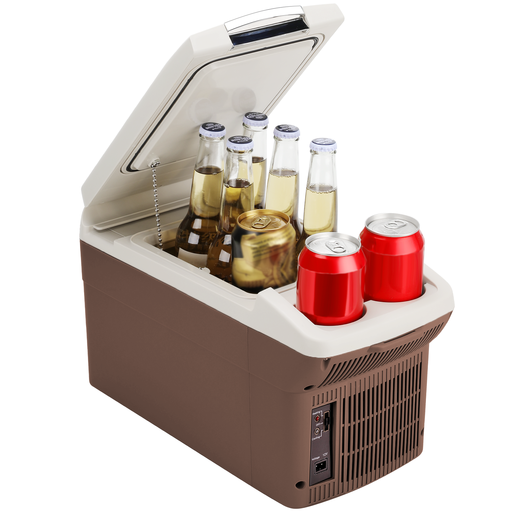
Why it suits this type of user: Compact enough for the passenger seat and suitable for drinks, snacks and lunch on daily drives or short road trips.
The product information clearly states that it uses a thermoelectric cooling system and has a cooling range of around 4 °C. So don’t expect it to freeze food.
12V connection, around 40 dB according to the product listing, and an integrated seatbelt slot.
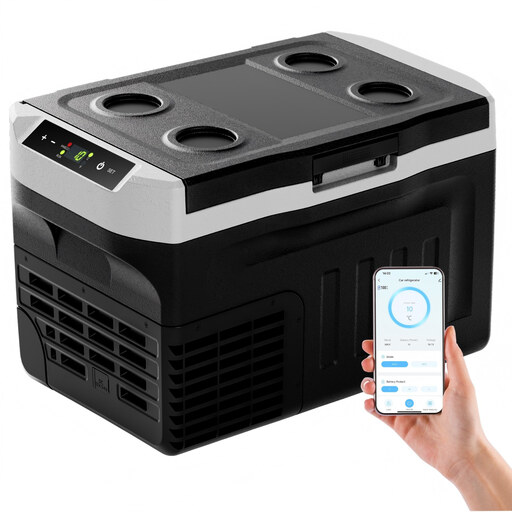
Why it suits this type of user: A mid-sized option for campers and campervan owners who want to combine cooling and freezing with app control.
The stated temperature setting ranges from -20 °C to 20 °C. ECO and MAX modes are also listed, along with three battery protection levels.
21-litre capacity, 12/24V DC and 220–240V AC adapters according to the product listing, plus Bluetooth control.
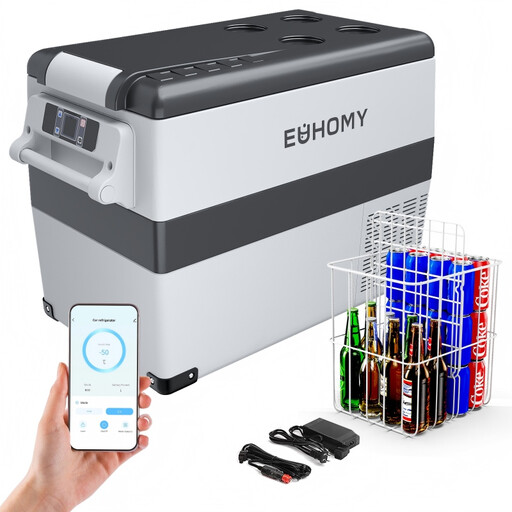
Why it suits this type of user: Designed for longer trips, campervans, lorries, boats and families taking enough chilled supplies for several days.
The stated 12/24V and 100–240V connections reduce reliance on a single power source. The listing also mentions three battery protection levels.
40-litre capacity, two storage zones and a stated temperature range of -20 °C to 20 °C.
We’ve put together a complete, up-to-date list of products that meet these strict selection criteria and the applicable European safety regulations.
It depends on the battery, energy consumption and battery protection. A starter battery isn’t designed to provide an unlimited power supply when the engine is off. If you’re parked for a long time, it’s better to use a mains connection, campsite power supply or portable power station. Set the battery protection according to the manual.
The cost depends on the power rating, how long you use it, the outside temperature and your electricity tariff. A stated power rating of, for example, 45 watts doesn’t mean the appliance uses 45 watts continuously; the compressor switches on and off. ECO mode can help reduce energy consumption while maintaining the temperature.
Its lifespan is affected by ventilation, transport, moisture, cleaning and how the power supply is used. Place the fridge on a stable surface, keep the vents clear, avoid tilting it unnecessarily and clean the inside after unplugging it. Before buying, also check the warranty, technical support and availability of accessories such as adapters.
