
Vandaag of morgen in huis

Kwaliteit gegarandeerd

Welkomstaanbiedingen ontgrendelen: GRATIS bezorging | Tot 80% korting | Gratis 30 dagen JoyPlus-proefperiode
Download de app
A portable car fridge is useful for road trips, camping holidays, long journeys and stays in a motorhome or boat. However, many models look similar even though there can be major differences in cooling technology, power supply and capacity. A compact electric cool box may be perfectly suitable for drinks, but unsuitable for frozen food. Conversely, a compressor cool box takes up more space and requires stable positioning and good ventilation.
So don’t look only at the capacity or an attractive price. Pay particular attention to these common pitfalls.
Not every 12V car fridge is a freezer. Thermoelectric models usually cool relative to the ambient temperature. In hot weather, the actual internal temperature may therefore be higher than expected. Some models can also heat food, which is useful for meals, but they are not designed for storing frozen products over long periods.
A compressor cool box works differently. According to the product specifications, it can often reach a set temperature below zero. So check the stated temperature range rather than relying only on terms such as “deep cooling” or “portable freezer”. A model with a range of, for example, -18 °C to 15 °C serves a different purpose from a cool box that only cools to around 4 °C below the ambient temperature.
A 12V 24V cool box may be suitable for a car, lorry, motorhome or boat, but first check which connection your vehicle has. 12V is widely used in cars, while 24V is more common in lorries and certain larger vehicles.
An important detail is battery protection. Built-in multi-stage protection can switch off the power when the voltage becomes too low. This helps reduce the risk of draining the starter battery, but it does not replace good planning. For prolonged use with the engine switched off, a separate leisure battery, power station or permanent motorhome installation is often more suitable.
Also check whether a 100-240V AC adapter is included. With some compact models, the mains adapter is optional. This matters if you want to use the cool box at a campsite, at home or in a motorhome connected to mains power.
A compressor releases heat through ventilation openings. Do not place the cool box tightly against a wall, beneath luggage or inside an enclosed box. Various product specifications recommend leaving approximately 10 cm of clearance around the ventilation openings. Without sufficient air circulation, the compressor may become hotter and work less efficiently.
Also consider positioning during transport. According to the instructions for various compressor models, it is advisable to leave an appliance that has been laid on its side or tilted significantly standing upright for several hours before switching it on. This allows the compressor oil to redistribute.
A temperature display, ECO mode and MAX mode are practical features. According to information provided by brands, MAX modes can cool more quickly, while ECO modes can help limit energy consumption. Treat these as features of the appliance; actual performance also depends on the ambient temperature, load, ventilation and power supply.
Choose the capacity based on how you intend to use it:
A removable basket or divider makes loading more organised. With models featuring two zones, you can keep chilled and frozen products separate. However, check whether both zones can be adjusted independently; this is not standard on every model.
A stated noise level of approximately 40 to 45 dB can be comfortable when sleeping in a motorhome or travelling in a quiet car. Power consumption is often stated in watts, for example around 45W for certain compressor models. Actual consumption varies according to the temperature setting and surrounding conditions.
Measure the available space beforehand. Don’t just consider the length and width, but also the lid height, handles and ventilation side. In a car, a securing option or non-slip base is useful. On a boat, the electrical circuit must be suitably protected; BINGI’s product information, for example, advises using residual-current protection when the appliance is used on a boat.
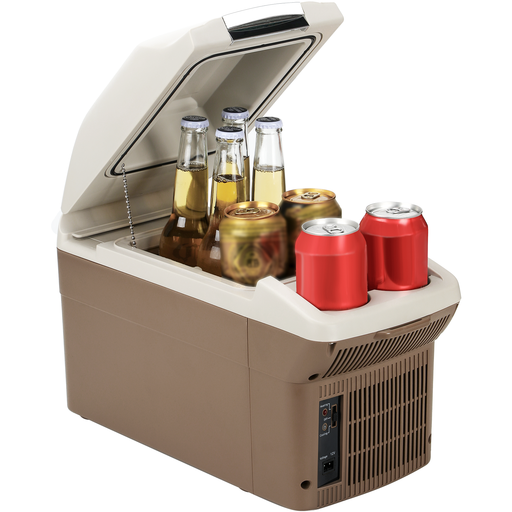
Why it suits this profile: The compact capacity and passenger-seat design make it suitable for short journeys, picnics and everyday use in the car. According to the product description, this model offers both cooling and heating.
The stated 12V connection makes it clear that this is primarily a car-based solution. According to the description, an optional adapter is required for use with 220-240V.
9L capacity, carrying strap, two cup holders and a stated noise level of approximately 40 dB.

Why it suits this profile: This model is aimed at users who want to combine capacity, freezer functionality and convenient controls for use in a motorhome, boat, lorry or on longer camping trips.
The specifications list a compressor, -20 °C to 20 °C, ECO and MAX modes, and three levels of battery protection. This makes the distinction from a basic thermoelectric cool box clearer.
40L capacity, 12/24V DC and 100-240V AC, app control and a stated noise level below 42 dB.

Why it suits this profile: The 35L version with two baskets, divider, handles and wheels is practical for a motorhome, caravan, boat or large camping set-up.
The product information lists 12/24V DC, 220-240V AC, three protection levels and a compressor range of -20 °C to 20 °C. However, its dimensions mean that sufficient luggage space is required.
Two storage zones, two baskets, wheels, app control and ECO/MAX modes for different usage scenarios.
We have put together a complete, up-to-date list of products that fully meet these strict selection criteria and the applicable European safety regulations.
For a caravan or motorhome, also check the available storage space, fuse and cable diameter. A large fridge designed for campervan use will not automatically be compatible with every leisure battery. For a boat, moisture protection and suitable residual-current protection are also important.
This may be technically possible, but operating time depends on the vehicle battery, set temperature, outside temperature and battery protection. For a night without the engine running, a separate leisure battery or power station is usually more practical than relying solely on the starter battery.
Consumption is determined by the power drawn and how often the compressor switches on. A model that uses approximately 45W according to its product specifications will not consume exactly 45W continuously: insulation, the load and ambient temperature all affect how long it runs. ECO mode can help limit consumption while maintaining the temperature, but always check the product’s own specifications.
Not without checking first. Look at the voltage of the connection, the fuse and the available space. A model supporting both 12V and 24V is more versatile for cars, lorries and boats, while a model supporting only 12V is mainly intended for cars. Also check whether the required AC adapter is included if you want to use the cool box indoors as well.
