
Vandaag of morgen in huis

Kwaliteit gegarandeerd

Welkomstaanbiedingen ontgrendelen: GRATIS bezorging | Tot 80% korting | Gratis 30 dagen JoyPlus-proefperiode
Download de app
A portable car fridge is handy on a road trip, camping holiday, boat trip or long lorry journey. However, not every model is suited to the same situation. A small electric cool box may be ideal for keeping drinks cool on a day trip, while a compressor cool box is a better choice if you need to store food for several days or freeze items.
The biggest buying mistakes usually come down to three misunderstandings:
A compressor car cool box uses active cooling technology and usually has an adjustable temperature range. According to their product specifications, some models can reach temperatures below zero, making them a portable fridge freezer or portable freezer.
This type is suited to:
Check the stated temperature range. A model with a range of -18 °C to 15 °C offers different capabilities from an electric cool box that can only cool a few degrees below the ambient temperature.
A thermoelectric cool box is often more compact and straightforward. Models in this category can usually cool and warm, but they aren’t designed to work as fully fledged freezers. The actual temperature depends on the surroundings, ventilation and the starting temperature of the contents.
A 12V model may be enough for a day out, your commute or a short picnic. For longer-term storage, a compressor cool box is usually the more practical choice.
A 12V/24V fridge is suitable for many cars, campervans, lorries and boats. Check which cables and adapters are included. 100-240V AC is useful for use at a campsite or at home. A model with both DC and AC connections can be used in a vehicle, at a campsite or at home.
Also look at:
A low wattage doesn’t automatically mean low overall energy consumption. A compressor switches on and off periodically. Energy use is affected by the ambient temperature, the temperature setting and the ECO or MAX mode selected.
For one or two people, 6 to 10 litres may be enough for drinks, lunch and snacks. A capacity of 18 to 22 litres gives you more room for a weekend trip. Models from 35 litres upwards are more suitable for families, campervan use or longer journeys.
Don’t just check the capacity in litres. Also consider:
A cool box for a boat or camper also needs to sit securely, with enough ventilation space all around it.
Compressor cool boxes make noise from the compressor and fan. Some models are listed in product specifications as producing around 40 to 42 dB. This is worth bearing in mind if the appliance will be running overnight in a small campervan or cab.
Keep the ventilation openings clear. The BINGI model specifies at least 10 cm of clearance around the ventilation openings. Don’t place a fridge right up against a wall, under a blanket or in an enclosed cupboard. If the appliance has been tilted during transport, follow the manufacturer’s instructions and leave it upright before use.
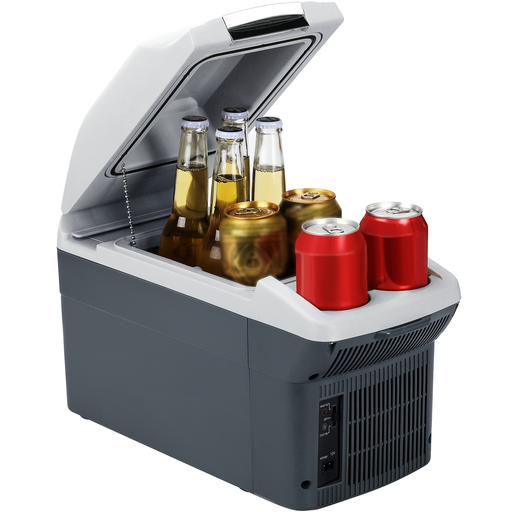
Why it suits this type of user: The 9-litre capacity and 12V connection are handy for short car journeys, picnics and everyday use on the go.
The product description clearly states that it can both cool and warm. This helps avoid confusion with a compressor freezer, as long as you use the model for short journeys.
12V DC, around 40 dB according to the product information, a carry strap and two cup holders.

Why it suits this type of user: This model combines a 22-litre capacity with use in a car, campervan, lorry, boat or with mains power.
The stated temperature range is -18 °C to 15 °C. The product also lists 12/24V DC, 100-240V AC and a battery protection system.
Compressor cooling, a 22-litre capacity and an adjustable range for chilling or freezing.

Why it suits this type of user: The 40-litre layout is designed for longer trips in a campervan, caravan, lorry, boat or with larger camping gear.
The specifications list two storage compartments, 12/24V DC, 100-240V AC and three levels of battery protection.
Temperature range of -20 °C to 20 °C according to the product information, plus ECO and MAX modes and app control.
We’ve put together a complete, up-to-date list of products that meet these strict selection criteria and the applicable European safety regulations.
That depends on the battery, power consumption and the model’s battery protection. Ideally, choose a fridge with adjustable protection and check the manual. If you’ll be using it for a long time with the engine switched off, a separate power station or mains connection may be more practical.
Power consumption varies depending on the compressor, outside temperature, settings and insulation. Product information for some EUHOMY models gives a figure of around 45 watts while running, but this isn’t a guaranteed average daily consumption. ECO mode can help reduce energy use once the desired temperature has been reached.
Yes, as long as the supply voltage, dimensions and ventilation are suitable for the installation. Check whether the model supports 12V or 24V, make sure it is positioned securely and keep the ventilation openings clear. On a boat, the electrical installation must also be suitably protected in line with the manufacturer’s instructions.
