
Vandaag of morgen in huis

Kwaliteit gegarandeerd

Welkomstaanbiedingen ontgrendelen: GRATIS bezorging | Tot 80% korting | Gratis 30 dagen JoyPlus-proefperiode
Download de app
A portable car fridge is handy for road trips, camping, work journeys and longer stays in a campervan or boat. Yet many models look similar, even though their cooling technology, power consumption and capacity can vary considerably. A small electric cool box, for example, may be suitable for drinks cans, but not necessarily for frozen food.
Joybuy Product Recommendation Officer helps you compare the most important specifications. That way, you can choose a 12V car fridge, a compressor cool box for your campervan or a compact model for occasional use without relying on marketing claims alone.
A thermoelectric cool box uses a fan and semiconductor technology. Its actual temperature also depends on the ambient temperature. This type is practical for drinks and lunch, but is generally less suitable as a car freezer.
A compressor fridge works differently. According to the stated product specifications, its compressor can reach below-zero temperatures. This makes it a more suitable choice for meat, fish or frozen food on longer journeys.
The exterior dimensions, layout and insulation all affect how much you can actually take with you. A 40-litre model with two compartments may be more practical than one large open space. Check whether it comes with baskets, shelves or a divider, and whether these can be removed.
Also check the space available in your boot, under a campervan seat or on a boat. A roomy camping fridge that doesn’t fit properly can be awkward to use on the go.
A 12V/24V cool box is suitable for many cars, campervans, lorries and boats, but always check the connection. A 100-240V adapter is useful for use at home or on a campsite.
If you’re using it for a long time with the engine switched off, built-in battery protection is important. According to the product description, this feature switches the unit off if the voltage gets too low. It reduces the risk of draining your starter battery, but doesn’t replace checking your vehicle’s battery or electrical system.
Choose according to how you plan to use it:
A temperature range such as -18 °C to 15 °C means that, according to the stated specifications, the model can be set to work as either a fridge or a freezer. Always check whether the model actually has a freezer compartment; “cooler and warmer” doesn’t mean the same as “fridge with freezer”.
A capacity of 6 to 22 litres may be enough for one or two people. A larger cool box for campervan use often starts at around 35 litres, but it will need more storage space and weigh more.
Before buying, check:
A compressor model uses more power when starting up than it does to maintain the temperature. An ECO mode can help reduce consumption once the desired temperature has been reached. Some models are listed with a power rating of around 45 W; actual consumption depends on the ambient temperature, the set temperature and how long you use it.
Remember to allow for ventilation too. Keep the air vents clear and place a compressor cool box on a stable surface. For the BINGI 22L, at least 10 cm of clearance around the air vents is specified. If some compressor models have been transported at an angle, you may need to wait a few hours before switching them on. Check the instructions for guidance.
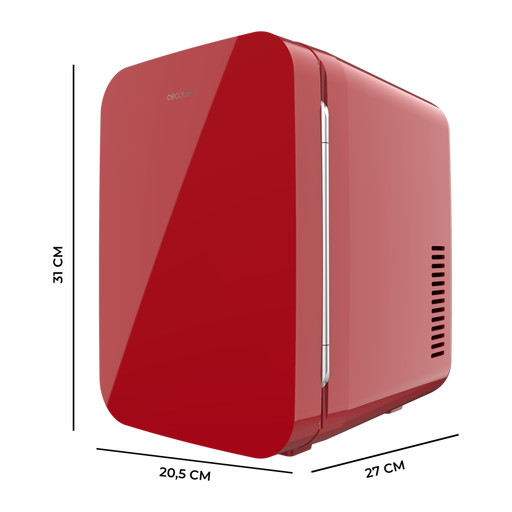
Why it suits this type of buyer: With a capacity of 6 litres, it takes up little space and is suited to short car journeys, picnics and occasional camping trips. According to the product information, it works with 12V and 220V power and has both cooling and warming functions.
The product description clearly states that it doesn’t have a freezer compartment. So you know from the outset that this is a compact electric cool box for chilled drinks and food.
6-litre capacity, one shelf, temperature control, and use in a vehicle or with mains power.

Why it suits this type of buyer: This model is designed for campervan and boat owners, as well as travellers who need to take plenty of supplies. According to the product information, it has two storage zones, 12/24V DC and 240V AC connections, and an adjustable temperature range of -20 °C to 20 °C.
The separate zones make it easier to organise than one large compartment. The stated battery protection is also useful when you’re not connected to mains power.
49.4-litre capacity, two zones, AC/DC power, three battery protection levels and app control according to the product description.

Why it suits this type of buyer: This compressor fridge is suited to lorry drivers, campers and road-trippers who want to chill and freeze food. Its stated temperature range is -18 °C to 15 °C.
It doesn’t rely solely on the ambient temperature: the product information specifies a compressor, a freezer range, and 12/24V DC and 100-240V AC power.
22-litre capacity, compressor cooling, MAX and ECO modes, digital controls and three battery protection levels.

Why it suits this type of buyer: With a 35-litre capacity, two baskets, a divider and wheels, this model is designed for use in a campervan, caravan or larger car. The product description mentions app control.
The two baskets and removable divider mean you don’t have to pile everything into one deep compartment. Wheels and handles make it easier to move, but check the exterior dimensions beforehand.
35-litre capacity, 12/24V and 220-240V support, compressor operation, two baskets and wheels.
We’ve put together a complete, up-to-date list of products that meet these strict selection criteria and the applicable European safety regulations.
That depends on the vehicle’s battery, the power setting and the battery protection. If the engine is off, it’s best to use a model with adjustable cut-off levels or connect it to a suitable power station. Check the battery voltage regularly and avoid leaving the fridge running in MAX mode unnecessarily.
Its lifespan depends on use, ventilation, transport and maintenance. A compressor model needs to be on a stable surface, with enough air around the vents. Clean the inside with a soft cloth, unplug it before cleaning and let it dry completely before storing it for a long period.
Consumption varies by model and conditions. A stated power rating of, for example, 45 W doesn’t mean it uses a constant amount of power every hour: a compressor switches on and off to maintain the temperature. Warm outdoor temperatures, frequent opening and a low freezer setting generally increase energy use. Use ECO mode to maintain the temperature, and MAX mode only when you need to cool things down more quickly.
