
Vandaag of morgen in huis

Kwaliteit gegarandeerd

Welkomstaanbiedingen ontgrendelen: GRATIS bezorging | Tot 80% korting | Gratis 30 dagen JoyPlus-proefperiode
Download de app
A portable car fridge is handy for long drives, camping holidays, motorhome trips and working on the go. However, not every electric cool box is suitable for every situation. A compact 12V cooler may be ideal for drinks, but not cold enough for frozen food. A large compressor cool box offers more options, but also takes up more space and uses more power.
As a Joybuy Product Recommendation Officer, I focus on the product specifications that matter in everyday use. This helps you avoid choosing based solely on a low price, an impressive temperature range or a marketing claim.
A thermoelectric cool box usually lowers the temperature relative to the surrounding air. So the actual temperature inside depends on how warm it is outside. If the car is parked in the sun, the cooling performance may disappoint.
A compressor cool box works differently. Products in this category usually have an adjustable temperature range and, according to their product information, can also freeze. Always check the stated range and conditions of use. A car fridge with a freezer is particularly useful for meat, frozen food or longer trips.
A 12V car fridge usually runs from the cigarette lighter or a 12V socket. 24V is also relevant for lorries, motorhomes and some boats. If you plan to use it in different vehicles, choose a 12V/24V cool box.
Also look for battery protection. Some compressor models have an adjustable feature that cuts the power if the vehicle voltage gets too low. This reduces the risk of draining the starter battery, but it doesn’t replace checking the battery, wiring or connection.
A 40-litre cool box won’t necessarily fit under a car seat. Measure the available space in your boot, motorhome, boat or lorry cab. Check the position of the handles, lid and ventilation openings too.
Compressor models need to let warm air escape. For different models, the product information recommends leaving around 10 cm of clear space around the ventilation openings. A closed storage compartment can reduce cooling performance and put extra strain on the appliance.
Think about how you’ll use it, not just the number of litres:
A dual zone or removable basket can make it easier to organise the contents. Also check whether bottles fit upright and whether a divider takes up too much of the interior.
A model with 12V/24V DC and 100–240V AC can be used in a car, motorhome or at home. Check whether the mains adaptor is actually included. Some compact models have an optional AC adaptor.
The stated noise level is usually given in decibels. A rating of around 40 to 45 dB may be acceptable for many users, but the noise you hear also depends on the surface, ventilation and compressor cycles. If you’re sleeping beside the cool box, it’s worth planning where to put it in advance.
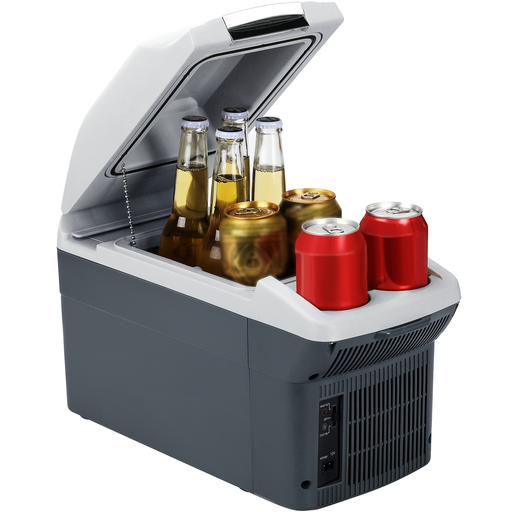
Why it suits this profile: According to the product description, this compact 9L electric cool box is designed for use in cars, on camping trips and when travelling. Its 12V connection and carry strap make it easy to take with you for everyday use.
The product information clearly states its 9L capacity and 12V DC power supply, making it easier to work out in advance what the cool box is suitable for. It isn’t a compressor freezer.
9L capacity, two cup holders, a carry strap and a stated noise level of around 40 dB. The cooling and warming functions can be used separately, according to the product description.
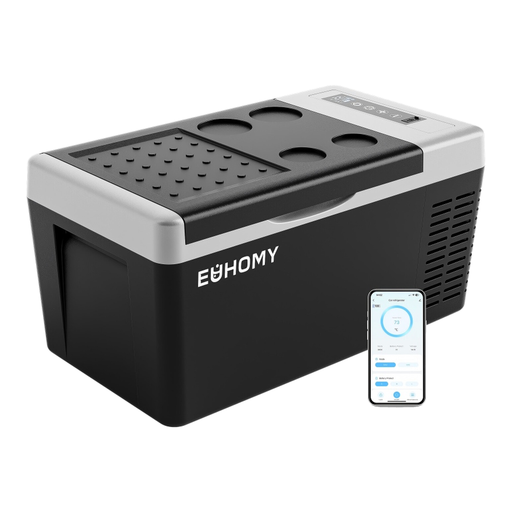
Why it suits this profile: If you’re looking for a 12V car fridge that can also be used at home, the specifications list a compressor, 12/24V DC and 100–240V AC connections, plus app control.
Its stated range of -20°C to 20°C makes the difference between this and a standard thermoelectric cool box clear. The three battery protection levels are useful when using it in a vehicle, but you still need to check the connection.
18L capacity, compressor cooling, Bluetooth app, AC/DC adaptors and a stated noise level of 42 dB.
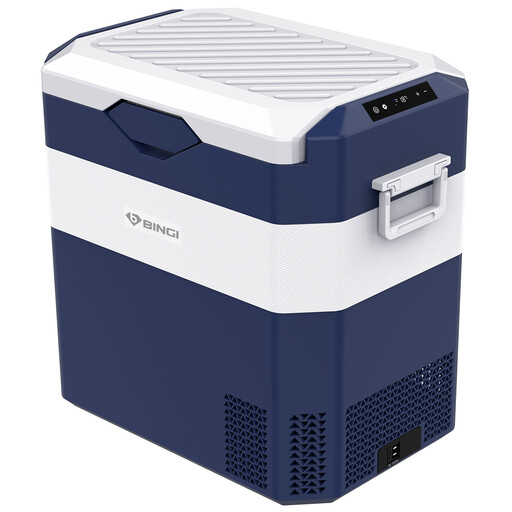
Why it suits this profile: According to the product information, this 42L compressor cool box is designed for motorhomes, lorries, boats, travel and home use. Its capacity suits groups of several travellers or longer stays.
The specifications list 12/24V DC, 100–240V AC and three battery protection levels. This makes it easier to see in advance how to connect the cool box in different vehicles and at a campsite.
42L capacity, compressor with a stated range of -18°C to 15°C, ECO mode and a noise level below 45 dB according to the product description.
We’ve put together a complete, up-to-date list of products that meet these strict selection criteria and comply with current European safety regulations.
It depends on the model, the temperature setting, the surroundings and the capacity of the vehicle battery. If the fridge has a battery protection function, it’s best to use it. For extended use when the engine is off, a separate power station or mains connection is often more practical.
Its lifespan depends on how it’s used, ventilation, transport and maintenance. A compressor should be placed on a stable surface and kept as level as possible. If a model has been tilted significantly during transport, some manufacturers recommend leaving it upright for a few hours before switching it on. Check the manual for your specific product.
It depends on the situation. A thermoelectric cool box may be simpler and lighter, but it often relies on the temperature difference between the inside and the surrounding air continuously. A compressor model can cool or freeze more precisely and may have an ECO mode. Before choosing, compare the stated power consumption and operating time, and think about what you’ll use it for.
