
Vandaag of morgen in huis

Kwaliteit gegarandeerd

Welkomstaanbiedingen ontgrendelen: GRATIS bezorging | Tot 80% korting | Gratis 30 dagen JoyPlus-proefperiode
Download de app
A portable car fridge freezer is useful for road trips, camping, lorries and boats. But not every plug-in cool box works like a fridge. Some models only cool food and drink below the ambient temperature, while others use a compressor and can also freeze. If you only look at capacity or a low price, you could end up buying a product that isn’t right for how you plan to use it.
An electric cool box with thermoelectric technology may be suitable for drinks and lunch, but it usually doesn’t have an adjustable freezer range. Its cooling performance is also heavily affected by the ambient temperature. A compressor cool box works more like a household fridge, making it a better choice as a car freezer.
So check the stated temperature range. Models with a range such as -18 °C to 15 °C or -20 °C to 20 °C are designed for both cooling and freezing. A product that only says it “cools to around 4 °C” isn’t necessarily suitable for frozen food.
A 12V car fridge can continue drawing power when the engine is off. Without battery protection, there’s a risk of draining the starter battery too far. If you plan to use it for long periods, choose a cool box with battery protection and check whether it offers several protection levels.
A system with low, medium and high settings gives you more choice for different vehicles and battery conditions. However, automatic shut-off is no substitute for careful use: check the battery status and follow the manufacturer’s instructions.
A 20-litre capacity doesn’t mean every bottle or container will fit. As well as the capacity, check the internal dimensions, the position of the baskets and whether there are any dividers. A dual-zone model can be practical, but it may take up extra space.
Measure the space available in your boot, campervan, caravan or boat beforehand. Make sure you also leave room around the ventilation openings. For several models, at least 10 cm of clearance around the vents is recommended to help dissipate heat.
A compressor cool box is usually the obvious choice if you want to freeze food or need a stable temperature. Look out for:
Claims about cooling speed, noise levels or energy consumption come from the relevant brand’s product information. Treat them as product specifications under the stated conditions, not as a guaranteed result in every car or outdoor temperature.
12V DC is standard for a car. A 24V lorry fridge is better suited to vehicles with a 24V system. If you want to use the fridge at home, at a campsite or in a motorhome with mains electricity, you’ll also need 100-240V AC or 220-240V AC.
Before buying, check:
For one person on short trips, 9 to 18 litres may be enough. A model of around 21 or 22 litres offers more space for meals, bottles and snacks. For a family, a longer stay in a motorhome or regular use on a boat, models of 35 to 65 litres are worth considering. Larger models from around 80 litres upwards do need a permanent spot and a suitable power supply.
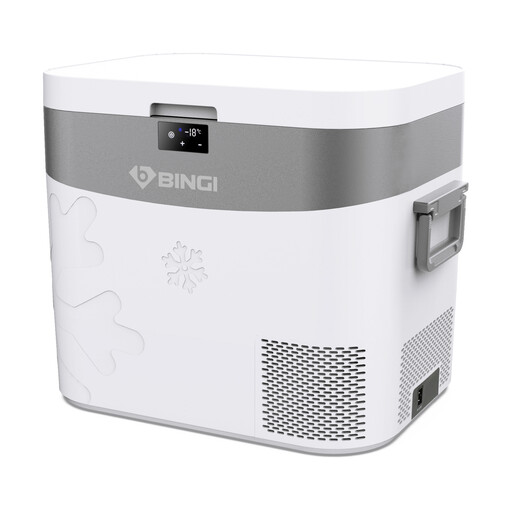
Why it suits this type of user: This model combines a 22-litre capacity with 12V/24V DC and 100-240V AC connections. That makes it suitable for use in a car, motorhome, lorry or at a campsite with mains electricity.
The product description lists a compressor, a temperature range of -18 °C to 15 °C and built-in battery protection with three levels.
Compressor function, dual power supply and a size that’s relatively easy to fit in a vehicle.
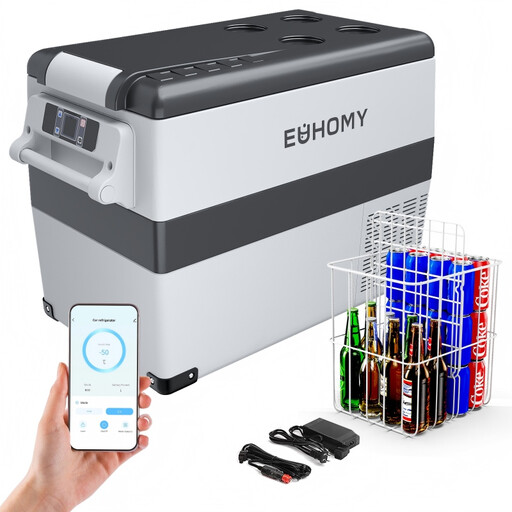
Why it suits this type of user: Its 40-litre capacity and two storage zones are designed for longer trips, motorhome use and carrying different types of food.
According to the product description, this model has an adjustable temperature range of -20 °C to 20 °C, ECO and MAX modes, and three battery protection levels.
40-litre capacity, 12/24V DC and 100-240V AC, app control according to the product information, and two storage zones.
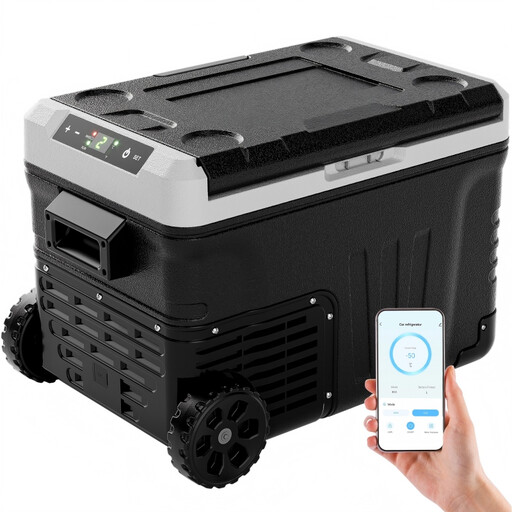
Why it suits this type of user: The wheels, handles, two baskets and divider are practical for a motorhome, boat, lorry or larger camping set-up.
The listed specifications include a compressor, 12/24V and 220-240V connections, a temperature range of -20 °C to 20 °C and battery protection.
35-litre capacity, wheels for easy movement, two storage zones and app control according to the product description.
We’ve put together a complete, up-to-date list of products that meet these strict selection criteria and the applicable European safety requirements.
After transporting a compressor fridge, leave it upright before switching it on. For some models, it’s recommended that you wait six to twelve hours if the appliance has been tilted. This gives the compressor oil time to settle. Place the fridge on a flat, stable surface and don’t block the ventilation.
Use MAX mode only when you need to cool things quickly. Then switch to ECO, if available. Let hot food cool first when it’s safe to do so, and don’t pack the interior so tightly that cold air can’t circulate. To defrost ice build-up, switch off the power; don’t use sharp objects.
On a boat, make sure the electrical circuit has suitable protection. Also protect the appliance from rain and direct water spray.
It can, if the model supports both a 12V/24V DC cable and a 100-240V or 220-240V AC adapter. Always check that both cables are included and suitable for your needs.
Power consumption depends on capacity, the set temperature, the outside temperature, insulation and operating mode. Some product descriptions state around 45 watts or mention an ECO mode. This is a figure provided by the brand, not a fixed level of consumption in all conditions.
Its lifespan depends on ventilation, transport, cleaning, power supply and how often it’s used. Keep the ventilation openings clear, avoid leaving it tilted for long periods, and unplug it before cleaning or moving the appliance. Also check the warranty and service terms for each product.
