
Vandaag of morgen in huis

Kwaliteit gegarandeerd

Welkomstaanbiedingen ontgrendelen: GRATIS bezorging | Tot 80% korting | Gratis 30 dagen JoyPlus-proefperiode
Download de app
A portable car fridge-freezer is ideal for campers, road-trippers, lorry drivers and boat owners. It keeps drinks chilled, stores groceries on the go and, with certain models, also freezes food. Many electric cool boxes look similar, yet the technology and day-to-day use can differ a lot.
Pick the wrong one and you may end up with too little space, a flat vehicle battery or a cool box that doesn’t get cold enough in practice. Below are the key considerations, followed by some suitable product choices for different use cases.
A basic electric cool box often uses a thermoelectric cooling system. This type suits chilled drinks and snacks, but usually doesn’t provide a true freezing function. Its cooling performance also depends on the ambient temperature.
A compressor cool box works more like a small fridge. Models with a settable range below 0 °C can, according to their product specifications, also serve as a car freezer. Always check the stated temperature range and search specifically for “compressor” if freezing matters to you.
A 12V fridge for the car typically plugs into a standard cigarette lighter or 12V socket. For a lorry, some motorhomes and larger boats, 24V is also relevant. A 12V/24V DC model gives you more flexibility across different vehicles.
For use at the campsite or at home, a mains adapter is practical. Check whether a 12V/230V fridge truly includes both connection options. With some compact cool boxes, the mains adapter is optional.
A battery protection function doesn’t mean the battery can be used indefinitely. According to the product information of certain brands, a three-level cut-off switches the power off when voltage drops too low. The setting might be low, medium or high, for instance.
Check whether the product genuinely has an adjustable cool box with battery protection and read how the levels work. For prolonged use with the engine off, a separate power station or a mains connection remains the wiser choice.
For both cooling and freezing, a compressor is the most important technical choice. Also look at:
A stated cooling range is a product specification, not a guarantee that every content will freeze equally quickly under all conditions. Warm groceries, frequent opening and high outside temperatures affect performance.
A camping fridge of 6 to 10 litres fits easily on a car seat and suits a few drinks or lunch items. For a motorhome weekend with several people, 18 to 22 litres is more practical. Larger models of 35 to 49 litres give you more storage, but also take up considerably more space in the car boot or motorhome.
Check before buying:
For a portable fridge for a motorhome, boat or lorry, handles, a non-slip base and stable placement are at least as important as the number of litres.
Check which lead is included and whether the connection suits your vehicle. A 24V cool box is especially relevant for lorries and some commercial vehicles. A 12V/24V model is more versatile.
The stated power, for example around 45 W, doesn’t tell you exactly how much energy is used per day. The compressor cycles on and off. To limit consumption, pre-chill items, keep the fridge out of direct sunlight and use ECO mode after quick pull-down.
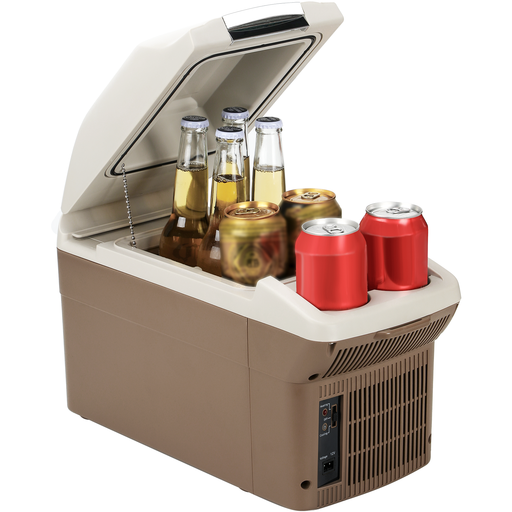
Why this suits the profile: The compact 9-litre cool box is suitable for car journeys, picnics and short camping trips. According to the product description it cools and warms and runs via 12V DC.
The product description clearly mentions cooling and warming, but no compressor or freezing function. That makes it clear upfront this is a cool box for drinks and snacks, not for deep-freeze storage.
9-litre capacity, shoulder strap, two cup holders and a stated noise level of around 40 dB according to the product information.
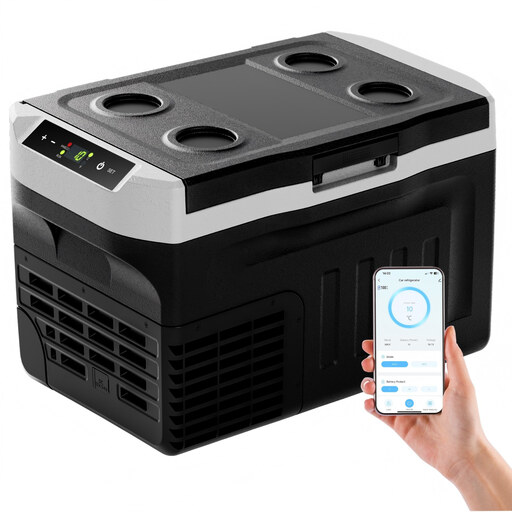
Why this suits the profile: According to the product listing, this model combines a 21-litre capacity with an adjustable range from -20 °C to 20 °C. It’s a great fit for travellers who want both cooling and freezing.
The stated compressor, temperature control and three battery protection levels make the technical capabilities verifiable before purchase.
12V/24V DC and 220-240V AC according to the product information, plus ECO and MAX modes, app control and two removable shelves.

Why this suits the profile: The 42-litre capacity targets families, motorhome owners and users who are on the road for longer. According to the product information, the model is intended for campervan, lorry, boat and travel.
The specified 12V/24V connection, 100-240V AC support and three battery protection levels make use across multiple vehicles and at campsites more straightforward.
42-litre capacity, -18 °C to 15 °C according to the product specification, ECO mode and a stated noise level below 45 dB.
We’ve compiled a complete, up-to-date list of products that fully meet these strict selection criteria and comply with current European safety regulations.
Yes, if the model also supports 24V DC alongside 12V. Always check the product listing and the supplied cables. A 12V-only model isn’t automatically suitable for a 24V system.
Consumption depends on capacity, outside temperature, set temperature, insulation and operating mode. A stated power of, say, 45 W isn’t a fixed daily usage. ECO mode, pre-chilled contents and opening the lid less often can reduce consumption.
Service life depends on use, ventilation, transport and maintenance. Place the fridge stable, avoid prolonged tilting, keep ventilation clear and follow the manual. Also check the seller’s and manufacturer’s warranty and service terms before buying.
