
Vandaag of morgen in huis

Kwaliteit gegarandeerd

Welkomstaanbiedingen ontgrendelen: GRATIS bezorging | Tot 80% korting | Gratis 30 dagen JoyPlus-proefperiode
Download de app
A portable car fridge is useful for road trips, camping, fishing, working on location, or long journeys by lorry. However, not every electric cool box delivers what it promises at first glance. A low price may, for example, come with limited cooling performance, while a large model requires plenty of space and power.
The three most common pitfalls:
A compressor fridge uses a compressor and refrigerant to actively remove heat. According to the product descriptions of several models in this range, compressor versions can reach temperatures below zero, for example from around -18 °C to 15 °C or from -20 °C to 20 °C. This makes them suitable for use as both a fridge and a freezer.
A semiconductor or thermoelectric system works differently. It generally cools in relation to the surrounding temperature and, on some models, can also provide heating. This makes a compact cool box with heating practical for lunches, drinks and short journeys. However, performance depends more heavily on the outside temperature and ventilation.
Look out for the following points in the product description:
For a car, caravan, motorhome or boat, a 12V 24V cool box offers flexibility. Check in advance which connections and cables are included. Lorries often use 24V, while passenger cars usually have a 12V socket.
A model with 12/24V DC and 100-240V AC can also be used at home, on a campsite with mains power, or via a suitable power station. This means you do not need a different portable fridge for every location.
Also pay attention to:
For one person on a day trip, a mini fridge for a car with a capacity of 4 to 9 litres may be sufficient. Think cans, fruit, sandwiches and a lunch box. For a weekend away with two people, 18 to 22 litres is more suitable. Families, motorhomes and longer journeys often benefit from 35 to 49 litres or more.
A larger capacity is not automatically more convenient. Measure the space in the boot, under a table or on the back seat. Also check:
A motorhome fridge or cool box for motorhomes and boats with wheels and handles is more convenient for larger capacities. For a passenger car, a compact box with a shoulder strap may be a better fit.
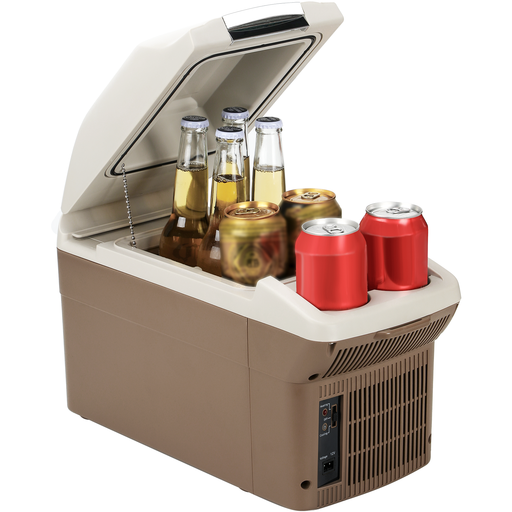
Why it suits this profile: The capacity is easy to manage for short journeys, picnics and everyday use in the car. According to the product description, this model runs on 12V and can both cool and heat.
The product information clearly states the 9L capacity and 12V power supply. Check whether the optional AC adapter is required for use at home.
Cooling and heating, a shoulder strap, dual cup holders and a noise level of around 40 dB, as stated in the description.
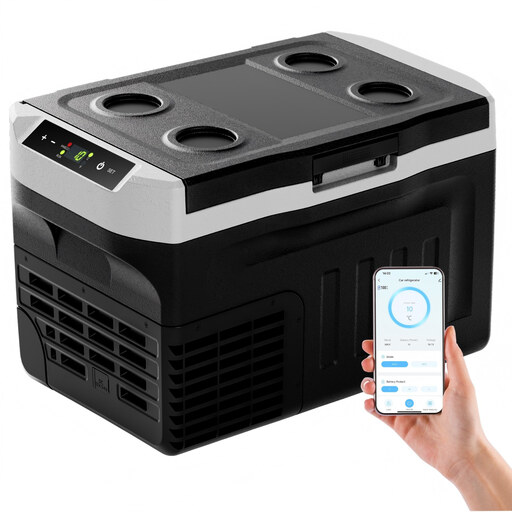
Why it suits this profile: This 21L compressor cool box is aimed at campers and travellers who want to combine cooling and freezing with app control.
The stated temperature range of -20 °C to 20 °C clearly sets it apart from a basic thermoelectric cool box. Check the available internal space before buying.
12/24V DC and 100-240V AC, ECO and MAX modes, three battery protection settings and a noise level of around 42 dB, as stated in the product information.

Why it suits this profile: The 40L capacity, two zones and included baskets make it suitable for families, motorhomes, anglers and longer stays without a fixed fridge.
The dual-zone layout and adjustable temperature make its function clearer than a general claim that it merely “keeps things cold”. Measure the available boot space carefully.
12/24V DC and 100-240V AC, a temperature range of -20 °C to 20 °C according to the product information, app control and three battery protection levels.
We have put together a complete, up-to-date list of products that fully meet these strict selection criteria and the applicable European safety regulations.
A portable fridge is not the same as a camera cooler. Photographers making long recordings with a mirrorless or DSLR camera may want to consider the ULANZI CU01 Camera Fan Cooler. According to the product description, this accessory uses semiconductor cooling, a fan and automatic temperature control. It is designed to help reduce heat around the camera, not to store food or drinks. Do not use it in heavy rain and do not block the air vents.
That depends on the battery, the selected protection level, the outside temperature and the model. A compressor box with battery protection may switch off the power when the voltage is low, but check the manual and preferably use a power station or a permanent campsite connection when the engine will be switched off for a long time.
Consumption varies depending on the compressor, insulation, ambient temperature and setting. A product description may, for example, state a rated power of around 45 W, but this does not mean that the compressor runs continuously at that power. ECO mode, pre-chilled products and sufficient ventilation space can help limit usage.
Its service life depends on transport, cleaning, ventilation and a correct power supply. Keep a compressor box upright after transporting it at an angle, keep the ventilation openings clear and clean the inside after switching off the power. Also regularly check the cables, plugs and seals for wear.
