
Vandaag of morgen in huis

Kwaliteit gegarandeerd

Welkomstaanbiedingen ontgrendelen: GRATIS bezorging | Tot 80% korting | Gratis 30 dagen JoyPlus-proefperiode
Download de app
A portable car fridge is handy for road trips, camping, work journeys and long days on the road. However, not every electric cool box is suited to the same situations. A compact cool box for drinks works differently from a portable compressor fridge with a freezer function. Power consumption, available space and how you plan to use the fridge also make a big difference.
A thermoelectric cool box can usually keep its contents a few degrees cooler than the surrounding air. The actual temperature depends on the outside temperature and ventilation. This type of model is suitable for drinks, lunch and snacks, but usually not for keeping food frozen for extended periods.
A cool box with a freezer function usually uses a compressor. This allows it to reach lower temperatures, such as -18 °C to -20 °C according to the product specifications. Always check that the product is specifically described as both a fridge and a freezer. A model labelled “cooler & warmer” doesn’t automatically have a freezer compartment.
A large capacity sounds appealing, but a 40 or 50-litre fridge takes up considerably more space. Measure the space in your car boot, campervan, boat or lorry before buying. Also check the height of bottles and the lid opening.
A mini fridge for travel with a capacity of 4 to 9 litres may be enough for one or two people. For a family, campervan or longer trip, 18 to 40 litres is more practical. Larger models of 65 litres or more are mainly intended for extended stays in a campervan, RV or boat.
A car fridge can also run when the engine is off. However, using it for extended periods without battery protection can put a strain on your vehicle battery. When choosing a 12V car fridge or a 12V 24V cool box, look for built-in cut-off protection with adjustable levels.
Also check the connection. A product with 12V/24V DC is suitable for many cars, lorries and boats. For home or a campsite, you’ll need a model with 100-240V AC, or a separate mains adapter. An AC/DC cool box is therefore more versatile.
According to their stated specifications, compressor fridges can often reach sub-zero temperatures, making them suitable for use as freezers. Power consumption doesn’t stay at the maximum wattage all the time: the compressor switches on and off to maintain the set temperature.
A thermoelectric fridge is usually lighter, simpler and cheaper. The ICEROVER and Cecotec models in this selection combine cooling and heating. The ICEROVER PN-06 and PN-09 are specified as cooling to around 4 °C and heating to approximately 60 °C. According to the product description, performance can vary with the ambient temperature.
Check whether the temperature is adjustable and what range the manufacturer specifies. For example, compressor models in this selection offer a range of -20 °C to 20 °C or -18 °C to 15 °C. This makes them suitable for chilled drinks, fresh ingredients and frozen food.
An LCD panel is handy for direct control. Some EUHOMY models also support a Bluetooth or Wi-Fi app. According to the product description, you can use it to adjust the temperature and mode remotely. Before buying, check that your phone is compatible and that you’ll actually need the app.
A compressor fridge needs to be able to disperse heat. Leave around 10 centimetres of clear space around the ventilation openings, unless the manual says otherwise. Place the appliance on a flat, stable surface and don’t block the fan with luggage.
If the fridge has been tilted during transport, leave it upright as instructed in the product guidance before switching it on. Several models specify a waiting time of 6 to 12 hours. This helps the compressor start up correctly in line with the instructions.
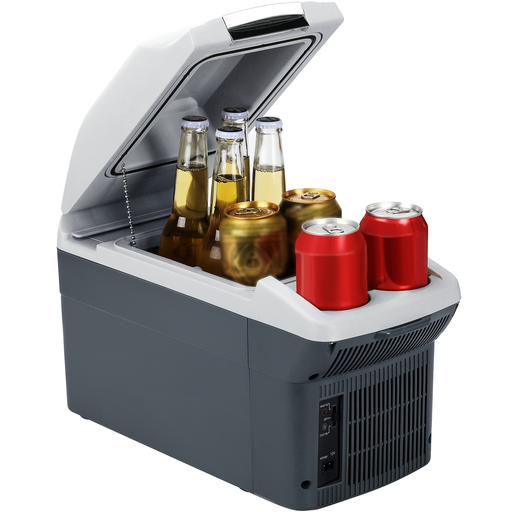
Why it suits this profile: Its 9-litre capacity is ideal for drinks, lunch and snacks on car journeys, picnics and short camping trips.
The product description clearly states that it has a 12V power supply and cooling and heating functions. Don’t expect a compressor freezer.
9-litre capacity, carry strap, cup holders and a stated noise level of around 40 dB.

Why it suits this profile: Its 40-litre capacity, two storage zones and app control make it a good fit for longer holidays in a campervan, caravan or boat.
The specifications state -20 °C to 20 °C, 12/24V DC and 100-240V AC. Be sure to check that you have enough space for it first.
ECO mode with stated power consumption below 45 W, three battery protection levels and a stated noise level below 42 dB.

Why it suits this profile: With wheels, two baskets and a 35-litre capacity, this model is designed for campervans, lorries, boats and longer trips.
The product information lists 12/24V, mains power, battery protection and clearance around the ventilation openings. This makes the key usage requirements clear from the outset.
Temperature range of -20 °C to 20 °C according to the product specifications, plus wheels, two storage baskets and app control.

Why it suits this profile: This mid-sized model offers more space than a mini cool box and, according to the product description, is suitable for use in a car, campervan, lorry, boat or at home.
The stated connections are 12/24V DC and 100-240V AC. Three-stage battery protection is also listed.
22-litre capacity and an adjustable range of -18 °C to 15 °C according to the product specifications.
We’ve put together a complete, up-to-date list of products that meet these strict selection criteria and the applicable European safety regulations.
Yes, many models are designed for 12V DC and connect to a 12V socket or cigarette lighter socket. We recommend choosing a model with adjustable battery protection. Don’t leave the fridge running indefinitely with the engine off, and check the settings in the manual.
It varies depending on the size, temperature, insulation and ambient temperature. Product information for several EUHOMY models gives a figure of around 45 W, particularly in ECO mode. This is a stated figure, not a fixed amount of power used per hour. A compressor usually runs in cycles and may stay on for longer in hot weather or when using MAX mode.
Its lifespan depends on ventilation, transport, cleaning and how heavily it is used. Keep the ventilation openings clear, position the fridge securely and don’t use sharp objects to remove ice. Disconnect the appliance from the power supply before cleaning it, and store it somewhere dry when it won’t be used for an extended period.
