
Vandaag of morgen in huis

Kwaliteit gegarandeerd

Welkomstaanbiedingen ontgrendelen: GRATIS bezorging | Tot 80% korting | Gratis 30 dagen JoyPlus-proefperiode
Download de app
A portable air pump can come in handy for a flat car, bicycle or motorbike tyre, or an air bed. However, models vary considerably in pressure, speed, battery life and connections. A compact design doesn’t automatically mean a pump is suitable for car tyres or SUP boards.
The most common buying mistakes stem from three misunderstandings:
So don’t just check the marketing copy. Pay close attention to the technical specifications and the fittings supplied.
You’ll need a high-pressure pump for car tyres, motorbike tyres and many bicycle tyres. A rating of 150 or 160 PSI indicates the maximum pressure, but doesn’t tell you how much air the pump moves per minute.
Check both values:
A car tyre pump with an airflow of 26 L/min may be suitable for topping up tyres and occasional inflation. For inflating several large tyres in a row, a model with higher airflow may be more practical. Always use the tyre pressure recommended by the vehicle or tyre manufacturer. The pump’s maximum pressure isn’t the target pressure for your tyre.
A cordless air pump is handy if you break down on the road, at a campsite or on a cycle path. Check the capacity in mAh or Wh, as well as the stated run time.
For example, according to its product description, the Porbi Q19 has a 4000 mAh battery and a run time of up to 25 minutes. The same description states that it takes around 7 to 8 minutes to inflate each flat car tyre. This makes the model best suited to occasional use and a few tyres, rather than prolonged, continuous inflation.
A 12V tyre pump runs from your car’s power socket and doesn’t need a built-in battery. This is useful for longer jobs, but check that the cable is long enough to reach all the wheels. If the instructions recommend it, keep the engine running during prolonged use to avoid putting unnecessary strain on the car battery.
A digital tyre pump with adjustable pressure makes it easier to select a set value. According to the product description, an air pump with automatic shut-off stops when the selected pressure is reached. This can help prevent over-inflation, but it’s best to check the pressure afterwards with a separate tyre pressure gauge.
Also look for:
A mini tyre compressor isn’t the same as an air pump for air beds. Models that deliver a large volume of air at low pressure are better suited to soft inflatables.
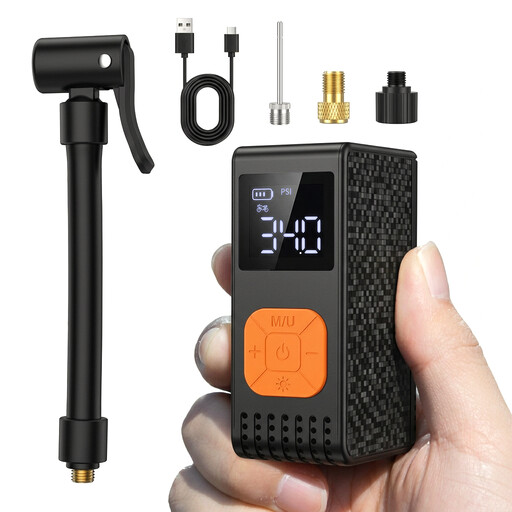
Why it suits this profile: This compact model is aimed at cyclists, motorcyclists and sports enthusiasts who mainly want to inflate smaller tyres or balls. According to the product description, the pump has a 1600 mAh battery and three modes for motorbikes, bicycles and balls.
Its intended uses are clearly defined. So you won’t end up buying a large model for jobs that mainly involve bicycle tyres and sports balls.
Measures 52 × 43 × 85 mm, charges via USB-C and is stated to inflate a bicycle tyre from 0 to 2.06 bar in around 70 seconds.

Why it suits this profile: The GT160 is designed for people who want a single cordless air pump for their car, motorbike, bicycle and balls. According to the product description, it has a 7500 mAh battery, a maximum pressure of 160 PSI and an airflow of 35 L/min.
The stated battery capacity and airflow make it easier to assess than a PSI claim on its own. According to the product description, the pump also has adjustable pressure and automatic shut-off.
Four preset modes, a digital display showing PSI, kPa and bar, plus an LED function. The product description states that it can run cordless for up to 45 minutes.
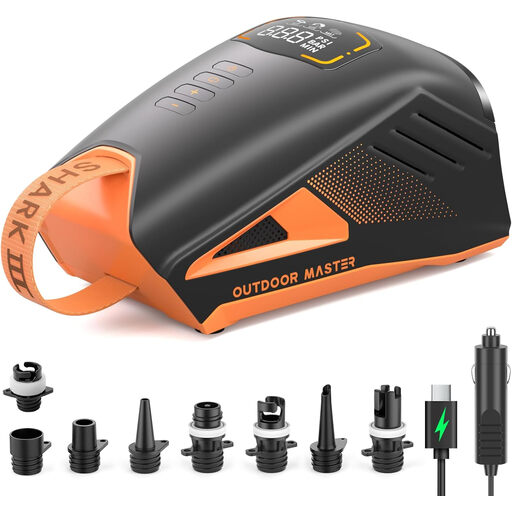
Why it suits this profile: This model is specifically designed as a SUP air pump for inflatable boards and boats. According to the product description, it has a built-in 74 Wh battery and can also be powered via USB-C or a 12V/15.8V connection.
It’s presented as a high-volume pump with a maximum pressure of 20 PSI, not as an all-purpose tyre pump. This helps prevent you from choosing it for tyres that need higher pressure.
Digital pressure setting, automatic shut-off, several nozzles and a stated inflation time of 3 minutes and 50 seconds for a 10.6-foot board up to 15 PSI.
We’ve put together a complete, up-to-date list of products that meet these strict selection criteria and current European safety regulations.
That depends on the maximum pressure, airflow and valve. Choose a model that’s specifically listed as suitable for car or motorbike tyres, and check the stated pressure in PSI or bar. A low-pressure pump for air beds or pool inflatables isn’t suitable.
Run time varies depending on the battery and the load. Inflating a flat car tyre uses considerably more energy than topping up a bicycle tyre. So, as well as checking the capacity, look at the stated run time, the number of tyres it can inflate per charge and the charging time. If you regularly use it on the road, a model with a 12V connection may be a practical addition.
With a cordless model, you mainly pay to charge the battery; power consumption per charge is generally low. A 12V tyre pump draws power from your car. More important than charging costs are the battery’s lifespan, recommended cooling breaks and the availability of adapters or replacement parts. Check the instructions and store the pump somewhere dry and clean.
