
Vandaag of morgen in huis

Kwaliteit gegarandeerd

Welkomstaanbiedingen ontgrendelen: GRATIS bezorging | Tot 80% korting | Gratis 30 dagen JoyPlus-proefperiode
Download de app
A portable air conditioner may seem straightforward: place the appliance in the room, connect the hose to the window and set your preferred temperature. In practice, a few details determine whether a portable air conditioner works comfortably or simply takes up space. The right capacity is particularly important in flats, bedrooms, home offices and small office spaces.
Don’t just look for terms such as “powerful cooling” or “quiet operation”. Check the technical specifications, the supplied window kit and how condensation is drained. This helps you avoid a poor purchase and choose an air conditioner that suits your home and your routine.
A 9000 BTU air conditioner is not automatically suitable for every room. A model with a higher capacity may be noisier, use more electricity and be unnecessarily large for a small bedroom. Check the stated room size, but also consider sunlight, insulation, ceiling height and the number of people in the room.
For a compact bedroom or study, a model around 7000 BTU may be sufficient. A larger living room or poorly insulated space may need a 9000 or 12000 BTU model instead.
A portable air conditioner with a window kit expels warm air outdoors through a hose. Check in advance whether the kit is suitable for your type of window. Homes in the Netherlands commonly have tilt-and-turn windows, vertical sliding windows and horizontal sliding windows. A universal seal will not necessarily fit every window.
Measure the window opening and check that the supplied panels or seal fit it properly. A poorly sealed window allows warm air to flow back in, making the portable air conditioner less efficient.
The term quiet portable air conditioner means little without a noise level in decibels. Check whether the brand states the sound pressure level or sound power level. The difference between normal mode and sleep mode can also be significant.
The AUX 9000 BTU is listed as 52 dB(A) in the description, while the specification table states 64/62 dB. This difference is a reason to check the manual and product page carefully before buying. Sleep mode is relevant for a bedroom air conditioner, but a compressor will still be audible.
Cooling capacity is usually expressed in BTUs per hour or watts. A higher figure does not automatically mean lower energy consumption. Always compare:
A model’s product description may state a particular floor area, but this will always depend on the conditions in the room. Treat the stated m² as a guideline, not a guarantee.
An energy-efficient air conditioner does not simply use little electricity on paper. Usage time, the temperature setting and insulation also affect energy costs. A timer helps prevent the unit from running unnecessarily for too long. Some models also offer an automatic mode or sleep mode.
Check the power input. For example, the AUX 7000 BTU lists 788 watts as its rated cooling power and a maximum input of 900 watts. The AUX 9000 BTU lists a rated power of 1000 watts and a maximum of 1050 watts. These are useful figures for comparing models more fairly.
A portable air conditioner with a dehumidifying function collects moisture from the air. Thanks to self-evaporation, the water may not need to be drained manually as often under normal conditions. However, in high humidity or during prolonged use, the collection tank may still become full.
Also look for:
Clean the filter according to the manual. The Humhold models recommend cleaning every two weeks. Allow a washed filter to dry completely before replacing it.
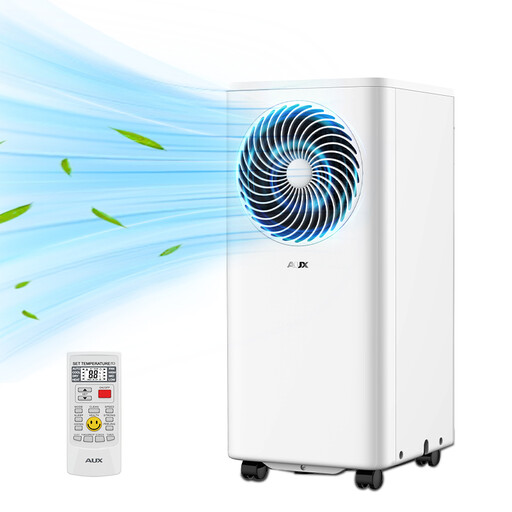
Why it suits this profile: This compact model is designed for bedrooms, living rooms and home offices where a lower cooling capacity is sufficient. Wi-Fi, a remote control and a 24-hour timer make operation convenient.
The product information lists 2050 watts of cooling capacity, rated consumption of 788 watts and a window kit included. However, check your window measurements in advance.
7000 BTU, three fan speeds, R290 refrigerant, self-evaporation and a washable filter.
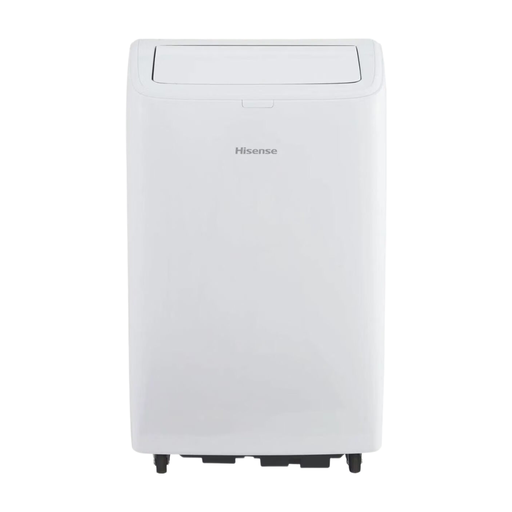
Why it suits this profile: Ideal for anyone who wants to combine cooling, heating, ventilation and dehumidification in one appliance. Wi-Fi control and a remote control are well suited to everyday use in a living room or home office.
The specifications list 3500 watts of cooling capacity, a window kit and a sound pressure level of 52–54 dB(A). At 31.6 kg, it is less practical to carry, so the wheels and a permanent position are important.
12000 BTU, four functions, R290 refrigerant, Wi-Fi and remote control.
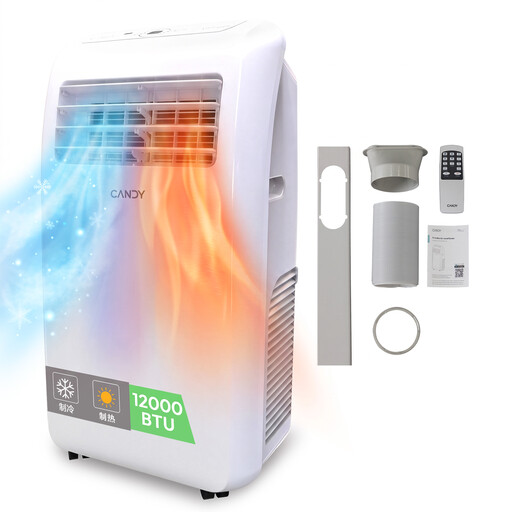
Why it suits this profile: This model is worth considering for larger spaces and for users who also want ventilation, dehumidification and heating outside the summer months.
The product page lists the power input, airflow of 400 m³/hour and dimensions. This allows you to compare capacity, space requirements and electricity usage in advance.
12000 BTU, cooling and heating function, A+ rating according to the product information, timer and window kit.
Place the appliance on a flat, stable surface and keep the air intake and outlet clear. Position the unit close enough to the window to fit the exhaust hose without sharp bends. Use the window kit to seal the opening as effectively as possible.
After transport, leave an appliance containing refrigerant standing upright as instructed in the manual before switching it on. Use an earthed socket and avoid a multi-socket adaptor or extension lead when these are not permitted. Switch off the portable air conditioner and unplug it before carrying out maintenance.
A timer is useful if you want the air conditioner to start, for example, before bedtime or before you arrive home. The function does not automatically reduce electricity consumption per hour, but it can help you cool for shorter periods and target your usage more effectively.
We have put together a complete, up-to-date list of products that fully meet these strict selection criteria and the applicable European safety regulations.
It can be, provided the noise level, dimensions and cooling capacity are suitable for the room. Check the dB rating and see whether the model has a sleep mode. Do not place the unit directly next to the bed, and make sure the warm air is expelled outdoors through a window.
This depends on the power input and how long it is used. A 1000-watt model theoretically uses around 1 kWh when running continuously at that power for one hour. In practice, the compressor regularly switches on and off. The actual cost depends on your energy tariff, temperature setting, insulation and outdoor temperature.
The lifespan depends on usage, storage and maintenance. Clean the filter regularly, move the appliance in an upright position and do not block the ventilation openings. Follow the manual for drainage, winter storage and maintenance. When buying, also check the warranty, availability of spare parts and the accessibility of the responsible seller.
