
Vandaag of morgen in huis

Kwaliteit gegarandeerd

Welkomstaanbiedingen ontgrendelen: GRATIS bezorging | Tot 80% korting | Gratis 30 dagen JoyPlus-proefperiode
Download de app
A portable air conditioner offers flexibility for rented homes, flats and home offices. You can move it when needed, and it usually doesn’t require permanent installation. However, an air conditioner that doesn’t need installing can’t simply be placed anywhere. The exhaust hose needs to carry heat outside, and the cooling capacity must suit the room.
As a Joybuy Product Recommendation Officer, I filter product information for practical details. Look out for these three common pitfalls:
Cooling capacity is often listed in BTU and kW. According to the product information for various models, a 7,000 BTU or approximately 2.0 kW model is designed for smaller spaces, such as a bedroom or home office of up to around 28 m². A 9,000 BTU or 2.6 kW model is more commonly offered for rooms of up to about 35 m².
Bear in mind that the stated floor area isn’t a guarantee for every home. Sunlight, ceiling height, insulation, windows and the number of people in the room all affect actual cooling performance. For a sunny living room, a portable air conditioner with a little extra capacity may be more practical than one sized to match the theoretical floor area exactly.
A portable air conditioner with a window kit only works well if the warm air is carried outside through a hose. So check:
The supplied window kit doesn’t always include the same type of parts. Some models use sliding panels, while others come with a sealing kit or window film. Measure your window opening in advance. A separate 3 or 4-metre window seal strip can also be useful, but always check its dimensions and compatibility.
A quiet portable air conditioner is especially important in a bedroom or home office. Check the stated noise level in dB(A) and see whether it applies to the lowest setting, sleep mode or another operating mode. A model with sleep mode may adjust the controls and fan speed, but the compressor will still make some noise.
An air conditioner with a remote control, timer or Wi-Fi offers extra convenience. For example, a 24-hour timer can stop the unit running unnecessarily. To work out energy use, check the power consumption in watts or kilowatts. A simple calculation is:
power consumption in kW × number of hours used × your electricity tariff = estimated running cost.
Actual costs depend on the temperature setting, outside temperature, insulation and compressor cycles. An energy label is useful for comparison, but it doesn’t replace checking the technical data sheet.
A 3-in-1 air conditioner typically combines cooling, fan and dehumidifying functions. The fan setting circulates air without the compressor needing to cool continuously. Dehumidifying can be useful when the air indoors feels muggy, but some units may need their water drained manually more often.
Self-evaporation reduces how often you need to empty the water tank during normal use, but it doesn’t always eliminate the need altogether. In high humidity or during prolonged dehumidifying, the tank may still fill up. So check where the drain is and whether a condensate hose is included.
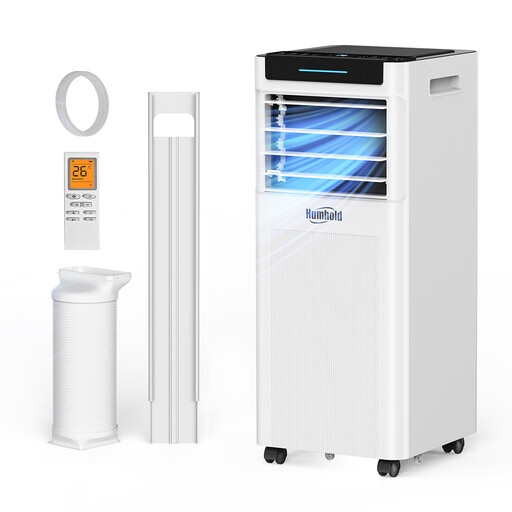
Why it suits this profile: According to the product description, this 2.0 kW portable air conditioner is designed for rooms of up to 28 m², such as a bedroom, home office or smaller living room. Its 19.7 kg weight and castors make it easier to move.
The product information lists a window kit, 3-in-1 operation, self-evaporation and a timer. Be sure to check in advance that the supplied window seal fits your window.
2.0 kW cooling capacity, 3 fan speeds, remote control, 24-hour timer and a stated sleep-mode noise level of less than 49 dB.
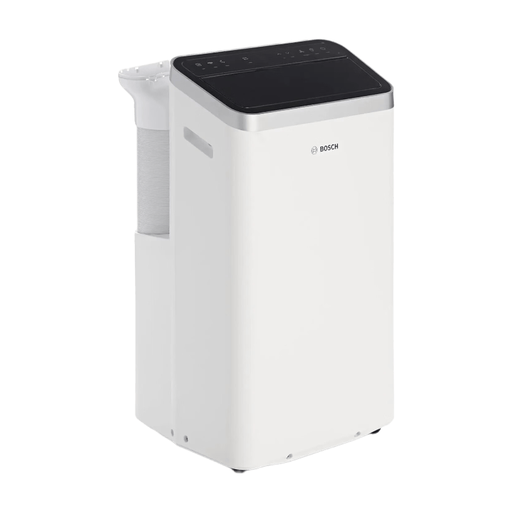
Why it suits this profile: According to the product details, this model combines 2.6 kW of cooling capacity with automatic, quiet and sleep modes. It’s a good fit for users who value a regular routine and a choice of settings.
The product specifications list a supplied window kit, remote control and 24-hour timer. When buying, compare the stated noise level and energy use with your own needs.
2.6 kW cooling capacity, 3-in-1 operation, automatic air circulation, LED touch controls and a stated A+ energy class.
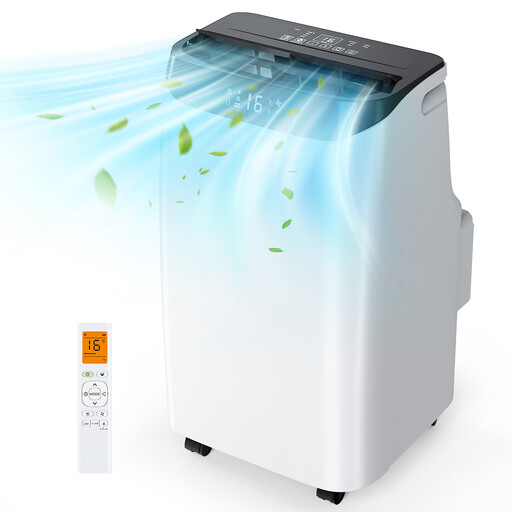
Why it suits this profile: The stated 3.5 kW and 12,000 BTU are designed for larger spaces of up to around 45 m². This makes the model worth considering for a living room or a frequently used workspace, provided the room and window set-up are suitable.
The product description lists a complete window venting kit, automatic swing function and self-evaporation. Drainage may still be needed in high humidity, so keep an eye on the water indicator.
3.5 kW cooling capacity, cooling, dehumidifying and fan modes, 24-hour timer, remote control and a stated noise level of less than 48 dB.
We’ve put together a complete, up-to-date list of products that meet these strict selection criteria and the applicable European safety regulations.
Place your portable air conditioner on a level surface, with enough clear space around it. Connect it to an earthed 220–240 V and 50 Hz socket if specified in the product information. Don’t use an extension lead or multi-plug adaptor if the manufacturer advises against it.
Clean the removable filter regularly, following the instructions in the manual. A blocked filter reduces airflow and can increase energy use. Switch off the unit and unplug it before cleaning or maintenance. Don’t move a compressor-based unit while it’s lying down, and follow the waiting time in the manual before switching it on.
For effective cooling, usually not. A portable air conditioner carries heat outside through a hose. Without a window kit or another opening, that heat will continue to circulate in the room. In fan mode, the unit can still move air without venting it outside.
It varies by model and how you use it. Multiply the stated power consumption in kW by the number of hours it runs and your electricity tariff. A timer, a higher temperature setting and a well-sealed window can reduce the number of hours it runs, but actual energy use depends on the conditions.
It can be, as long as the cooling capacity suits the room and the noise level is acceptable. Look for sleep mode, a timer and a remote control. Also check that the window kit seals properly, and don’t place the unit right next to the bed if the noise or airflow might disturb you.
