
Vandaag of morgen in huis

Kwaliteit gegarandeerd

Welkomstaanbiedingen ontgrendelen: GRATIS bezorging | Tot 80% korting | Gratis 30 dagen JoyPlus-proefperiode
Download de app
A portable air conditioner can be a practical solution for a bedroom, living room or home office without fixed air conditioning. You can move it whenever you need to, and many models also offer ventilation and dehumidifying functions as well as cooling.
However, choosing the wrong model can mean disappointing cooling, excessive noise or a window that doesn’t seal properly. So don’t just look at the BTU rating or a low price. Consider the installation, noise level and energy consumption too.
A higher BTU rating might sound appealing, but the cooling capacity needs to suit the room. According to the product specifications for various models, a 7000 BTU air conditioner is designed for smaller spaces. A 9000 BTU air conditioner or 12000 BTU air conditioner may be more suitable for larger rooms.
Your actual requirements also depend on:
An underpowered unit may run for a long time without delivering the results you want. A more powerful model, on the other hand, could take up unnecessary space and use more electricity.
A portable air conditioner expels warm air outside through a hose. Without a good seal, warm air from outside can get back in. So check whether a portable air conditioner with a window seal is included, and whether the kit is suitable for your type of window.
Some models come with an adjustable window kit. For tilt-and-turn windows, wide windows or doors, a separate sealing strip may be more practical. Measure the opening before you order. A 3- or 4-metre window sealing strip can help close gaps around the exhaust hose, but always check the dimensions and fitting method on the product page.
A compressor makes noise. Sleep mode may adjust the noise level or how the unit runs, but you’ll still hear a portable air conditioner. Check the stated noise level in dB(A) and think about where you’ll use the unit.
For a bedroom, sleep mode, a timer and a lower fan speed are useful. In a living room during the day, a slightly higher noise level may matter less.
Use the stated floor area as a guide only. Manufacturers base their recommendations on specific conditions. A bedroom air conditioner will often need less power than a sunny living room with large windows.
As a guide:
Also check the power rating in kW. This makes it easier to compare models than relying on a marketing term alone.
A 3-in-1 air conditioner typically combines:
The dehumidifying function can be useful in a stuffy room, but capacity varies considerably between products. For example, according to the product information, the Humhold 7000 BTU has a stated dehumidifying capacity of up to 26 litres per day. Figures like this depend on the temperature and humidity, so they aren’t guaranteed for every home.
A portable air conditioner with heating can also be used outside the warmer months. Check the heating capacity, energy consumption and permitted operating conditions separately.
An energy rating, such as A, A+ or A++, indicates efficiency within the relevant product category and measurement method. Also check the power consumption in watts or kilowatts. The actual cost depends on your electricity tariff and how many hours the unit runs.
An air conditioner with a timer can help limit how long you use it. A remote control is especially handy if the unit is in a bedroom or living room. Some models also offer Wi-Fi control, but check whether you’ll need a separate app and account.
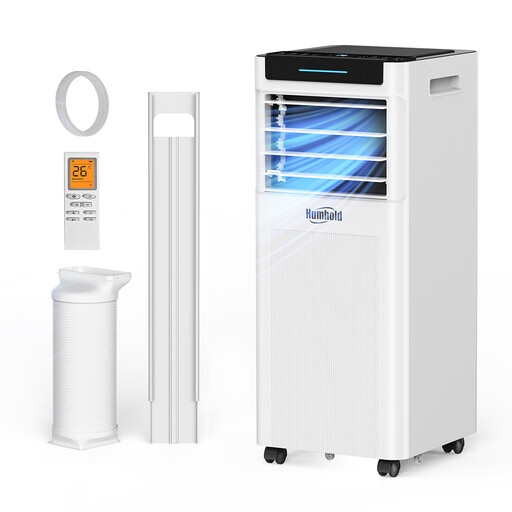
Why it suits this type of user: This model combines 7000 BTU with cooling, dehumidifying and ventilation. According to the product information, it’s designed for rooms up to 28 m² and comes with a window sealing kit.
The specifications list the cooling capacity, dimensions, noise level of under 49 dB and the included window kit. This makes it easier to check in advance whether it’s right for your room.
7000 BTU, remote control, 24-hour timer, sleep mode and R290 refrigerant, according to the product information.
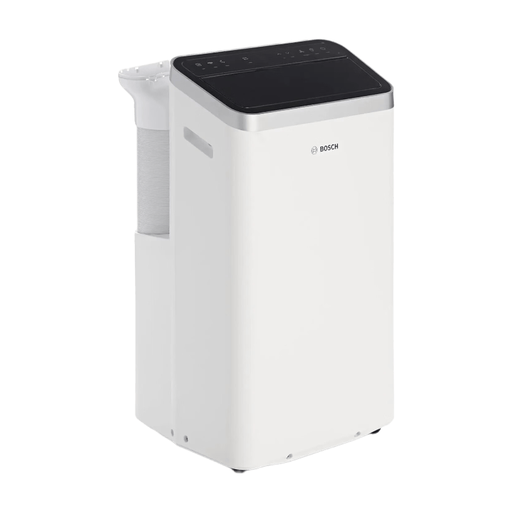
Why it suits this type of user: For those who value ease of use, the product information lists a touchscreen, remote control, automatic mode, quiet mode and sleep mode.
The model comes with a window installation kit and exhaust hose. Check in advance that your window opening is wide enough for the specified installation.
2.6 kW, 3-in-1 functions, A+ according to the product information, and suitable for rooms up to 35 m² according to the stated product specifications.
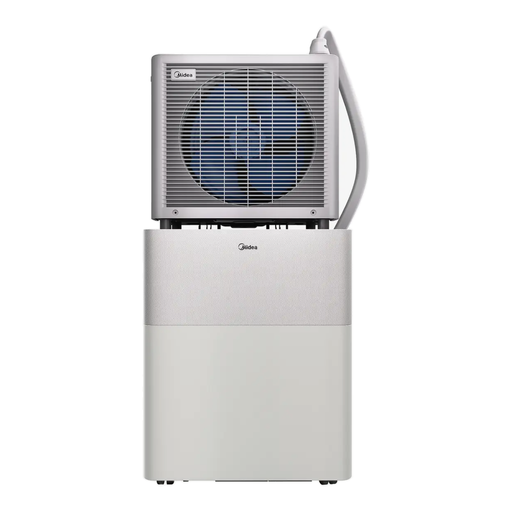
Why it suits this type of user: This system is designed for users looking for 12000 BTU, with both cooling and heating. It consists of an indoor and an outdoor unit, so placement needs more consideration than with a conventional portable air conditioner.
The stated sound pressure level in quiet mode is 39 dB(A), but installing the outdoor unit needs careful consideration. Follow the instructions and ensure any work is carried out in accordance with the regulations.
12000 BTU, A++ for cooling, A+ for heating and a stated coverage area of up to 42 m² according to the product information.
We’ve put together a complete, up-to-date list of products that meet these strict selection criteria and the applicable European safety regulations.
Place the portable air conditioner on a level surface, close to a window, with enough clear space around the air inlet and outlet. Keep the exhaust hose as straight as possible. Sharp bends can restrict airflow.
Also bear these points in mind:
It can be, as long as the cooling capacity suits the room and the noise level is acceptable to you. Ideally, choose a model with sleep mode, a timer and a remote control. A good window seal is important to keep warm air out.
It depends on the power consumption, how long you use it, the temperature setting and your electricity tariff. For a rough estimate, multiply the power in kW by the number of hours used and your price per kWh. A timer can help prevent the unit from running for longer than necessary.
Its lifespan depends on how it’s used, maintained and stored, as well as the quality of the installation. Clean the filter as instructed, prevent blockages and handle the exhaust hose with care. If the compressor, refrigerant circuit or electrical components develop a fault, it’s best not to attempt repairs yourself.
