
Vandaag of morgen in huis

Kwaliteit gegarandeerd

Welkomstaanbiedingen ontgrendelen: GRATIS bezorging | Tot 80% korting | Gratis 30 dagen JoyPlus-proefperiode
Download de app
A portable air conditioner seems simple: put it in the room, connect the hose and set the temperature. Yet many households, renters and people working from home end up disappointed with the model they buy. The problem often isn’t just cooling capacity; installation, noise levels and the difference between marketing claims and official specifications can all play a part.
A portable air conditioner can be useful in a rented home, student room, bedroom or home office because it doesn’t need permanent installation. However, there are a few common pitfalls to watch out for before you order.
A 7000 BTU portable air conditioner isn’t automatically right for every room. Insulation, the amount of sunlight, ceiling height and the number of people in the room all make a difference. A compact room with little direct sun needs less capacity than a large, south-facing living room.
So, as well as checking the BTU rating, look at the stated cooling capacity in watts or kilowatts, the recommended room size and the airflow rate. A model with 2,0 kW of cooling capacity is often used in smaller living and working spaces. More powerful models can cool larger rooms, but they’re generally bigger and heavier too.
A manufacturer might describe an air conditioner as quiet or whisper-quiet, but always check the dB(A) rating and whether it refers to the lowest setting, sleep mode or normal operation. For example, AUX quotes 52 dB(A) in its marketing information, while the technical specifications give a noise level of 64 dB. That difference matters if you plan to use the appliance in a bedroom.
So, there’s no such thing as a silent portable air conditioner. Sleep mode, a lower fan setting and a level surface can make it more comfortable to use, but you’ll still hear the compressor and airflow.
An air conditioner with a window kit sends warm air outside through a hose. Without a good seal, warm air can get back in, making the appliance less efficient. So check:
A universal kit won’t always fit perfectly. Some windows may need an extra window sealing strip.
For smaller bedrooms, study rooms and home offices, a model around 7000 BTU or approximately 2,0 kW is often a practical choice. The Humhold HDPAC-07-PSA1 is rated at 7000 BTU, has a cooling capacity of 2,0 kW and is recommended for rooms up to 28 m². Treat this as a guide, not a guarantee: a poorly insulated attic room may need more capacity.
For larger rooms, you could look at models rated around 9000 to 12000 BTU. Bear in mind the weight, dimensions and power consumption. A heavier air conditioner may not be ideal if you want to move it between rooms regularly.
A 3-in-1 air conditioner typically combines:
An air conditioner with a dehumidifier can be useful in a stuffy room, but check whether you’ll sometimes need to empty the water tank by hand. Self-evaporation means you’ll need to drain it less often, but it won’t always eliminate the need. The tank can still fill up in high humidity or when using dehumidifying mode.
You can’t judge an energy-efficient air conditioner by its energy label alone. Compare the rated power, the EER or SEER figure, and features such as a timer or automatic fan speed. An appliance rated at 788 watts would theoretically use around 0,788 kWh per hour if it ran continuously; actual consumption depends on the temperature, insulation and compressor cycles.
A Wi-Fi air conditioner is useful if you want to switch the appliance on remotely. A model with a remote control is more convenient for adjusting the settings from your sofa or bed. A 24-hour timer can help you run the appliance only when you need it.
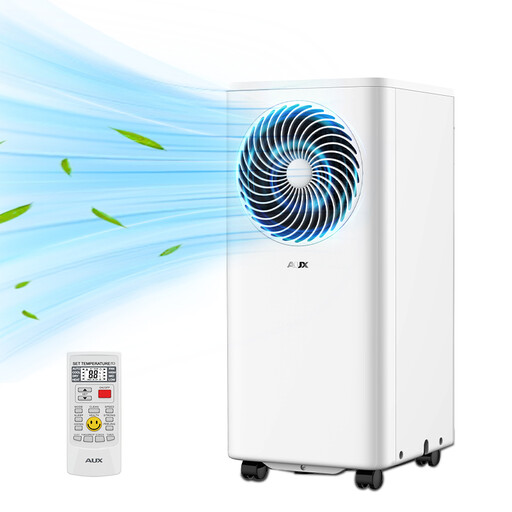
Why it suits this type of buyer: This compact 20 kg model is designed for bedrooms, living rooms, home offices and study rooms. Wi-Fi, a remote control and a 24-hour timer make it easy to use.
The official specifications list a cooling capacity of 2050 W, an airflow rate of 330 m³/u and a window kit included. However, check the difference between the stated 52 dB(A) claim and the technical figure of 64 dB.
3 functions, R290 refrigerant, self-evaporation, washable filter, and Wi-Fi or remote control operation.
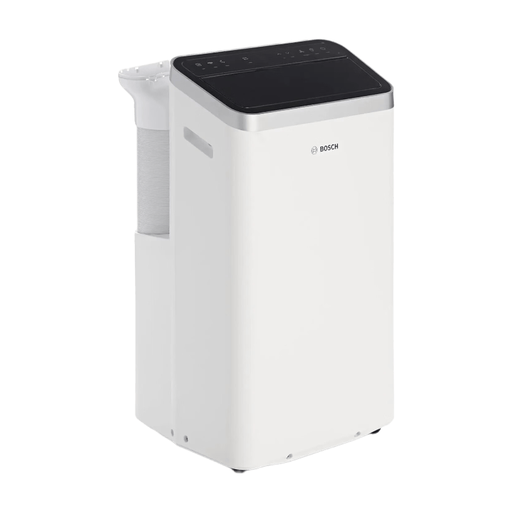
Why it suits this type of buyer: A good choice if you value straightforward controls and a more comprehensive package. According to the product information, this model is suitable for rooms up to 35 m².
The product specifications list a cooling capacity of 2,6 kW, a window installation kit and an integrated exhaust hose. Before buying, check that your window opens to at least 60 cm wide.
A+ according to the product description, 3-in-1 operation, touchscreen, remote control and automatic shut-off if the appliance overheats.
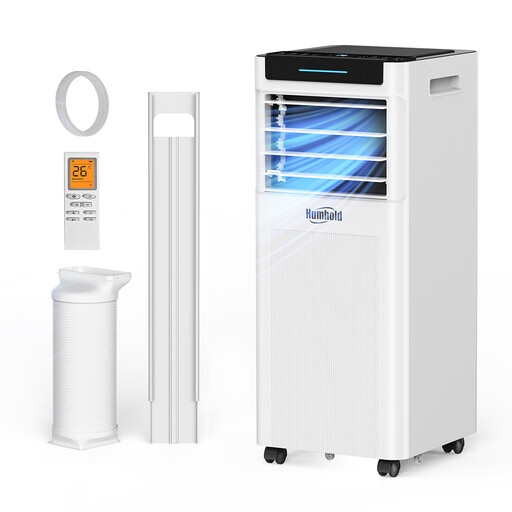
Why it suits this type of buyer: A sensible choice if you’re looking for a 7000 BTU portable air conditioner with sleep mode, dehumidifying and a comprehensive window exhaust kit.
The manual gives clear installation requirements: at least 50 cm of clearance, a hose with no kinks and an earthed socket without an extension lead.
7000 BTU, 24-hour timer, remote control, R290, self-evaporation and a stated noise level below 49 dB in quiet mode.
We’ve put together a complete, up-to-date list of products that meet these strict selection criteria and current European safety regulations.
Place the appliance on a level surface and keep the air inlet and outlet clear. Connect the exhaust hose securely and use an earthed socket. Don’t tilt the air conditioner while it’s running or move it while the compressor is operating.
Clean the washable filter regularly, following the manual. For the Humhold, for example, it’s recommended that you clean the filter about every two weeks and let it dry completely before putting it back. Switch off the appliance and unplug it before carrying out any maintenance.
Place the air conditioner near a window, attach the exhaust hose and fit the window kit around the opening. Keep the hose as straight as possible and check that no warm air is getting in around the seal.
It depends on the power rating and how long it runs. A model rated at 788 watts uses around 0,788 kWh per hour if it runs continuously. In practice, the compressor switches on and off, so actual consumption may vary.
Its lifespan depends on how it’s used and maintained, how it’s stored and the ventilation around the appliance. Clean the filter, keep the airways clear and store the air conditioner in a dry place when the cooling season is over. If there’s a fault or a refrigerant problem, always contact the retailer or manufacturer rather than trying to open the appliance yourself.
