
Vandaag of morgen in huis

Kwaliteit gegarandeerd

Welkomstaanbiedingen ontgrendelen: GRATIS bezorging | Tot 80% korting | Gratis 30 dagen JoyPlus-proefperiode
Download de app
A flat or underinflated car tyre at the roadside is frustrating, especially when there’s no petrol station nearby. A portable air compressor for car tyres can be just what you need, but not every compact device is up to the same task. Some models are mainly designed for bicycles and balls, while others offer enough pressure and capacity for car tyres.
When comparing models, don’t just look at the maximum PSI. The battery, airflow, connections and runtime all determine how well a pump works in practice.
A rating of 150 PSI sounds impressive, but it doesn’t tell you how much air the compressor actually moves or how long inflation will take. The recommended pressure for a standard car tyre is usually much lower. A pump with a high maximum pressure can still be slow if its airflow is limited.
So look at these factors too:
A small air pump for air beds, toys or balloons isn’t automatically suitable as a compressor for car tyres. For example, the Baseus PocketGo lists a pressure of 3.5 kPa, or around 0.5 PSI. According to the product information, it isn’t designed for car, SUV or motorbike tyres.
Always check that the device is suitable for your vehicle’s tyre pressure. Different pressure levels and valves are relevant for bicycle tyres, balls and car tyres.
A cordless tyre inflator is handy because you don’t need to run a 12V cable. However, the battery has a limited runtime. The Porbi Q19 is listed with a battery capacity of 4000 mAh and a runtime of up to 25 minutes. According to the product description, a full charge can typically handle two flat 195 car tyres, taking around 7 to 8 minutes per tyre.
That’s useful for emergencies and occasional top-ups, but less suitable for inflating several vehicles one after another. Check the charging time too, and whether it can be charged via USB-C.
On paper, a 150 PSI tyre inflator offers plenty of headroom for many cars, motorbikes and bicycles. Its real-world usefulness also depends on the airflow. The Porbi Q19 and Q16, for example, list an airflow of 26 l/min. This helps distinguish a proper tyre compressor from a low-pressure air pump.
For a car or electric car, it’s sensible to choose a model whose product description specifically mentions car tyres. Compact models are often unsuitable for lorry or trailer tyres. For example, the WORKPRO 8 V Mini Air Pump specifically states that it isn’t suitable for lorry or trailer tyres.
A tyre inflator with a digital pressure gauge makes it easier to set a target pressure in PSI, bar or kPa. Check that your preferred unit is available and that the display remains easy to read in low light.
A tyre inflator with automatic shut-off stops when the set pressure is reached, according to the product description. This can help prevent over-inflation, but always check your car’s recommended tyre pressure before use. You’ll usually find it on a sticker on the door frame, in the owner’s manual or near the boot.
A rechargeable tyre inflator is versatile for cars, motorbikes and bicycles. A model with a 12V connection, on the other hand, can keep running for as long as the car supplies power. Also look out for:
An LED light is useful if you break down at the roadside, but it doesn’t replace a warning triangle or other legally required safety equipment.
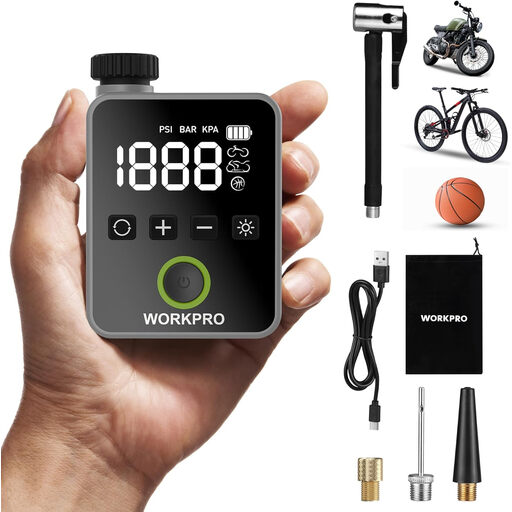
Why it suits this type of user: According to the product information, this compact cordless pump weighs 270 grams, so it fits in a glovebox, rucksack or cycle bag.
The product lists adjustable pressure from 3 to 140 PSI, automatic shut-off and several modes. However, the manufacturer states that this model isn’t suitable for lorry or trailer tyres.
Four modes, an LED screen, SOS lighting and included attachments for tyres, balls and other inflatables.
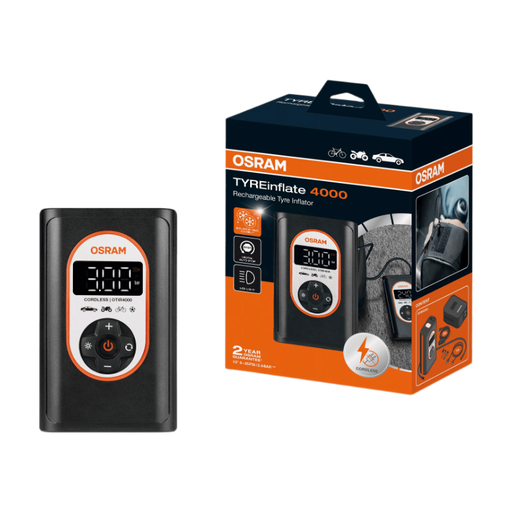
Why it suits this type of user: This model combines a rechargeable battery with a 12V cable, making it suitable for everyday use and longer journeys.
The product description lists both USB-C charging and power via the 12V socket. This means you’re less reliant on battery capacity alone.
Maximum working pressure of 8,3 bar, pressure memory for up to four vehicles, automatic shut-off, an LED light and a deflation valve.
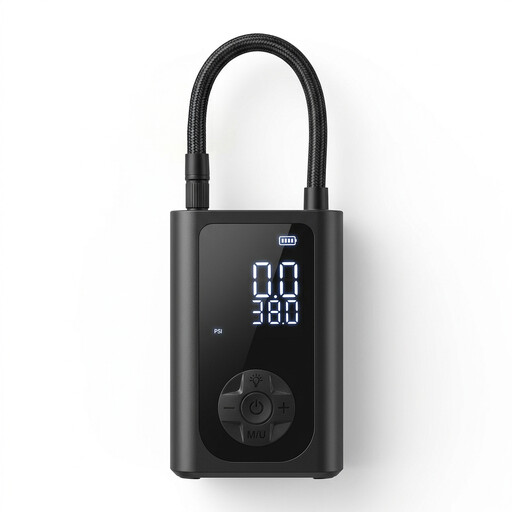
Why it suits this type of user: With a 4000 mAh battery, 26 l/min airflow and five preset modes, this model is well suited to drivers who also want to inflate motorbike and bicycle tyres and balls.
As well as the maximum pressure of 150 PSI, the product information also lists the airflow, charging time and estimated runtime. This gives you a more realistic idea of its performance.
Five modes, digital pressure measurement, automatic charging function, USB-C and LED lighting with steady and SOS modes.
We’ve put together a complete, up-to-date list of products that meet these strict selection criteria and the applicable European safety regulations.
The basic choice is the same for electric vehicles: check the permitted tyre pressure and choose a pump designed for car tyres. A cordless model is useful if the 12V socket is difficult to reach.
That depends on the battery capacity, airflow and maximum runtime. For regular top-ups, a compact rechargeable tyre inflator is often enough. For inflating several flat tyres one after another, a model with a 12V power supply may be more practical. Always follow the stated cooling and usage intervals.
Its lifespan depends on the number of charge cycles, storage temperature, runtime and maintenance. Keep the pump dry, avoid prolonged exposure to heat and charge the battery according to the manual. A battery left flat in storage for a long time may lose capacity more quickly.
A cordless pump uses relatively little electricity each time you use it, but it will need recharging over time. With a model that connects to a 12V socket, the energy comes directly from the car battery. The main practical costs are usually the purchase price and any wear to the battery, hose or adapters.
