
Vandaag of morgen in huis

Kwaliteit gegarandeerd

Welkomstaanbiedingen ontgrendelen: GRATIS bezorging | Tot 80% korting | Gratis 30 dagen JoyPlus-proefperiode
Download de app
A flat car or motorbike battery usually happens at the worst possible time. A portable 12V jump starter could get you back on the road without needing roadside assistance or jump leads. However, not every model is suitable for every car, motorbike, boat or light commercial vehicle. High amp ratings, limited compatibility information and unclear safety features can all lead to the wrong purchase.
This buying guide will help you compare a 12V car jump starter based on verifiable specifications, ease of use and portability.
A figure such as “2000A” sounds impressive, but it usually refers to the maximum peak current. That’s not the same as the current available continuously over several starting attempts. So check:
A 2000A jump starter may look powerful on paper, but that doesn’t automatically make it suitable for every vehicle.
A 20,000 mAh lithium-ion battery has a larger energy reserve than a 10,000 mAh model, but capacity alone doesn’t determine whether a jump starter can start an engine. The internal battery, cables, clamps and peak current all play a part too.
Look out for the difference between:
A lithium-ion jump starter with a power bank function can be handy on the go, but a standard power bank isn’t a substitute for a jump starter.
Connecting the clamps incorrectly can cause damage. Check whether the product description mentions features such as reverse polarity protection, spark-free connection, short-circuit protection or a boost function for a low-voltage battery.
These features don’t guarantee that every starting attempt will work. Always follow the instructions, check the battery voltage and don’t use a jump starter with a 24V system unless this is explicitly stated.
Choose the starting power to suit your vehicle, not just the price. A compact jump starter may be sufficient for a small petrol car or motorbike. For a larger petrol engine, diesel car or light commercial vehicle, a model with a higher stated peak current is a more sensible choice.
Also check whether the manufacturer says the model is suitable for:
A 12V model isn’t suitable for heavy 24V lorries, buses or high-voltage batteries in electric vehicles.
A capacity of 16,000 to 20,000 mAh also gives you the option of charging mobile devices. Check the charging method too. QC 18W is useful for compatible devices, while USB-C Power Delivery can provide higher output power.
Store your jump starter in a dry place, away from direct sunlight and not in an extremely hot car. Recharge it after use. If you don’t use it for months, check the charge level regularly and follow the maintenance advice in the instructions.
A jump starter with a display makes it easier to check the remaining charge or charging status. Check the cable length and the quality of the clamps too. A boost function may be designed for batteries with very low voltage, but the minimum activation voltage varies by model.
According to the product descriptions for the CAROSS models below, spark-free technology and reverse polarity protection are included. Treat these as manufacturer specifications and always check the current instructions before use.
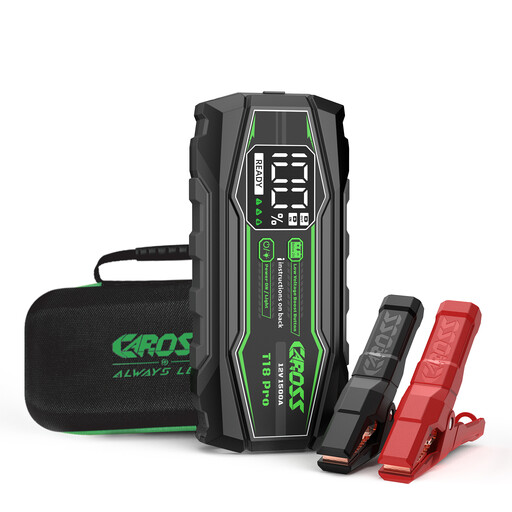
Why it suits this profile: The 16,000mAh lithium-ion battery, 2.3-inch display and included protective case provide a straightforward option for motorists and motorcyclists who want to carry an emergency solution with them.
The specifications give more than just the peak current: they also include the capacity, boost function, spark-free technology and reverse polarity protection.
1500A peak current, 16,000mAh capacity, QC 18W output and a protective case, according to the product description.
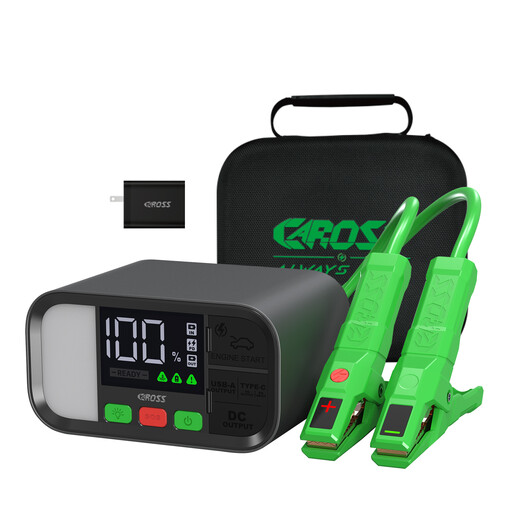
Why it suits this profile: If you want to charge a laptop, tablet or phone on the go as well as jump-start your vehicle, this model has a 65W USB-C PD output and a 3-inch digital display.
The product description mentions Smart Connect with non-polarised clamps and automatic polarity detection. Check the indicator and follow the instructions before jump-starting.
1600A peak current, 16,000mAh lithium-ion battery, 65W PD output, display and protective case, according to the product specifications.
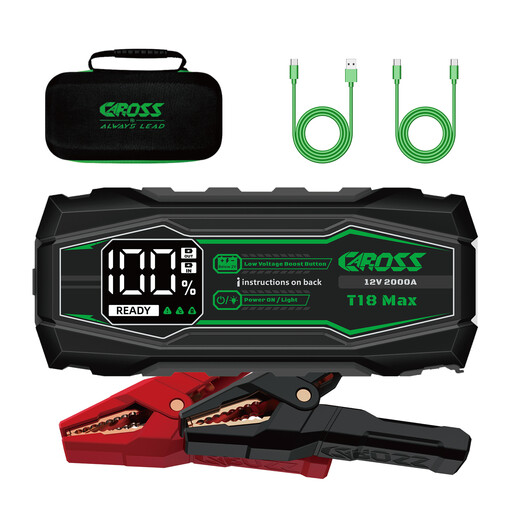
Why it suits this profile: This model is aimed at users looking for a higher stated peak current and greater battery capacity for a range of compatible 12V vehicles.
As well as 2000A and 20,000mAh, the product description lists a boost function, spark protection, reverse polarity protection and a digital display.
2000A peak current, 20,000mAh lithium battery, QC 18W charging, 2.3-inch display and included protective case.
We’ve put together a complete, up-to-date list of products that meet these strict selection criteria and the applicable European safety regulations.
Switch off the vehicle and first check that the jump starter is sufficiently charged. Connect the red clamp to the positive terminal and the black clamp to the negative terminal or a suitable earth point, unless the instructions specify a different method. Only activate the boost function if the instructions say it’s needed. Crank the engine briefly, then disconnect the clamps once it’s running.
Its lifespan depends on charging cycles, storage temperature, moisture and maintenance. Don’t leave the device discharged for long periods, and store it in the supplied case. Check the charge level regularly, even if you rarely use the jump starter. A lithium-ion battery also gradually ages, even with limited use.
After purchase, running costs are usually limited to the electricity used to recharge it. The main expense is replacing the battery when its capacity decreases over time. A model that also works as a jump starter with power bank may be more practical if you regularly use it to charge phones or other devices. Just make sure you check the stated output power and compatibility with your devices.
