
Vandaag of morgen in huis

Kwaliteit gegarandeerd

Welkomstaanbiedingen ontgrendelen: GRATIS bezorging | Tot 80% korting | Gratis 30 dagen JoyPlus-proefperiode
Download de app
A portable 11 kW Type 2 EV charger is handy if you want to charge at home, at a family member’s house or while travelling using a suitable CEE socket. You can keep the charging unit in your car and usually connect it to the vehicle using a Type 2 connector. However, not all portable charging solutions are the same. A low price or long cable says little about whether a charger is suitable for your car and power supply.
An 11 kW electric car charger typically uses three phases, with a maximum of 16 amps per phase. Your car must also support this charging capacity. If it has an onboard charger rated at, for example, 3.7 kW or 7.4 kW, it won’t automatically charge at 11 kW.
The actual charging speed depends on:
So, an 11 kW portable charger does not guarantee charging at 11 kW.
A Type 2 charging cable is suitable for many electric cars and plug-in hybrids in Europe, but always check your vehicle’s manual. The mains connection matters too. A CEE plug-in charging cable won’t fit every socket, and a standard domestic plug delivers different charging performance from a suitable three-phase connection.
So, check:
Don’t use an arbitrary adapter to get around an unsuitable connection.
An EVSE charging unit should regulate the charging current and stop charging if a problem occurs. Don’t just look at a list of safety features; check the specifications too. Look for overcurrent, overvoltage and undervoltage, residual-current and overheat protection.
An IP rating indicates protection against dust and water in certain conditions. IP65 or IP66 does not mean you can submerge the charging unit. During use, place the controller somewhere dry and stable, and follow the instructions.
An 11 kW 3-phase car charger typically uses a maximum of 16 A. Adjustable charging current is useful if the connection can’t always handle the same load. For example, a 16 A EV charger with several settings can be adjusted to suit the available power supply.
Before buying, check whether the product page lists the following:
If you’re unsure about the protection, wiring or load on the circuit, ask a qualified installer to check the connection.
A 5-metre cable is often easier to store than a 10-metre one. A longer cable can be useful if the socket is further from your parking space. Consider the weight and stiffness of the cable, as well as where you’ll place the control box.
An LCD screen can show the charging current, power or charging status. This makes it easier to check whether the portable EV charger is working correctly. An app is particularly useful if you want to schedule charging or monitor it remotely. Check whether it requires Wi-Fi or Bluetooth, and whether the app is compatible with your phone.
According to the product information for the feyree models, features include residual-current, overload, overheat and overvoltage protection. The Wi-Fi model is also listed as having residual-current protection with AC and DC detection. These are manufacturer product specifications; correct installation and use also affect how the charger performs.
Don’t use an electric car charging cable:
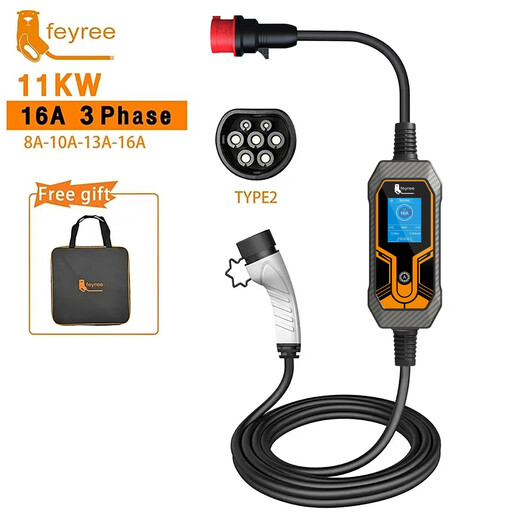
Why it suits this type of user: This portable charger is designed to be easy to carry and use with a CEE socket, without any extra app features.
The product information lists an adjustable charging current and an LCD screen, so you don’t have to rely solely on the theoretical maximum.
Type 2 compatibility according to the product description, an IP65 rating and listed protection against overcurrent and overheating, among other things.
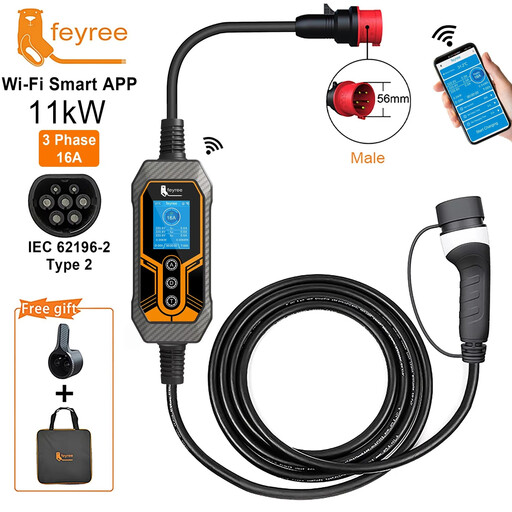
Why it suits this type of user: Ideal if you want to manage charging status, current settings and scheduled charging times through an app or the control box.
Adjustable settings from 8 A to 16 A help you match the charging current to the available connection and your car.
2.8-inch LCD screen, app control, scheduled charging and, according to the product information, IP66 protection for the connector.
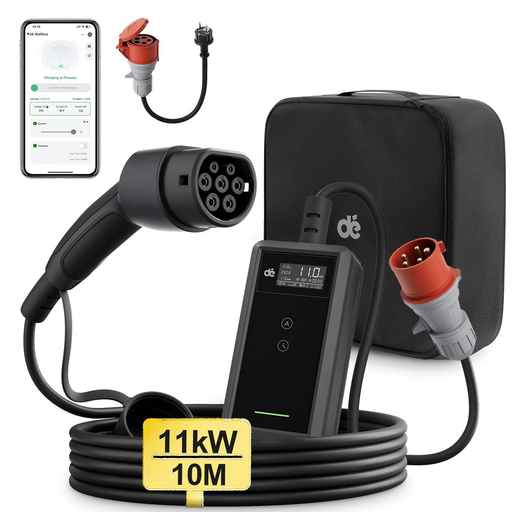
Why it suits this type of user: The 10-metre cable can be useful if your parking space isn’t right next to the CEE socket.
The product name specifies 3-phase charging, adjustable current from 6–16 A and a Schuko adapter. Before use, check that the adapter is suitable for your situation.
10-metre cable, app mentioned and 11 kW rating according to the product name.
We’ve put together a complete, up-to-date list of products that meet these strict selection criteria and the applicable European safety regulations.
No. An 11 kW charger typically requires a suitable three-phase 16 A connection. A standard domestic socket is not an equivalent alternative. Only use an adapter if it is specifically intended for the charging solution and the connection is correctly protected.
That depends on the usable battery capacity, charge level and the car’s onboard charger. If a car accepts 11 kW, you can theoretically add around 11 kWh per hour. In practice, charging losses and temperature can affect the result.
The charging unit itself uses relatively little additional energy; the main cost comes from the electricity used to charge the battery. To work this out, multiply the number of kilowatt-hours charged by your electricity tariff. Depending on the model, you can use an app or LCD screen to keep track of the charging process and energy use.
