
Families who like to plan ahead
If you prepare several breakfasts or lunch pots each week, you can compare the pack size with how much your family uses. For example, Jumbo offers wholegrain porridge oats in 500 g and 1 kg packs.


If several members of your family eat porridge regularly and you measure out portions at home, a large pack is a sensible choice. Fine flakes are ideal for a quick breakfast, while individual sachets save you measuring them out; just check that the pack contains enough for your family. For a school lunch, always take the current allergen label, preparation method and school rules into account.
If you prepare several breakfasts or lunch pots each week, you can compare the pack size with how much your family uses. For example, Jumbo offers wholegrain porridge oats in 500 g and 1 kg packs.
If you want to prepare a measured portion quickly at home, individual sachets are an alternative to weighing out the oats yourself. Albert Heijn describes Quaker Oats Express Naturel as twelve 27 g portions, ready in two minutes.
If someone has coeliac disease or an allergy, or the school has specific rules, the product label will help determine which option to choose. According to the Voedingscentrum, ordinary porridge oats are not automatically suitable for someone with coeliac disease; check the packaging for the official Crossed Grain trademark.
First, work out how much porridge your family gets through and whether you’ll prepare it at home or pack it for school. Then check the label and the school’s rules for the ingredients you want to pack.
| What to consider | What to check when buying | Who should pay particular attention? |
|---|---|---|
| Pack size | Compare the pack size with the number of portions you actually want to prepare. If you buy a large pack, check how to keep it dry and sealed. | If I’m measuring out porridge for several family members, I don’t want to keep needing a new pack. Around 40% of consumers prioritise having the right amount in stock for their family. |
| Preparation and portions | Check whether you need to measure the oats out yourself or get individual sachets, and how to prepare the product you’ve chosen. | On a busy morning, I want to make a set amount quickly at home. That’s why around 30% of consumers prioritise easy measuring and preparation. |
| Allergens and school rules | Read the current label; if you have coeliac disease, look for the official Crossed Grain trademark. Ask what the school allows and how a prepared pot can be stored. | If my child needs to avoid certain ingredients, I want to know what’s in this specific product before packing it. Around 30% of consumers say this is their main concern. |
A 1 kg pack is only practical if your family uses it regularly and you can store the oats properly.
Think about how many portions you usually prepare and choose a pack size to match. Store opened porridge oats in a dry, sealed container.
According to the Voedingscentrum, oats may come into contact with gluten during processing. Allergen statements also vary from product to product.
If you have coeliac disease, check for the official Crossed Grain trademark and read the ingredients and allergen information on the pack every time you buy.
A prepared pot containing milk or yoghurt needs to be stored differently from an unopened pack of dry oats. If the pot will be eaten at school, the storage options available there matter.
Ask in advance how the pot can be stored at school, and follow the rules on hygiene and allergens.
Jumbo’s range includes wholegrain porridge oats in 500 g and 1 kg packs. This makes the brand worth considering if you’re working out how much to keep in stock.
According to ALDI, Golden Bridge offers fine wholegrain porridge oats in a 500 g pack; ALDI also lists a coarse-flake version.
Albert Heijn describes Brinta Porridge Oats 450 g as extra-fine flakes for a quick hot breakfast at home.
According to Albert Heijn, Quaker Oats Express Naturel is available in twelve individual 27 g portions for preparation at home.
These products come in packs of porridge oats for preparing breakfast or a portion to eat later at home. Check each version’s pack size, portion format and allergen information to make sure it suits your family and the school’s rules.
 Image unavailable
An option for preparing porridge at home for a school day. The pack contains 324 g; check the portion format and current allergen label before choosing this version.
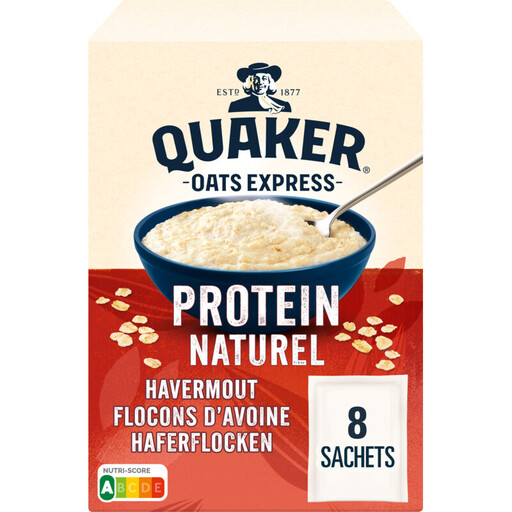 Image unavailable
A 302 g pack for preparing at home. Check how many portions this version contains, whether they’re individually wrapped and what the current label says about soya and gluten.
 Image unavailable
For anyone who wants to prepare porridge at home and measure out the amount themselves. Albert Heijn describes this 450 g pack as extra-fine flakes and lists eleven 40 g portions. Read the current label if gluten or other allergens are a concern.
Not necessarily. According to the Voedingscentrum, oats may come into contact with gluten during processing. If you have coeliac disease, only choose porridge oats with the official Crossed Grain trademark on the packaging, and read the current label.
That depends on the school’s rules and storage facilities. Ask how a prepared pot containing dairy can be stored, and check that the ingredients meet any allergy requirements. The Voedingscentrum lists porridge with yoghurt as a possible school meal, but that doesn’t determine every school’s policy.
Individual sachets are handy when you want a set amount without measuring it out yourself. If several members of your family eat porridge regularly, a large pack gives you the flexibility to measure out portions as needed. Check how many individual portions the specific product contains.
Don’t automatically make it a regular one-for-one replacement. The Voedingscentrum says oat products can replace bread occasionally, but points out that iodine is added to bread and not to porridge oats. So make sure your overall diet includes a good variety of foods.