Choose plain wholegrain porridge oats if you want to decide what to add yourself and prefer a short ingredients list. If you want more protein from the oats themselves, compare protein and sugars per 100 g in protein-enriched varieties, and check the ingredients and allergen information too: more protein does not automatically mean a product contains no added sugars.
Who should pay attention to the differences?
Breakfast eaters keeping an eye on protein
If you want more protein from the dry oats themselves at breakfast, the figures per 100 g are a useful starting point. Albert Heijn lists 20 g of protein per 100 g for AH Volkoren havermout proteïne, while Quaker Nederland lists 22 g for Oats Express Protein Naturel, compared with 11 g for Quaker Havermout Original. The amount in your whole meal also depends on your portion and what you add.
Shoppers who want to choose their own additions
A simple oat base lets you choose what to add to your porridge. Quaker Nederland lists 100% wholegrain porridge oats as the ingredient in Havermout Original; according to Albert Heijn's product information, Brinta Havermout is made from 100% oat flakes.
People who want a quick breakfast
Portion packs save you weighing ingredients, while fine flakes are designed for quick preparation. Quaker Nederland offers Oats Express Naturel in portion packs; Albert Heijn describes the flakes in Brinta Havermout as extra fine.
What should you look for when choosing?
First decide whether you mainly want more protein from the oats themselves or would prefer a simple base you can add to. Then compare the nutritional information per 100 g and read the ingredients and allergen information.
Plain wholegrain porridge oats
Choose these if: you want to decide for yourself what to eat with your oats.
Trade-off: the amount of protein in your breakfast will also depend on your portion and what you add.
Protein-enriched porridge oats
Choose these if: you want more protein from the dry oats themselves.
Trade-off: the varieties reviewed also contain soya; check separately whether any sugars have been added.
| What to consider |
What to check when buying |
Who is this important for? |
| Protein per portion |
Compare protein per 100 g and calculate the amount for the portion you actually use; check the source of the protein too. |
If I want more protein from my porridge oats, I don't just look at the name on the pack. Around 36% of consumers prioritise protein from the oat base. |
| Sugars and ingredients |
Read the ‘of which sugars’ figure per 100 g and the ingredients list; separately check whether the pack says ‘no added sugars’. |
I want a base where I can choose the additions myself, without assuming that a low sugar figure proves nothing has been added. This is the main consideration for around 29% of consumers. |
| Allergens |
Check the current packaging for soya and statements about cereals containing gluten or possible traces. |
If I need to avoid certain ingredients, allergen information matters more than the protein content. This is a priority for around 21% of consumers. |
| Preparation and portions |
Check the portion size and preparation instructions, and whether you want loose flakes or portion packs. |
On a busy morning, I want to spend less time weighing ingredients, while still knowing how much porridge oats are in a portion. Around 14% of consumers give this convenience top priority. |
Common mistakes
-
Assuming more protein means no added sugars
Albert Heijn lists 20 g of protein per 100 g for AH Volkoren havermout proteïne, but also 0.8 g of added sugars per 100 g. So the protein figure alone won't tell you whether you've avoided added sugars.
Assess protein, ‘of which sugars’, any added sugars and the ingredients separately.
-
Comparing prepared porridge with dry oats
The nutritional values for a prepared portion of Brinta made with semi-skimmed milk include the milk too. They are therefore not directly comparable with figures per 100 g of dry porridge oats.
First compare the dry products using the same quantity, then take into account what you add to your porridge.
-
Skipping the allergen information
The protein-enriched varieties reviewed from Albert Heijn and Quaker contain soya. Quaker Nederland also states that Oats Express Protein Naturel may contain barley and wheat.
If you need to avoid these ingredients, check the current ingredients and allergen information on the packaging every time you buy.
Brands compared
Quaker
Quaker Nederland offers both plain Havermout Original and Oats Express varieties, including one with added soya protein.
- According to Quaker Nederland, Havermout Original contains 100% wholegrain porridge oats, 1.1 g of sugars and 11 g of protein per 100 g.
- Oats Express Protein Naturel lists 22 g of protein per 100 g, but contains soya and may contain barley and wheat.
Albert Heijn
AH Volkoren havermout proteïne is a protein-enriched own-brand option for anyone wanting to compare the composition of a dry oat base.
- Albert Heijn lists 20 g of protein and 1.9 g of sugars per 100 g.
- The ingredients include soya protein isolate; Albert Heijn also lists 0.8 g of added sugars per 100 g.
Brinta
According to Albert Heijn's product information, Brinta Havermout consists of extra-fine oat flakes for quick preparation.
- The ingredients list for this variety names 100% oat flakes.
- The allergen information states that the product may contain wheat or rye. Don't compare the nutritional values of prepared porridge directly with those of dry flakes.
Jumbo
Jumbo offers a variety of fine wholegrain oat flakes, among others, whose nutritional values can be compared in their dry form.
- For Jumbo Havermout Fijne Vlokken Volkoren, Jumbo lists only wholegrain oat flakes as an ingredient, with 13.5 g of protein and 0.7 g of sugars per 100 g.
- Don't assume these figures apply to other Jumbo varieties; check the nutritional information for the specific product.
Porridge oats on Joybuy
This selection features protein-enriched porridge oats for anyone who wants to compare protein and sugars. If you'd rather choose what to add yourself, plain porridge oats are another option.
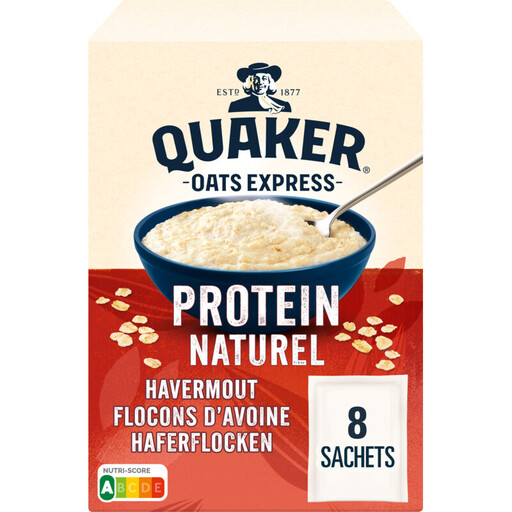 Image unavailable
Quaker Oats Express Protein, 302 g
A protein-enriched porridge oat variety for anyone who wants more protein from the oat base itself.
The pack contains 302 g. Check the protein value and portion size on the label for your usual serving; also look out for soya and possible barley and wheat.
View on Joybuy
Frequently asked questions
Does ‘no added sugars’ mean porridge oats contain no sugars?
No. Quaker Nederland lists both ‘no added sugars’ and 1.1 g of naturally occurring sugars per 100 g for Havermout Original. So check the ‘of which sugars’ line and the ingredients list too.
How do you compare regular and protein-enriched porridge oats for breakfast?
Compare the protein content of the dry products per 100 g, then consider your portion and what you add. The Voedingscentrum lists 5.1 g of protein for 40 g of regular porridge oats; according to Albert Heijn and Quaker Nederland, the protein-enriched varieties reviewed list 20 g and 22 g per 100 g. These figures are not based on the same portion size.
What should you look for if you avoid soya or cereals containing gluten?
Check the current ingredients and allergen information on the specific pack. According to Albert Heijn, AH Volkoren havermout proteïne contains soya protein isolate; Quaker Nederland lists soya protein for Oats Express Protein Naturel and says that this variety may contain barley and wheat. Don't rely on the product name alone, even for plain porridge oats.


