
Households that eat porridge oats regularly
If you order for several people or meal occasions at once, a larger pack lets you decide how much you need each time. Quaker, Jumbo and ALDI offer packs worth considering if you’re looking to stock up.


Choose a bulk pack of porridge oats if you want to measure out portions yourself for recurring meal orders for several people. If pre-measured portions matter more, instant sachets are a better fit. Fine oats are a middle ground when you want to make porridge quickly without individual sachets. Always compare the amount per portion, and if you have coeliac disease, check the current label and the official Crossed Grain symbol.
If you order for several people or meal occasions at once, a larger pack lets you decide how much you need each time. Quaker, Jumbo and ALDI offer packs worth considering if you’re looking to stock up.
If porridge oats are prepared separately alongside a delivered meal, a portion sachet can save you weighing them out. Quaker lists 27 g sachets of Oats Express Naturel, with a preparation time of 2 minutes.
Regular porridge oats are not automatically suitable for someone with coeliac disease. The Voedingscentrum advises checking for the official Crossed Grain symbol on oat products; also check the latest allergen information with every order.
Choose this if: several people eat porridge oats regularly and you want to measure out the amount yourself.
Bear in mind: you’ll need to weigh out portions and store the pack in a cool, dry place, sealed well after opening.
Choose these if: you want to measure out your own portions but make porridge quickly; Brinta says its fine oats take around 2 minutes in the microwave.
Bear in mind: the Brinta box reviewed contains 450 g, so it offers less than the 600 g and 1 kg packs mentioned.
Choose these if: individual, pre-measured portions make meal preparation easier.
Bear in mind: a sachet of Quaker Oats Express Naturel contains 27 g, compared with the 40 g per portion stated on Quaker’s 600 g pack.
| What to consider | What to check when buying | Who this matters to |
|---|---|---|
| Stock and portioning | Compare the total weight, the number of stated portions and whether you can seal the pack properly after opening. | If I’m ordering for several meals at once, I want enough in stock and to choose the amount myself. Around 46% of consumers would consider stock levels their main concern. |
| Preparation and portion size | Check the preparation instructions on the pack and the number of grams per sachet or portion measured out yourself. | When ordering individual meals, I don’t want to weigh out porridge oats every time, but I do want to know how much is in each portion. For around 36% of consumers, a quick, set portion would be the priority. |
| Allergens | Read the current label and allergen information; if you have coeliac disease, check for the official Crossed Grain symbol. | When ordering for someone with coeliac disease, I first need to be able to check whether this particular pack is suitable. Checking allergens would be the top priority for around 18% of consumers. |
Twelve sachets of Quaker Oats Express Naturel contain 324 g in total; each sachet contains 27 g. So the number of sachets alone doesn’t tell you how much porridge oats you’re buying.
Compare the total weight and the weight per portion with the number of people and meal occasions you’re ordering for.
According to the Voedingscentrum, oat products may come into contact with cereals containing gluten. So a regular pack is not automatically suitable for someone with coeliac disease.
For this purpose, check for the official Crossed Grain symbol and read the label and allergen information again with every order.
Albert Heijn gives the nutritional values for Brinta Havermout as prepared with semi-skimmed milk, while values per 100 g of dry oats describe something different.
Compare nutritional information on the same basis, such as per 100 g of dry product, and keep the ingredients added to the prepared portion separate.
The Dutch product information reviewed lists both a 600 g pack of porridge oats and Oats Express Naturel in portion sachets.
The Brinta Havermout reviewed contains extra-fine oats for those who want to measure out their own portions.
Jumbo showed fine wholegrain porridge oats in a 1 kg value pack for anyone looking to stock up.
The range shown at ALDI includes fine or coarse wholegrain porridge oats in 1 kg packs.
These products suit those looking for a quick porridge option. If you’re looking for a large pack to measure out portions yourself, use the comparison above, but don’t consider these two packs bulk options.
 Image unavailable
For portions prepared individually: the product description lists 12 portion sachets and says they can be prepared in 2 minutes in the microwave or in a pan.
The pack contains 324 g in total. If you’re ordering for someone with coeliac disease, check the current label and the official Crossed Grain symbol.
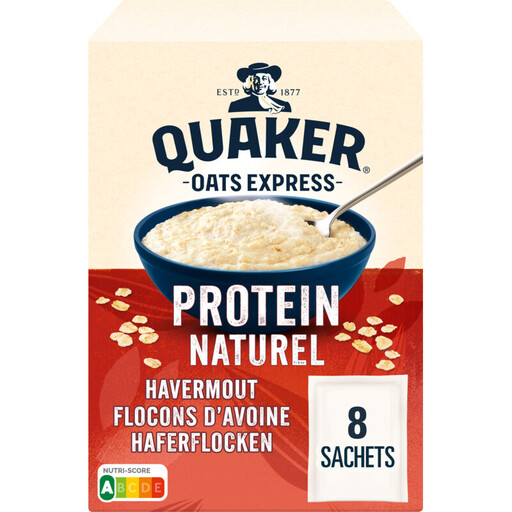 Image unavailable
For anyone looking for a quick way to prepare porridge oats: the product description gives a preparation time of 2 minutes.
The pack contains 302 g. Check whether the pack format suits individual portions; don’t infer a nutritional claim from the model name. If you have allergies or coeliac disease, read the current label and check for the official Crossed Grain symbol if needed.
A bulk pack is a good choice if you regularly make several portions and can measure them out yourself. Portion sachets are better if you need a set amount for each person; just compare the weight per sachet with the portion you want to prepare.
Not necessarily: Albert Heijn lists 27 g per sachet for Quaker Oats Express Naturel, while Quaker’s 600 g pack is based on 40 g portions. So check the number of grams per person, not just the number of sachets.
No. The Brinta Havermout reviewed contains fine oats that you measure out yourself and has a short preparation time; Quaker Oats Express Naturel is divided into individual sachets in advance. Check the preparation instructions for each product.
Not automatically. The Voedingscentrum notes that oats may come into contact with cereals containing gluten and advises people with coeliac disease to choose oat products bearing the official Crossed Grain symbol. Also check the current label on the pack you order.