
Breakfast eater looking to avoid added sugar
You’re looking for a simple oat base rather than a sweetened mix. Read the ingredients list and compare the sugars per 100 g, as the Netherlands Nutrition Centre recommends when comparing labels.


Choose plain porridge oats with an ingredients list that suits your aim of avoiding added sugar, then compare the sugars per 100 g. Loose flakes let you choose your own portion size; sachets can be more convenient on busy mornings, but remember to compare the packaging and cost per kilo too.
You’re looking for a simple oat base rather than a sweetened mix. Read the ingredients list and compare the sugars per 100 g, as the Netherlands Nutrition Centre recommends when comparing labels.
You want to prepare a measured portion quickly. For sachets, check the ingredients of the exact variety you’re buying: plain and flavoured versions may not have the same ingredients.
You want to measure out what you use, so you’re comparing loose flakes with portion packs. Remember to check the pack size and storage instructions too.
Start with the ingredients and nutritional information per 100 g. Then decide how much convenience a pre-measured portion is worth to you and which pack size suits your household.
| What to consider | What to check when buying | Who it matters to |
|---|---|---|
| Added sugar | Read the ingredients list and compare ‘of which sugars’ per 100 g across similar oat products. This nutritional value also includes naturally occurring sugars. | If I want to put together a simple breakfast, I want to be able to see what ingredients are in the porridge oats. Around 50% of consumers prioritise avoiding added sugar. |
| Ease of preparation | Check the preparation time, portion size and ingredients of the plain variety you’ve chosen. | On busy mornings, I don’t want to measure out a portion every time, but I also don’t want to automatically choose a sweetened mix. Around 30% of consumers give convenience top priority. |
| Packaging and use | Compare the cost per kilo, pack size and storage instructions for loose flakes and sachets. | In a smaller household, I want to be able to portion out what I need and finish the pack. For around 20% of consumers, this is the most important factor in their choice. |
Biscuits, bars and ready-made porridge can also contain oats. That doesn’t mean their ingredients or nutritional values are the same as those of plain porridge oats.
Compare a convenience product with plain porridge oats by checking the ingredients list and nutritional information per 100 g.
‘Of which sugars’ shows the total amount of sugars; on its own, the figure doesn’t tell you whether a sweetener has been added.
Read the ingredients list too, and look out for ingredients such as sugar, honey and syrup.
Individual sachets can suit a set routine, but the type of packaging also affects what you’re buying.
Compare the cost per kilo and decide which mornings a pre-measured portion would make a difference for you.
Milk, yoghurt and toppings all contribute to the nutritional value of your breakfast. The values on a pack of dry porridge oats don’t automatically describe the prepared bowl.
When comparing breakfasts, consider what you add to your porridge oats too.
The plain porridge oats are an option if you want to portion out loose oat flakes yourself.
Oats Express Plain is a portion-sized option for anyone looking for a set amount and quick preparation.
The own-label range includes loose fine and coarse wholegrain porridge oats, including a 1 kg pack.
ALDI Netherlands sells its fine wholegrain porridge oats in a 500 g pack.
These products include loose porridge oats and an Express variety for anyone considering preparation time. Compare the ingredients on the exact pack: the Express Protein variety is not the same product as Oats Express Plain.
 Image unavailable
For anyone who wants to measure out loose oat flakes and put together breakfast to suit their tastes.
450 g pack. Joybuy lists 100% oat flakes as the ingredient and 0.8 g sugars per 100 g. If you have a relevant allergy, check the allergen information on the pack.
 Image unavailable
For anyone who wants to compare a loose pack with other oat products and measure out their own portions.
500 g pack. Check the product label for the exact ingredients, allergens and sugars per 100 g.
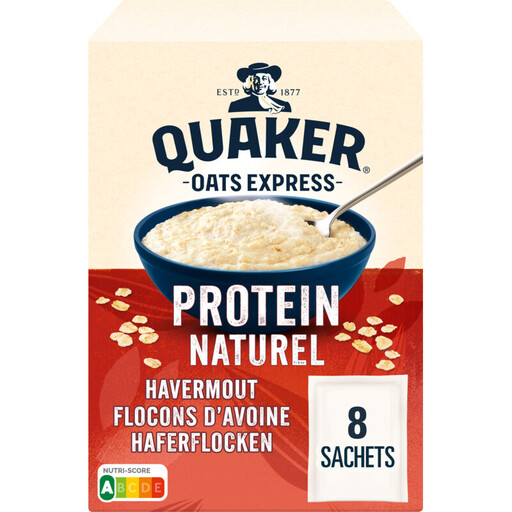 Image unavailable
For anyone considering an Express variety and wanting to compare its ingredients with regular porridge oats.
302 g pack. This is the Protein variety; don’t assume the information for Oats Express Plain applies to it. Check the ingredients and allergens for this variety, especially if you’re looking for oats only or need to avoid soya.
No. A product with no added sugars may still contain naturally occurring sugars. Check both the ingredients list and ‘of which sugars’ per 100 g; for example, Jumbo lists 1 g sugars per 100 g for Quaker Oats Express Plain.
First compare the nutritional information per 100 g, as the Netherlands Nutrition Centre recommends. Then consider how much you use for breakfast and which ingredients you add.
Treat an oat bar as a different type of product, not as the same oat base. According to the Netherlands Nutrition Centre, pre-packed oat bars often contain plenty of sugar, saturated fat and calories too; check the ingredients and nutritional information for the specific bar.
Follow the storage instructions and use-by date on the pack you choose. Before buying, check whether the pack size suits how much porridge oats you use.