Who is this guide for?

An extra snack for school

For parents and pupils who want to pack popcorn alongside a balanced lunch and find out what the portion weight means for its nutritional values. The Netherlands Nutrition Centre stresses that getting enough energy and eating a varied diet remain important during growth.

Take control of what you add

For anyone who wants to pop corn at home and decide how much oil, sugar or salt to add. Check the allergen information on the packaging of popping corn too: Albert Heijn states that AH Biologisch Popcorn mais may contain cereals containing gluten, soya and wheat.

Quick to pack for the school bag

For anyone who wants a snack to take along without cooking, or would rather make popcorn in the microwave at home. Ready-to-eat popcorn and microwave popcorn involve different steps. Jumbo says that children must not prepare its Magnetron Popcorn Zout without adult supervision.

What should you look for when choosing?

Compare the exact variant and the amount you’ll take with you. If you’re making popcorn yourself, remember to factor in any ingredients you add.

What to consider What should you check? Who is this important for?
Portion and energy Check the kcal per 100 g and the weight of the portion you’ll actually take with you. If I want to know what my extra snack adds to my diet, I weigh the amount rather than looking only at the figure per portion on the packaging. Around 36% of consumers give portion size and energy top priority.
Sugar, salt and oil Compare sugars, salt and fats per 100 g, and check the ingredients list for the exact variant. If you choose a sweet or savoury flavour, you’ll also want to know which ingredients it contains and how much sugar, salt or oil is in the variant. This is the top priority for around 29% of consumers.
Preparation and packing Choose a product type that fits your morning routine; follow the instructions on the packaging for microwave popcorn. If I’m short on time, it matters whether the popcorn is ready to eat or needs to be prepared at home. Around 21% of consumers consider convenience when preparing and packing to be most important.
Cost per snack occasion Compare packs on a like-for-like basis and work out the cost for the amount you’ll actually use. If you’re buying popcorn for several school days, you’ll want to know how many usable snack portions a pack provides and whether it’s practical to portion out. Cost per snack occasion is the top priority for around 14% of consumers.

Common mistakes

  • Assuming a low figure per portion proves popcorn is low in calories

    A small portion may provide little energy simply because it weighs very little. For a ‘low energy’ claim on solid foods, the European Commission sets a maximum of 40 kcal per 100 g; a smaller portion doesn’t change that threshold.

    Look at the portion weight and nutritional value per 100 g together. Don’t call a snack ‘low-calorie’ just because a measured portion has a low total figure.

  • Comparing calories alone

    A lower energy content doesn’t tell you how much sugar or salt a product contains. For example, AH Popcorn zoet lists fewer kcal per 100 g than AH Zoute popcorn, but also more sugars per 100 g.

    Compare the nutrition table and ingredients list for the variants you’re considering, then decide which trade-off matters for your snack.

  • Treating dried popping corn as the same as prepared popcorn

    The nutritional values for dried popping corn don’t automatically describe a prepared portion made with oil or other additions. The weight before and after preparation also isn’t a like-for-like basis for comparison.

    Keep the amount of corn separate from the weight of the prepared snack. If you’re using your own recipe, include all the ingredients in your calculations.

  • Treating a large pack or microwave bag as one school snack

    A pack may contain several portions, and a microwave bag still needs to be prepared at home. So the amount in the pack isn’t necessarily the amount you’ll want to take to school.

    Decide in advance how much you’ll pack. For microwave popcorn, follow the instructions and warnings on the exact packaging.

Brands to consider

Albert Heijn

Albert Heijn’s product information covers corn for popping at home, ready-to-eat sweet and salted popcorn, and microwave popcorn. These product types differ in how they’re prepared and their nutritional values.

  • The product pages provide nutritional values and portion details for the variants mentioned, making it easier to compare them.
  • Organic, sweet, salted and microwave are not interchangeable descriptions, and none of them proves that a product is low in calories.

Jumbo

Jumbo’s product information covers ready-to-eat salted popcorn and microwave popcorn.

  • Jumbo Magnetron Popcorn Zout carries a warning that children must not prepare the popcorn without adult supervision.
  • For its ready-to-eat salted variant, Jumbo states that it may contain milk. Check the allergen information on the exact packaging.

Lidl

Lidl Netherlands lists Snack Day Popcorn zeezout as a ready-to-eat popcorn variant in a 200 g pack.

  • This product type is a good option if you’re looking for a snack that doesn’t need preparing.
  • A 200 g pack isn’t automatically one lunch portion. Check the nutritional values and the amount you’ll actually pack.

ALDI

ALDI Netherlands lists SUN SNACKS Zoute popcorn as a ready-to-eat 100 g product.

  • This product type suits anyone who wants to take popcorn along without preparing it first.
  • The pack weight and salty flavour don’t tell you how much energy or salt your portion contains; check the nutritional values on the packaging.

Popcorn at Joybuy

This Joybuy selection is microwave popcorn for anyone who wants to prepare a snack at home and portion it out in advance.
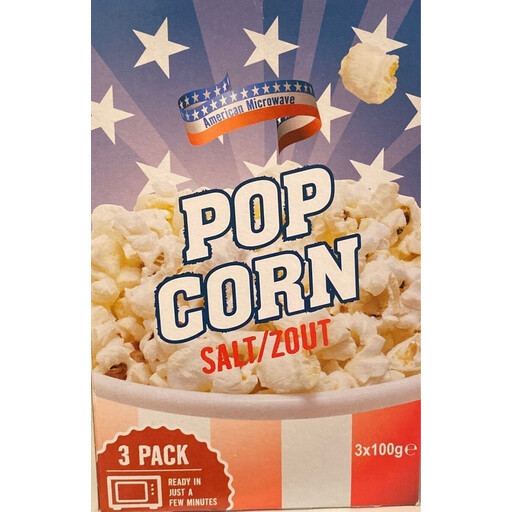
Pop Corn microwave popcorn, 3 x 100 g

Pop Corn, 3 x 100 g

For anyone who wants to make popcorn in the microwave at home; the product name specifies three 100 g bags.

View at Joybuy

Frequently asked questions

Can you call popcorn low-calorie because a small portion contains few calories?

No, a small portion alone isn’t enough to justify that. According to the European Commission, a solid food can carry a ‘low energy’ claim if it contains no more than 40 kcal per 100 g; a lower total for a smaller portion doesn’t change that product threshold.

Does ‘light’ always mean fewer calories?

No. Check what ‘light’ refers to. To claim reduced energy, a product must contain at least 30% less energy, and the property responsible for the reduction must be stated. Less sugar on its own doesn’t prove a corresponding reduction in energy.

How do you calculate the energy in a portion of ready-to-eat popcorn?

Multiply the kcal per 100 g by the weight you’re taking in grams, then divide by 100. For 25 g of AH Popcorn zoet, that’s: 419 × 25 ÷ 100 = 104,75 kcal. Don’t apply this calculation directly to prepared popping corn with added oil without taking all the ingredients and the basis for preparation into account.

Can popcorn replace a school lunch?

Treat popcorn as an extra snack in this guide, not as a replacement for a varied lunch. The Netherlands Nutrition Centre stresses that growing teenagers need enough energy and nutrients.

Can a child prepare Jumbo Magnetron Popcorn Zout on their own?

Jumbo states that children must not prepare this microwave popcorn without adult supervision. This warning applies to this specific product; follow the other instructions on the packaging too.

Is plain popping corn automatically suitable for someone with a gluten allergy?

Don’t assume so based only on corn being the ingredient. The packaging for AH Biologisch Popcorn mais states that it may contain cereals containing gluten, soya and wheat. If you need to account for allergens, check the label on the exact pack.
