Choose popcorn by comparing fat, saturated fat, sugar and salt per 100 g, and bear in mind how much you actually eat. For solid foods, the European Commission sets a maximum of 3 g of fat per 100 g for a ‘low fat’ claim. How the popcorn is prepared and what is added also affect what ends up on your plate. For school days, convenience, portion size and safe eating matter too, especially for young children.
Who is this guide for?
Label-conscious snack buyers
You want to choose a lower-fat option without unknowingly taking in more sugar or salt. Compare specific products and check the nutrition information per 100 g; the labels for Albert Heijn and Jumbo show that values vary between products.
Parents planning school snacks
You’re looking for something practical for a school day or after school. The Netherlands Nutrition Centre recommends snacks from the Dutch Wheel of Five for children aged 4 to 12 and warns that popcorn can pose a choking risk.
Home poppers who want control
You want to decide for yourself what to add and don’t mind a little preparation. Albert Heijn lists 4 g of fat per 100 g for its unpopped popcorn kernels; the final nutritional values change depending on how they’re prepared and what is added.
What should you look for when choosing?
Compare nutritional values per 100 g for products in the same state. For solid foods, the European Commission sets a maximum of 3 g of fat per 100 g for a ‘low fat’ claim.
| What to consider |
What should you check? |
Who is this important for? |
| Comparing fat |
Compare fat and saturated fat per 100 g, and check whether the figures are for dry kernels or prepared popcorn. For solid foods, the European Commission sets a maximum of 3 g of fat per 100 g for a ‘low fat’ claim. |
If your main aim is to eat less fat, compare products on the same basis. Around 42% of consumers prioritise limiting fat. |
| Sugar and salt |
Check sugar and salt as well as fat: Albert Heijn Sweet Popcorn lists 45 g of sugar per 100 g; the fat and salt values listed for Jumbo products vary. |
If you also want to limit sugar or salt, a lower fat figure on its own may not be enough. Around 33% of consumers give limiting sugar or salt top priority. |
| Preparation and portion size |
Check whether the popcorn is ready to eat, needs to be popped at home or is prepared in the microwave. Compare the nutritional values with the amount you actually serve, rather than automatically using the whole pack as a guide. |
For a busy school day, minimal preparation may be important, while serving a considered portion also matters. Around 25% of consumers prioritise convenience and portion planning. |
Common pitfalls
-
Assuming less fat means less sugar
Albert Heijn Sweet Popcorn lists 4 g of fat and 45 g of sugar per 100 g. So a lower fat figure doesn’t tell you how much sugar a product contains.
Compare fat, sugar and energy side by side, and choose based on what you want to limit.
-
Comparing dry popcorn kernels with a prepared snack
The 4 g of fat per 100 g listed for AH Organic Popcorn Kernels applies to the dry kernels before preparation. Albert Heijn’s preparation instructions use oil, so the nutritional values of the prepared popcorn may be different.
Assess the prepared snack and the portion you serve, not just the nutritional values for the dry kernels.
-
Treating a microwave bag as a child-sized portion
Jumbo Salted Microwave Popcorn contains three 90 g bags. The nutrition table also lists values per 30 g; this is not a recommended portion size for children.
Check the pack size and decide on the portion separately, rather than assuming one bag per child.
-
Equating ‘oil-free’ with ‘low fat’
The Netherlands Nutrition Centre lists 1.6 g of fat per 40 g portion of popcorn popped without oil or salt. That’s 4 g per 100 g, above the European Commission’s limit for a ‘low fat’ claim on solid foods.
Use ‘without oil’ only to describe how it’s prepared, and check any nutrition claim separately.
Brands to consider
Albert Heijn
The products mentioned are loose popcorn kernels and ready-to-eat sweet popcorn, so they suit different preparation preferences.
- According to the product specifications, both varieties contain 4 g of fat per 100 g. The dry kernels consist of corn; the sweet popcorn lists 45 g of sugar per 100 g.
- The figures relate to products in different states. The kernels are uncooked and won’t necessarily remain low in fat once oil is added.
Jumbo
The own-brand products reviewed are ready-to-eat salted popcorn and salted microwave popcorn.
- Jumbo’s product specifications list 23.9 g of fat and 2.1 g of saturated fat per 100 g for Salted Popcorn. For Salted Microwave Popcorn, the figures are 12.4 g and 5.1 g per 100 g.
- The same Jumbo Salted Popcorn page lists 1.05 g of salt per 100 g in the nutrition table and 3% salt in the ingredients. Check the current pack if salt is a deciding factor for you.
Lidl
Lidl lists sweet and salted popcorn under Snack Day; the sea salt variety reviewed is a ready-to-eat snack.
- Lidl’s product listing gives a pack size of 200 g for Snack Day Sea Salt Popcorn.
- The flavour and product type alone tell you nothing about the fat content. Compare the nutrition information on the label of the variety you choose.
ALDI
ALDI lists salted popcorn under its own SUN SNACKS brand.
- ALDI’s product page gives a pack size of 100 g.
- The product name isn’t proof of a lower fat content. Check the nutrition information for the specific product on the pack.
Popcorn at Joybuy
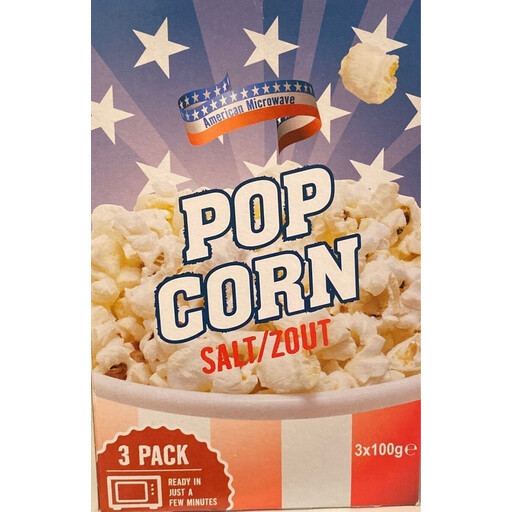
This Joybuy selection features popcorn for microwave preparation.
 No image available
Pop Corn 3 x 100 g
The product description says it’s prepared in the microwave and comes in three 100 g bags, making it a good option if you want to prepare popcorn hot.
Per 100 g, the product description lists 23 g of fat, 16 g of saturated fat, 3 g of salt and 1 g of sugar. This is useful information if you’re mainly looking to limit fat or salt.
Joybuy
Frequently asked questions
When can popcorn be called ‘low fat’?
For solid foods, the European Commission allows a maximum of 3 g of fat per 100 g for a ‘low fat’ claim. This is a condition for making the claim, not a general requirement when buying food. A product with 4 g of fat per 100 g doesn’t meet this limit.
Does popcorn made without oil mean the snack is fat-free?
No. The Netherlands Nutrition Centre lists 1.6 g of fat per 40 g portion of popcorn popped without oil or salt. That works out at 4 g per 100 g: no oil has been added, but the popcorn still contains fat.
Is less fat on its own a reason to choose popcorn as a school snack?
No, don’t assess the fat content alone. The Netherlands Nutrition Centre recommends snacks from the Dutch Wheel of Five for children aged 4 to 12, and suggests vegetables and fruit as good choices. So consider popcorn alongside your child’s usual diet.
What should I look out for when giving popcorn to young children?
The Netherlands Nutrition Centre explicitly warns that popcorn can pose a choking risk. Make sure your child eats sitting down and calmly, and supervise them. Its guidance doesn’t specify an exact age at which popcorn is safe for every child.
How should I store an opened bag of AH Sweet Popcorn?
Albert Heijn recommends storing this variety in a cool, dark and dry place and resealing the pack securely after use. For other popcorn products, follow the storage advice on their packaging.


