
Portion-conscious snackers
If you want to keep eating popcorn while keeping an eye on how much energy your snack contains, compare weighed portions and nutritional values. The volume of a bowl alone doesn’t tell you how many grams you’re eating.


First, compare the nutritional values per 100 g and calculate what they mean for the amount of popcorn you actually eat. Check organic certification separately. Organic popcorn kernels give you more control over the oil and flavourings, while ready-to-eat and microwave popcorn are convenient options. According to the European Commission, the ‘low energy’ claim for solid foods is limited to a maximum of 40 kcal (170 kJ) per 100 g; eating a smaller portion does not change this threshold.
If you want to keep eating popcorn while keeping an eye on how much energy your snack contains, compare weighed portions and nutritional values. The volume of a bowl alone doesn’t tell you how many grams you’re eating.
If organic ingredients matter to you and you want to decide how much corn, oil and flavouring to use, consider the organic ingredient and the finished recipe separately.
If you’re looking for ready-to-eat or microwave popcorn, compare the exact product by flavour, sugar, fat and preparation method. The values for one variety don’t automatically apply to other products from the same brand.
Start with the amount you eat, then check the ingredients and consider organic certification as a separate feature.
| What to consider | What should you check? | Who is this important to? |
|---|---|---|
| Energy per portion | Compare kcal per 100 g and weigh your own portion. If you’re making it yourself, include oil and any other additions. | If I mainly want to know how much energy my snack contains, I weigh my portion rather than judging by the volume of a bowl. Around 36% of consumers consider the total energy in each snacking occasion their top priority. |
| Organic origin | Check the organic label and, where applicable, the EU organic logo and control code. | When organic origin is my deciding factor, I check the certification and want to be able to choose the additions myself. Around 29% of consumers prioritise certified organic origin. |
| Sugar, fat and additions | Read the ingredients and nutritional information together; compare energy, sugars and fat for the same quantity. | If I’m mainly concerned about sugar, fat or flavourings, I compare those details alongside the energy content. Around 21% of consumers make ingredients their top priority when choosing. |
| Preparation and quantity | Check whether the popcorn is ready to eat or needs to be prepared, as well as the net weight and packaging instructions. | When I want a quick snack or want to make popcorn at home, I look at what preparation is involved and how much is in the pack. Around 14% of consumers prioritise ease of preparation. |
Nutritional values per 100 g and per portion answer different questions: the first helps you compare products on a like-for-like basis, while the second reflects the amount you eat. The Netherlands Nutrition Centre gives 154 kcal per 40 g bowl as a general value for popcorn; this isn’t a product-specific figure for every variety. For organic products, the EU organic logo certifies organic production, not energy content.
A portion may contain less energy than a larger one, but that doesn’t automatically mean the product meets the requirements for a low-energy claim. The European Commission sets a maximum of 40 kcal (170 kJ) per 100 g for solid foods.
Use the nutritional value per 100 g to compare products, then work out the value for your own portion. Treat portion size and the requirements for a nutrition claim as two separate things.
Organic certification relates to the conditions under which a product is made. Organic products can also contain sugar or oil; the certification itself says nothing about energy content.
Check the organic certification and the nutritional information separately. For popcorn kernels, also read the ingredients and include any additions you use when calculating the values for the prepared recipe.
The product information for AH Biologisch Popcorn mais gives values for dry corn. The preparation method described uses oil, so the nutritional value of the raw ingredient isn’t the same as that of the complete recipe.
Add together the energy from the corn and any additions you use, then calculate the value for the amount you actually eat.
AH Biologisch Popcorn mais is a specific organic corn option for making at home. Albert Heijn lists a 500 g pack and 374 kcal per 100 g of dry corn.
The Jumbo products discussed include ready-to-eat sweet and salted popcorn, as well as a sweet microwave variety.
Lidl lists Snack Day Popcorn zeezout as a 200 g product available in store.
ALDI Nederland lists Sun Snacks Zoute popcorn in a 100 g pack.
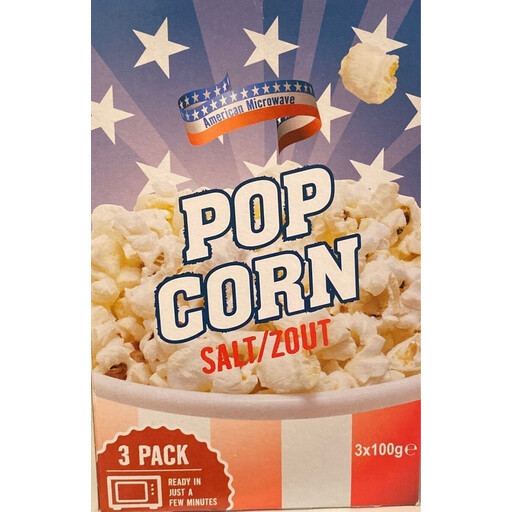
This selection focuses on microwave popcorn for making at home; compare the nutritional values with your portion size and personal priorities.
 No image available
This variety is designed for microwave preparation; the product description lists 510 kcal per 100 g.
The product description lists 23 g of fat, including 16 g of saturated fat, and 1 g of sugar per 100 g.
Add together the energy from the corn, oil and any other additions. Then calculate the value for the amount of the recipe you eat. The nutritional value of dry corn isn’t automatically the same as that of prepared popcorn. The European Union explains that nutritional information must relate to the product as sold, or to the prepared product where the information relates to that form.
Not on the basis of a small portion alone. According to the European Commission, the ‘low energy’ claim for solid foods is limited to a maximum of 40 kcal (170 kJ) per 100 g. This threshold applies to the product and doesn’t change when you eat a smaller amount.
No. Dutch origin isn’t the same as organic certification. The EU organic logo must be accompanied by an indication of the origin of the agricultural ingredients, such as EU Agriculture, non-EU Agriculture or EU/non-EU Agriculture. Check the information on the exact pack.
No. AH Biologisch Popcorn mais states that the product may contain cereals containing gluten, soya and wheat. Check the allergen information on the exact pack; the name of the main ingredient isn’t enough.
Follow the preparation instructions and warnings on the pack for the exact variety. For the sweet microwave popcorn it investigated, Jumbo warns that children shouldn’t prepare the popcorn without adult supervision. Also compare the nutritional values per 100 g and take into account how much you eat.