
For making your own and controlling the fat
When you make popcorn yourself, you decide how much oil or other ingredients to use. Bear in mind that the nutritional values for unpopped kernels are not the same as those for prepared popcorn.


If you want to control how much fat you add, unpopped popcorn kernels give you the most control. Bear in mind that the nutritional values for dry kernels are not the same as those for the prepared snack. A microwave multipack requires little preparation for each bag, while ready-to-eat popcorn is ready to enjoy straight away. For both, compare the exact variant and serving size: convenience or a larger pack does not automatically mean popcorn is low in fat.
When you make popcorn yourself, you decide how much oil or other ingredients to use. Bear in mind that the nutritional values for unpopped kernels are not the same as those for prepared popcorn.
A large bag of kernels or a multipack could suit several snack breaks. Think about how much you use and whether you find preparing and storing it practical.
If you want to keep preparation to a minimum but still control your portion, compare the amount you eat with the serving size on the label.
| What to consider | What to look for | Who is this most relevant to? |
|---|---|---|
| Fat in the prepared popcorn | Check the label for the exact variant and note what the nutritional values are based on. Albert Heijn lists 4 g of fat per 100 g for its unpopped kernels; Jumbo lists 4.5 g per 100 g for its unpopped kernels. Jumbo’s salted microwave popcorn lists 12.4 g of fat and 5.1 g of saturated fat per 100 g. These figures are for different product types and are not values for the same prepared serving. | If I want to control the fat in my finished portion, I need to know whether the label figures are for dry kernels or prepared popcorn, and I count any oil I add myself. Around 36% of consumers rank managing fat as their top purchase priority. |
| Quantity and stock | Compare the net weight and packaging within the same product type. Albert Heijn and Jumbo sell their unpopped kernels in 500 g packs; Jumbo’s microwave multipack contains 3 bags of 90 g. | If I’m considering a bulk pack, I want an amount that suits how often I eat popcorn and how I plan to prepare it. Around 29% of consumers rank having a useful supply at home as their top purchase priority. |
| Serving size and nutritional values | Weigh the amount you actually eat and compare values for the same weight. Jumbo Popcorn Zoet lists 1.4 g of fat, 14.6 g of sugars and 122 kcal per 30 g serving; these values apply to that specific variant. | If I want to manage my portion, I need to be able to apply the label figures to the amount I eat and check sugar and energy too. Around 21% of consumers rank portion control as their top purchase priority. |
| Ease of preparation | Choose a product type that suits the preparation method available to you and follow the instructions on the exact pack. A microwave multipack and ready-to-eat popcorn require different levels of preparation. | If I want to prepare something quickly, I look at how much preparation is needed and check the instructions for the variant I’ve chosen. Around 14% of consumers rank convenience as their top purchase priority. |
Popcorn can contain fat even when no oil has been added. The Netherlands Nutrition Centre lists 1.6 g of fat per 40 g bowl of popcorn popped without oil or salt. The European Commission sets a maximum of 3 g of fat per 100 g for the ‘low fat’ nutrition claim on solid foods.
Compare the label for the exact variant with the way you prepare and eat your popcorn. Include any extras and don’t treat the legal claim threshold as a recommended serving size.
A 90 g bag may contain more than the amount on which the per-serving nutritional values are based. Jumbo lists both a 90 g inner bag and nutritional values per 30 g for its microwave popcorn.
Weigh your own portion and calculate using the same amount as the one shown on the label.
Jumbo Popcorn Zoet lists 4.6 g of fat and 48.6 g of sugars per 100 g. A lower fat figure on its own therefore doesn’t tell you about a product’s other nutritional values.
For the exact variant, check the sugar and energy values too, and compare the same serving size.
The nutritional values for unpopped kernels don’t automatically describe the snack you end up eating. The preparation method and any additions change what’s in your portion.
Start by comparing the same product type, and if you prepare it yourself, remember to include any ingredients you add.
AH Biologisch Popcorn mais is made from unpopped kernels, for anyone who wants to choose how to prepare them and what to add.
The product examples reviewed include unpopped kernels, salted microwave popcorn and ready-to-eat sweet popcorn.
Snack Day Popcorn zeezout is a ready-to-eat option for anyone who doesn’t want to pop kernels themselves.
SUN SNACKS Zoute popcorn is a ready-to-eat example, sold in a 100 g pack.
This selection is a microwave multipack for individual popcorn occasions. If you’re limiting fat, pay particular attention to the nutritional values for the variant.
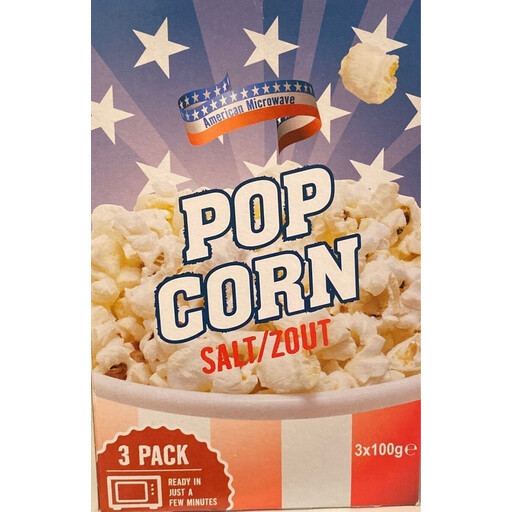 Image unavailable
The individual bags are designed for anyone who wants to prepare popcorn in the microwave; this variant prioritises convenience rather than low fat content.
Pack size: 3 x 100 g.
The product description lists 23 g of fat, including 16 g of saturated fat, per 100 g.
No, not automatically. According to the European Commission, the ‘low fat’ claim may only be used for solid foods containing no more than 3 g of fat per 100 g. This is a requirement for the nutrition claim, not a guide to your personal portion.
No. The Netherlands Nutrition Centre lists 1.6 g of fat per 40 g bowl of popcorn popped without oil or salt. This is general nutritional information, not a label value for every product variant.
For the same product and preparation method, use the value per 100 g, multiply it by the weight of your portion and divide by 100. If you prepare it yourself, include any additions; the weight of dry kernels is not the same as the weight of prepared popcorn.
Follow the instructions on the pack for the exact variant. For its Magnetron Popcorn Zout, Jumbo says to remove the film, that children should only prepare it under adult supervision, and that you must not restart the cooking process if it has been interrupted.
Don’t compare them as if they were the same product type or based on the same preparation method. Check the label for the exact variant, weigh your own portion and include any additions when you prepare popcorn yourself.